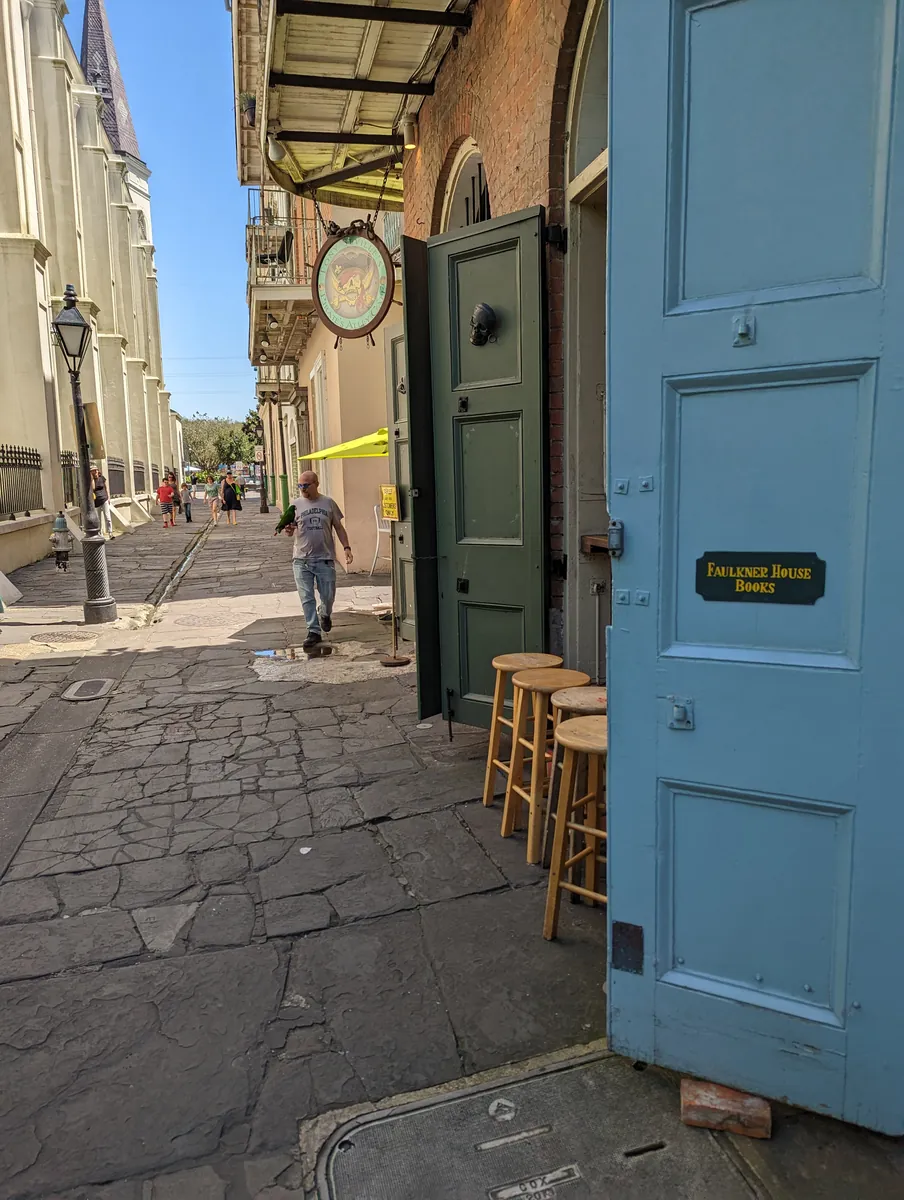
The passage runs between St. Louis Cathedral and the Cabildo—flagstones underfoot, gas lanterns overhead, cathedral wall rising on one side. The hardware predates the movie camera by a century, which matters because the alley photographs like a backlot dressed for pirates. There were no pirates. The lane was called Ruelle d'Orléans when it served residential traffic in 1831. Tourism rebranded it, borrowed Jean Lafitte's name, sold the same atmosphere the stones already had.
William Faulkner wrote his first novel in the apartment at 624. The apartment is now Faulkner House Books, which means you can walk into the room where he learned the trade and buy the proof he got better at it. The passage itself hasn't learned anything new. It still does what it did when it was Ruelle d'Orléans: it gets you from one block to another without ceremony. Walk it at dusk. The lanterns come up, the stones cool, and the wall holds its line.
- ·The narrow pedestrian passage runs between St. Louis Cathedral and the Cabildo.
- ·William Faulkner wrote his first novel in the apartment at 624 Pirate's Alley, now Faulkner House Books.
- ·Despite the name, there is no historical connection to pirate Jean Lafitte — tourism rebranded it.
- ·The original name was Ruelle d'Orléans, a residential lane.
- ·The flagstones, gas lanterns, and cathedral wall rising on one side predate the movie camera by a century.
- ·Walk it at dusk for the best atmosphere.
Memories
Editorial content compiled with AI assistance. Place details verified against public records.