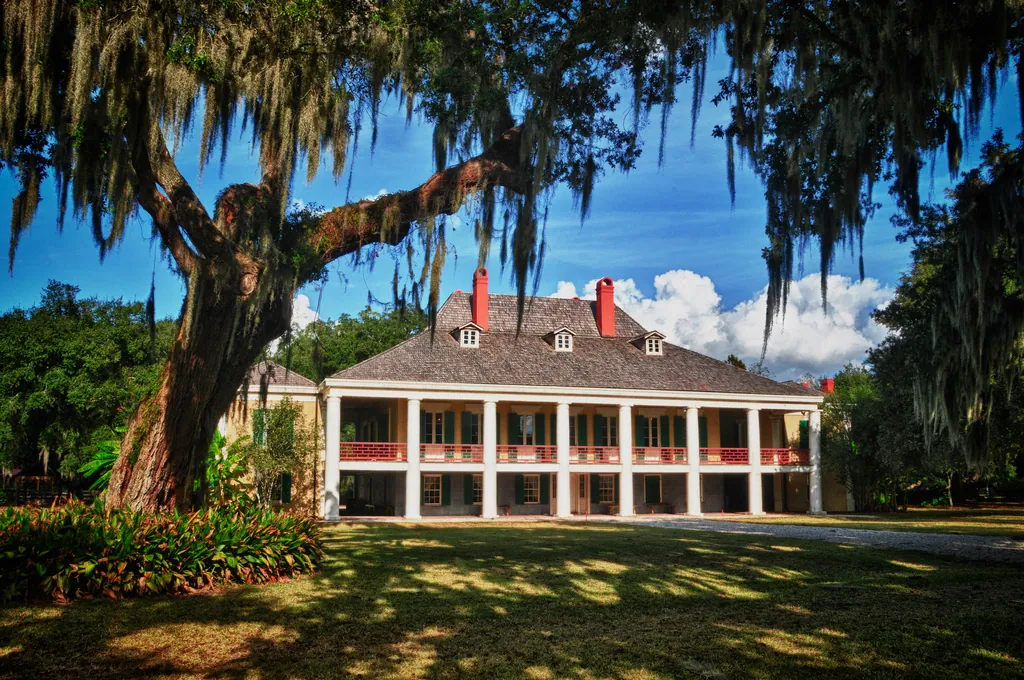
John T. McMurran came to Natchez from Pennsylvania in the 1820s, made his fortune in law and land, and in 1841 hired a Maryland architect named Jacob Byers to build him a 15,000-square-foot Greek Revival mansion on eighty acres at the edge of town. He named it Melrose, after the Scottish abbey he and his wife had visited. The house is exceptional — painted floor cloths original to 1841, Ionic columns framing interior doorways, a punkah still hanging in the dining room — but what makes this estate unrepeatable is that everything else survived. The slave quarters. The two-story kitchen and dairy buildings. The octagonal cistern houses. The smokehouse, privy, barn, carriage house. Every dependency a working plantation required is still standing, original, unaltered. It is the most complete antebellum estate complex in the South.
McMurran sold Melrose in 1865, financially broken by the war and grieving the deaths of his daughter and two grandchildren. He died in a steamboat accident the following year. The estate passed through the Davis family, who rarely occupied it for four decades. Two formerly enslaved women, Alice Sims and Jane Johnson, are credited with serving as caretakers during those years. In 1901, George Malin Davis Kelly and his wife Ethel restored the house after its long closure, choosing not to remodel but to keep it intact, merging furnishings from another Davis family property with what already existed at Melrose. That decision preserved a material record most estates lost.
The National Park Service acquired Melrose in 1990 and made it part of Natchez National Historical Park. The interpretation centers the enslaved community. The quarters are not peripheral — they are the structure through which the park asks you to understand what a plantation required and who bore the cost. Natchez was built on cotton wealth sustained by forced labor. Melrose shows the entire apparatus. Ranger-guided tours of the main house are free. The grounds are self-guided. Open daily, 8:30am to 5pm.
- ·Most complete antebellum estate complex in the South — main house plus all outbuildings survive.
- ·Built in 1841 by lawyer-planter John T. McMurran.
- ·National Park Service site since 1990. The NPS interpretation centers the enslaved community.
- ·Slave quarters, kitchen dependency, barn, carriage house, dairy, and privy all original.
- ·80 acres of landscaped grounds remain intact.
- ·Open daily 8:30am–5pm. Free ranger-guided tours of the main house; self-guided grounds.
Memories
Editorial content compiled with AI assistance. Place details verified against public records.