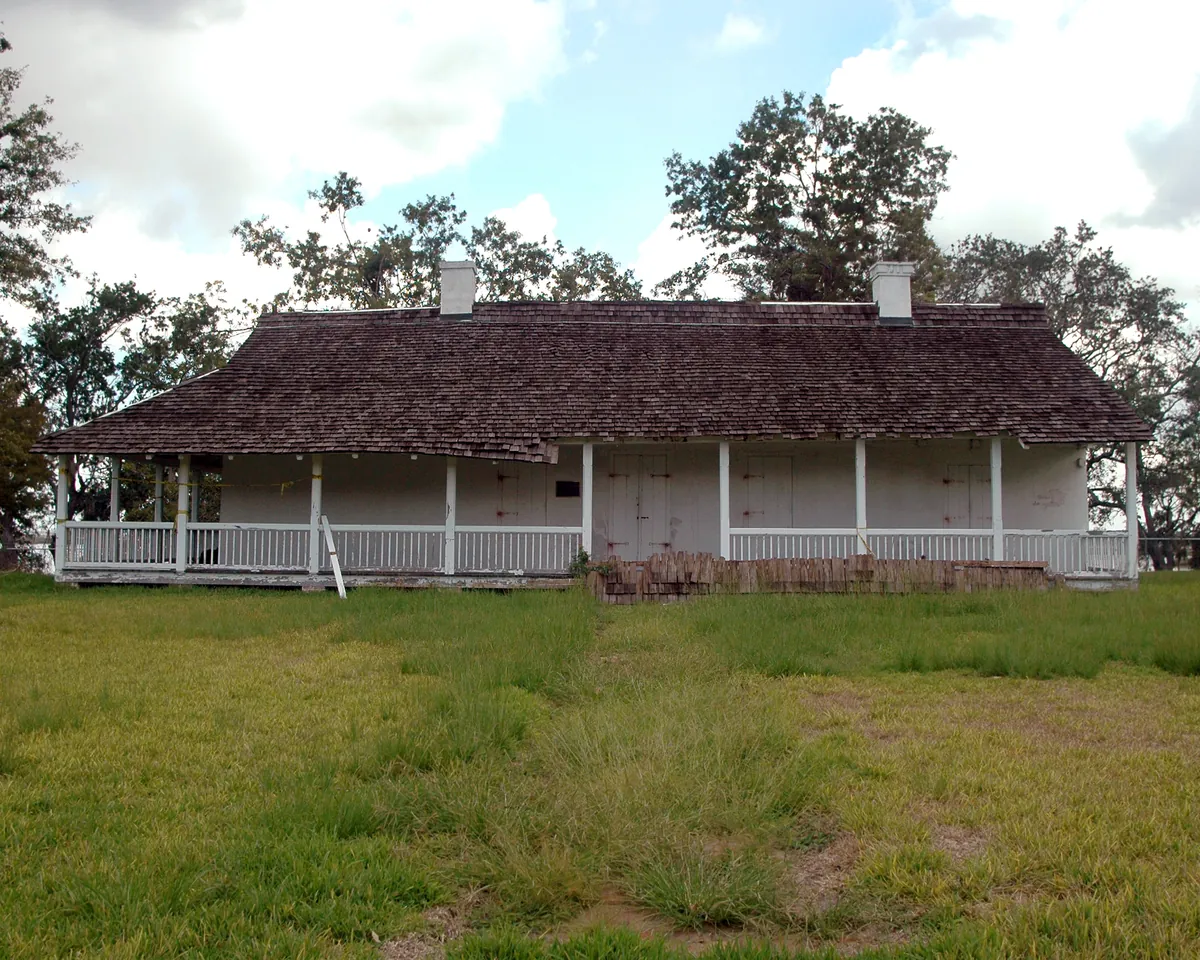
The oldest scientifically confirmed standing structure on the Gulf Coast sits on the shore of Lake Catahoula near Pascagoula. Locals call it the Old Spanish Fort, though the Spanish had nothing to do with building it. French Canadians did, using longleaf pine framing with walls of oyster-shell concrete packed into an 18-inch thickness. Dendrochronology dated timbers from the center tabby room to 1757. Samples from the east addition date to 1762 and 1772. The western addition, built with bousillage — clay and Spanish moss — dates to 1820 based on construction techniques and tool marks.
Joseph Simon dit La Pointe, a native of Montreal, was granted land at the mouth of the Pascagoula River between 1713 and 1717. He bred cattle first, then ran a plantation focused on indigo and wax myrtle — the former for blue dye, the latter for candlemaking. La Pointe enslaved Native Americans before purchasing African slaves. When he died in 1751, his daughter Marie-Josèphe and German son-in-law Hugo Ernestus Krebs took possession. They maintained the plantation using enslaved African labor to produce rice and cotton. According to the Anglo-Dutch traveler Bernard Romans, Krebs created a roller cotton gin more than two decades before Eli Whitney's 1793 invention.
The name Old Spanish Fort came during Spanish control of the Mississippi Territory in the late eighteenth century, when the structure served as a fortified home of Don Enrique Ginarest, an officer in the Spanish Army who married the granddaughter of Hugo Krebs. Descendants of Hugo Krebs owned and occupied the structure until 1914.
The LaPointe-Krebs House is Mississippi's oldest extant historic building and one of only two remaining French colonial-era structures on the Gulf Coast. The three-room house measured 37 feet in width and 62.25 feet in length. Three sides were bounded by porches supported by square wooden posts. The gable roof was covered with wooden shingles. Two fireplace chimneys were composed of stucco-covered brick. Flooring was oyster-shell concrete, covered in 1820 with boards at a height of 18 inches.
The LaPointe-Krebs Foundation operates the house as a museum for the history of Pascagoula and Jackson County. It was added to the National Register of Historic Places in 1971 and designated a Mississippi Landmark in 1984. You can see how French colonists actually lived on the Gulf Coast — the only place left where that's possible.
- ·Oldest standing structure in the Mississippi Valley — dates to around 1718.
- ·Built by French colonists using colombage: timber frame packed with mud, moss, and shells.
- ·Locals call it the Old Spanish Fort, but it was French-built.
- ·The Krebs family occupied the house for generations after the colonial period.
- ·Only surviving physical example of what early French Gulf Coast settlements looked like.
- ·Museum on-site with colonial-era artifacts. Open Wed–Sat. Admission charged.
Memories
Editorial content compiled with AI assistance. Place details verified against public records.