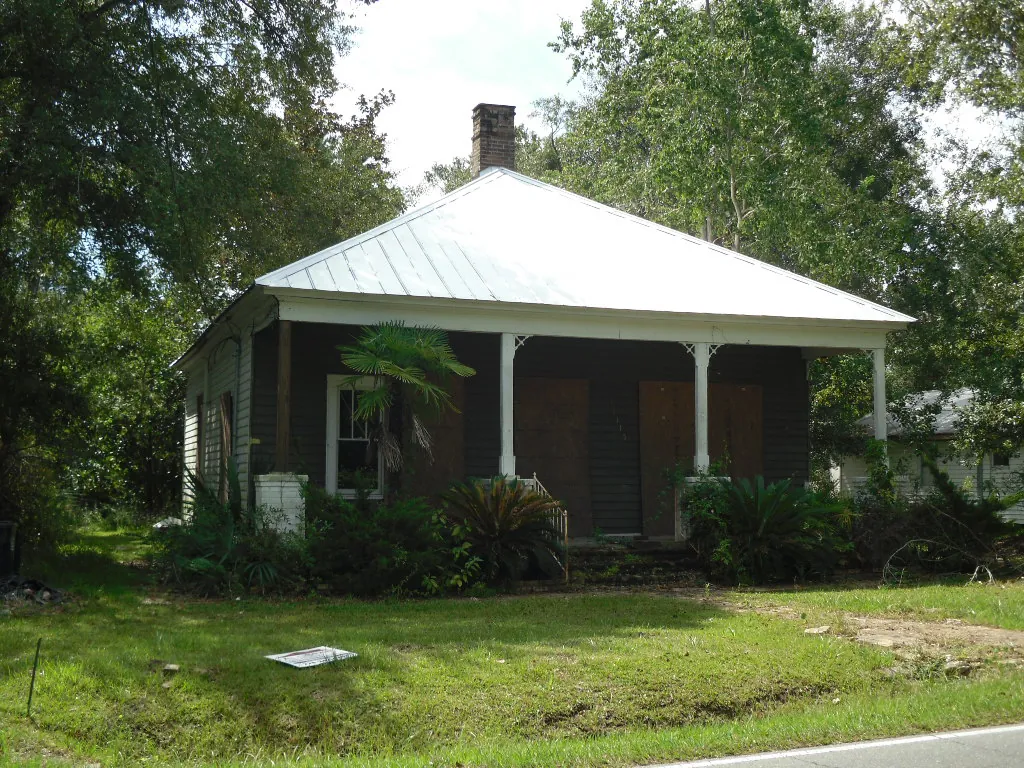
In 1866, a group of emancipated African Americans settled 320 acres along Turkey Creek, land formerly owned by Arkansas Lumber Company. Thomas and Melinda Benton acquired enough property that their holdings comprised half the community. Later settlers bought from the Bentons. The creek itself served as a transportation route. Residents planted gardens, grew fruit trees, raised livestock.
That original settlement has held. Through Reconstruction, Jim Crow, hurricanes, annexation, airport construction, casino towers, the slow grind of development pushing northward from the coast — Turkey Creek endured. The Mississippi Gulf Coast spent the twentieth century becoming "America's Riviera," then a gaming center, then a post-Katrina rebuilding story. Turkey Creek remained Turkey Creek: one-story cottages along Rippy Road, live oak overhead, freshwater marsh and coastal hardwood forest still intact, religious and educational structures still standing.
By the mid-1950s, infrastructure development associated with Gulfport's expansion began to encroach. Industries, highways, the airport. The community predated the founding of Gulfport itself, but the city annexed it in 1994. After Hurricane Katrina devastated the Mississippi Gulf Coast in 2005, business expansion accelerated northward, away from the coastline, into the community, garnering national attention. Turkey Creek Community Initiatives formed in response, receiving assistance from the Land Trust for the Mississippi Coastal Plain and Audubon Mississippi to protect what remained. In 2021, American Rivers listed Turkey Creek — the waterway itself, meandering 12.9 miles to Bayou Bernard — as one of America's 10 Most Endangered Rivers due to continuing threat of development.
The district was added to the National Register of Historic Places in 2007 as both a cultural and environmental resource. It is a residential community. Drive Rippy Road respectfully, or walk it. What you are seeing is 320 acres that have been held for over 150 years.
- ·Founded by formerly enslaved people around 1870 — one of the oldest African American communities on the Mississippi Gulf Coast.
- ·Maintained its identity for over 150 years through Reconstruction, Jim Crow, hurricanes, and development pressure.
- ·The community successfully fought annexation and encroachment in the 2000s.
- ·Listed on the National Register as both a cultural and environmental resource.
- ·Turkey Creek itself is an ecologically significant waterway that the community helped protect.
- ·Residential community — respectful drive-through or walking visit.
More archive
Memories
Editorial content compiled with AI assistance. Place details verified against public records.