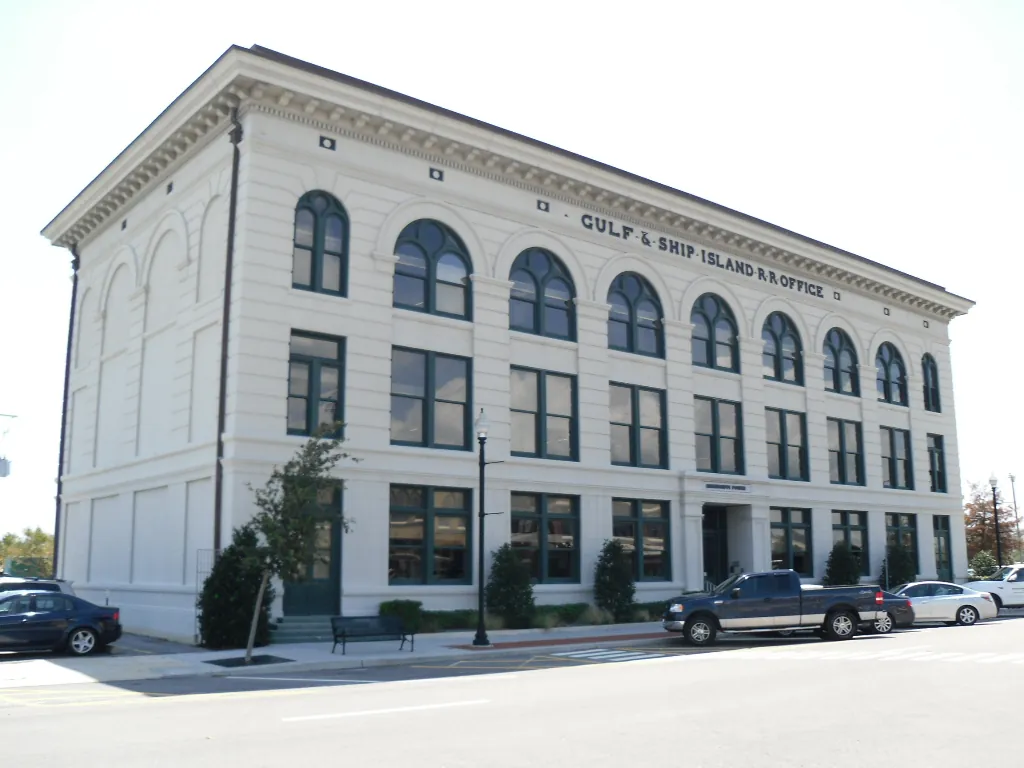
Gulfport was founded in the late 1880s as the planned terminal for the Gulf and Ship Island Railroad, which aimed to use the deepwater harbor protected by Ship Island. The railroad reached Hattiesburg in 1896. The blocks between 23rd and 28th Avenues formed the original commercial downtown — brick buildings built to last, reflecting turn-of-the-century commercial ambition.
The Hewes Building, an Italian Renaissance commercial block, anchors the district. In 1903, the railroads began work on a union station in the southeast quadrant of their crossing in Gulfport. The red brick building was completed in 1904. In December 1924, through sleepers began operating between Gulfport, Chicago, and Memphis. The Louisville and Nashville Railroad ran the Gulf Wind, the Pan-American, and the Humming Bird through the station. The Illinois Central Railroad acquired the Gulf and Ship Island in 1925 and discontinued Jackson–Gulfport passenger service in November 1950.
Amtrak service began with the Gulf Coast Limited, which operated between 1984 and 1985. The stop was reactivated in 1993 for the Sunset Limited. Service east of New Orleans was suspended after Hurricane Katrina struck the Gulf Coast in 2005. The station was a contributing property to the Harbor Square Historic District, added to the National Register of Historic Places on August 13, 1985. Hurricane Katrina significantly affected the historic district. It was replaced by the Gulfport Harbor Square Commercial Historic District on October 25, 2011. The new district includes the station and an adjacent shelter as contributing properties.
Service to Gulfport returned with the Mardi Gras Service on August 18, 2025. The building now serves as the Gulfport Centennial Museum. The district is walkable and combines well with Fishbone Alley and the harbor area.
- ·Gulfport's original commercial downtown — the blocks between 23rd and 28th Avenues.
- ·The Hewes Building (1903), an Italian Renaissance commercial block, anchors the district.
- ·Gulfport was founded as a railroad and shipping town in 1898.
- ·Architecture reflects turn-of-the-century commercial ambition — brick buildings built to last.
- ·Listed on the National Register of Historic Places.
- ·Walkable district downtown. Combines well with Fishbone Alley and the harbor area.
Memories
Editorial content compiled with AI assistance. Place details verified against public records.