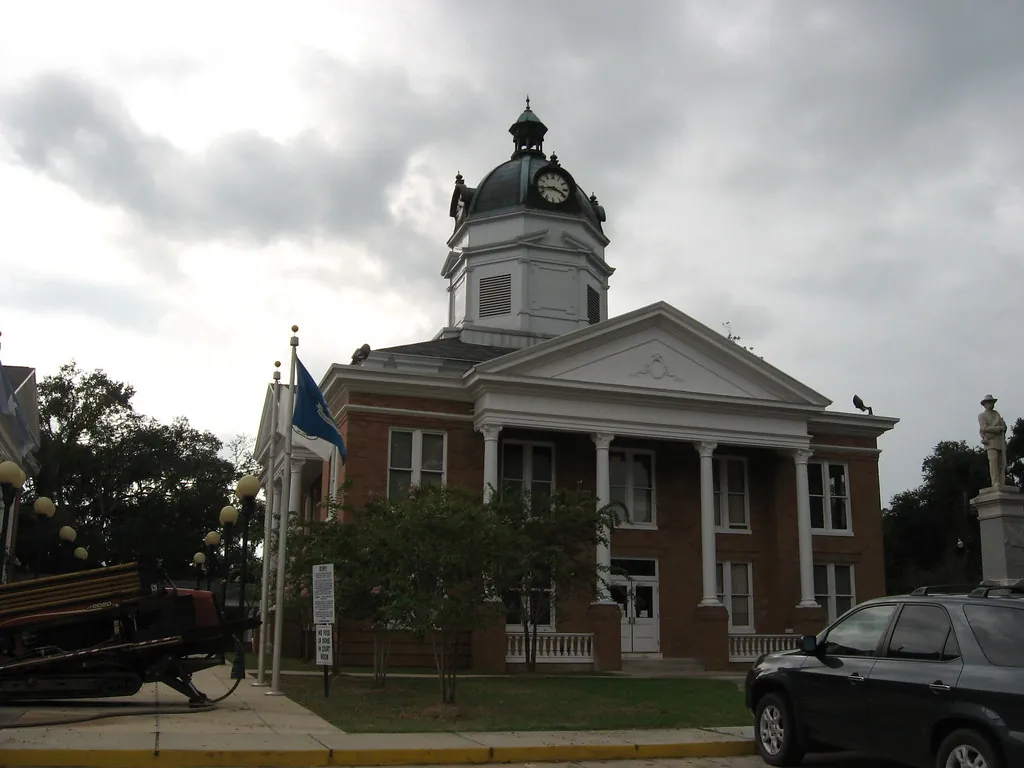
On September 23, 1810, armed rebels led by Philemon Thomas stormed Fort San Carlos at Baton Rouge in a sharp and bloody firefight, killing two Spanish soldiers and capturing the Spanish governor. They raised a flag bearing a single white star on a blue field — sewn by Melissa Johnson, wife of a cavalry commander in the assault — and declared the Republic of West Florida. The new nation's capital was St. Francisville, upriver on a Mississippi bluff.
The revolt grew from a boundary dispute left open by the Louisiana Purchase. When France sold Louisiana to the United States in 1803, the U.S. claimed West Florida — the territory between the Mississippi and Perdido Rivers — was included. Spain disagreed; it had controlled West Florida as a separate province since 1783. By 1810, the Baton Rouge District was almost exclusively Anglo-American settlers, many of them land speculators who stood to profit if the territory joined the Union.
The Republic adopted a constitution modeled on the United States Constitution, with executive, judicial, and legislative branches. The legislature elected Fulwar Skipwith as governor on November 7. Skipwith was a cotton planter who had been appointed by George Washington in 1795 to the staff of James Monroe, the U.S. ambassador to France, served as consul general under Thomas Jefferson, and had helped negotiate the Louisiana Purchase. He moved to Baton Rouge in 1809 and joined the effort to free West Florida from Spanish control. In his inaugural address, he hinted at annexation: "The blood which flows in our veins...will return if not impeded, to the heart of our parent country."
President Madison issued a proclamation annexing the Republic on October 27, 1810. William C. C. Claiborne entered St. Francisville with three hundred troops from Fort Adams on December 6 and Baton Rouge on December 10. Skipwith complained bitterly that the United States had abandoned its right to the territory by tolerating Spanish occupation for seven years and that his people would not submit without terms. John Ballinger, commander of the fort, agreed to surrender after Claiborne assured him his troops would not be harmed. At 2:30 p.m. on December 10, 1810, the men marched out of the fort, stacked their arms, saluted the flag of West Florida as it was lowered for the last time, and dispersed.
The Republic lasted exactly 79 days. Baton Rouge is the only U.S. state capital that was once a foreign capital. Spain did not relinquish its title to the occupied territory until 1819. The Lone Star flag is displayed at the Old State Capitol museum.
- ·In September 1810, American settlers seized the Spanish fort and declared the Republic of West Florida.
- ·The nation lasted exactly 79 days before President Madison annexed it.
- ·Baton Rouge was briefly a national capital — the only U.S. state capital that was once a foreign capital.
- ·The revolt forced the legal question of what the Louisiana Purchase had actually purchased.
- ·The Lone Star flag of the Republic is displayed at the Old State Capitol museum.
Memories
Editorial content compiled with AI assistance. Place details verified against public records.