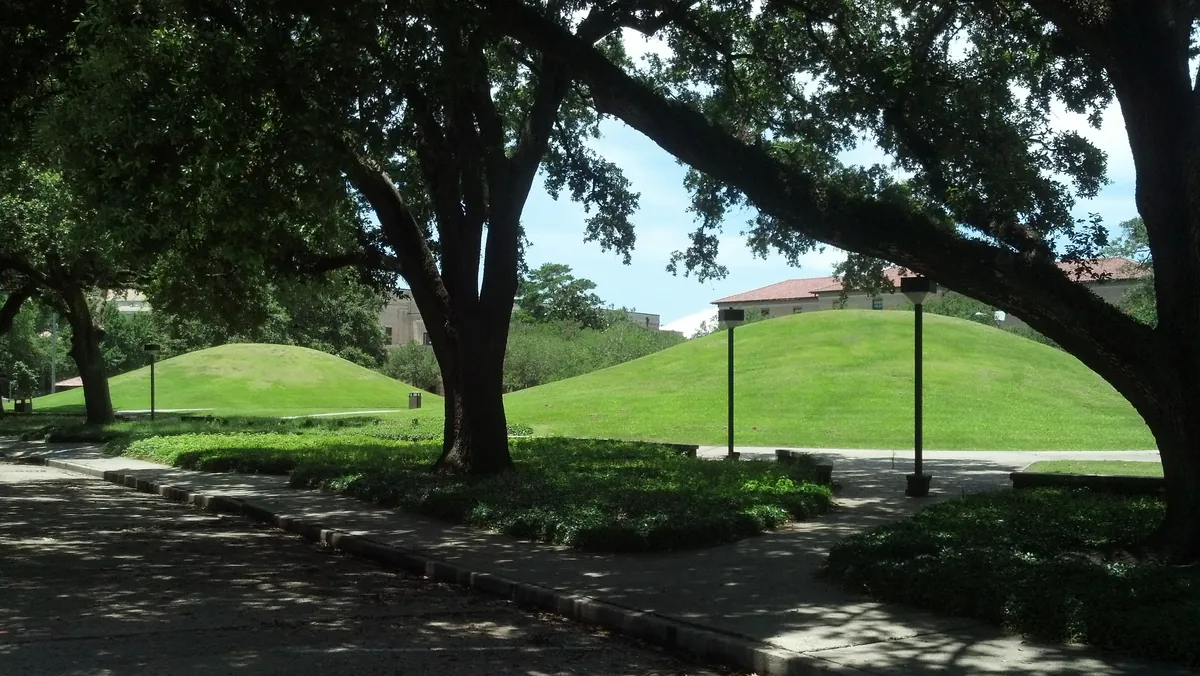
Two earthwork mounds sit beside a football practice field on the LSU campus. Construction on the 20-foot-tall structures began more than 11,000 years ago and may have continued until 5,000 years ago — they predate the Great Pyramids of Egypt. The northern mound consists of hard clay dirt; the southern mound is more porous. Most students walk past them daily without knowing what they are.
The scholarly consensus is that they were used for ceremonial and marking point purposes, rather than for burial. They are part of a larger, statewide system of mounds. In 2009, LSU professor Brooks Ellwood took core samples that revealed a layer of charcoal, possibly from a pit barbecue or a cremation. Based on his analysis, Ellwood conjectures that they contain cremated human remains and are substantially older than the existing consensus, as much as 11,300 years old. The builders are not directly connected to any modern tribal nation, making these among the more mysterious indigenous sites in Louisiana.
Human habitation in the Baton Rouge area has been dated to about 8000 BC. Earthwork mounds were built by hunter-gatherer societies in the Middle Archaic period, from roughly the 4th millennium BC. By the time French explorer Sieur d'Iberville led an exploration party up the Mississippi River in 1699, many political centers were already in decline. The mounds stand as evidence of cultures that shaped this ground thousands of years before the red pole that gave the city its name.
Due to their location in a heavily trafficked area of campus, the mounds began to show signs of degradation and natural erosion. The university installed a sidewalk between the mounds in 1985 and placed a low brick wall around them to prevent vehicles from crossing. In 1996, LSU Facility Services used river silt to patch damage on both mounds and seeded a hybrid Bermuda grass to prevent future problems. The mounds were listed on the National Register of Historic Places on March 1, 1999. While they were formerly used for tailgate parties, in 2010 they began to be fenced off during LSU's home football games to prevent them from being damaged.
They are freely accessible south of the Quadrangle near Dalrymple Drive. No admission. Among the oldest known human-constructed features in North America, designated a National Historic Landmark.
- ·The two earthwork mounds are approximately 5,000 years old — predating the Egyptian pyramids and Stonehenge.
- ·Among the oldest known human-constructed features in North America.
- ·The builders are not directly connected to any modern tribal nation, making these among the more mysterious indigenous sites in Louisiana.
- ·The mounds sit beside a football practice field; most students walk past them daily without knowing what they are.
- ·Designated as a National Historic Landmark.
- ·Freely accessible on the LSU campus, south of the Quadrangle near Dalrymple Drive. No admission.
Memories
Editorial content compiled with AI assistance. Place details verified against public records.