These eight National Historic Landmarks sit inside one half-mile-wide neighborhood because three successive colonial powers built their institutions on the same blocks and didn't demolish each other's work. The Old Ursuline Convent (1752) is the oldest surviving French Colonial structure in the Mississippi Valley. The Cabildo is where the Louisiana Purchase was signed in 1803, doubling the United States in a single afternoon. The U.S. Mint is the only branch that ever struck coin for the Confederacy. The Pontalba Buildings are the oldest continuously rented apartments in the country.
The route
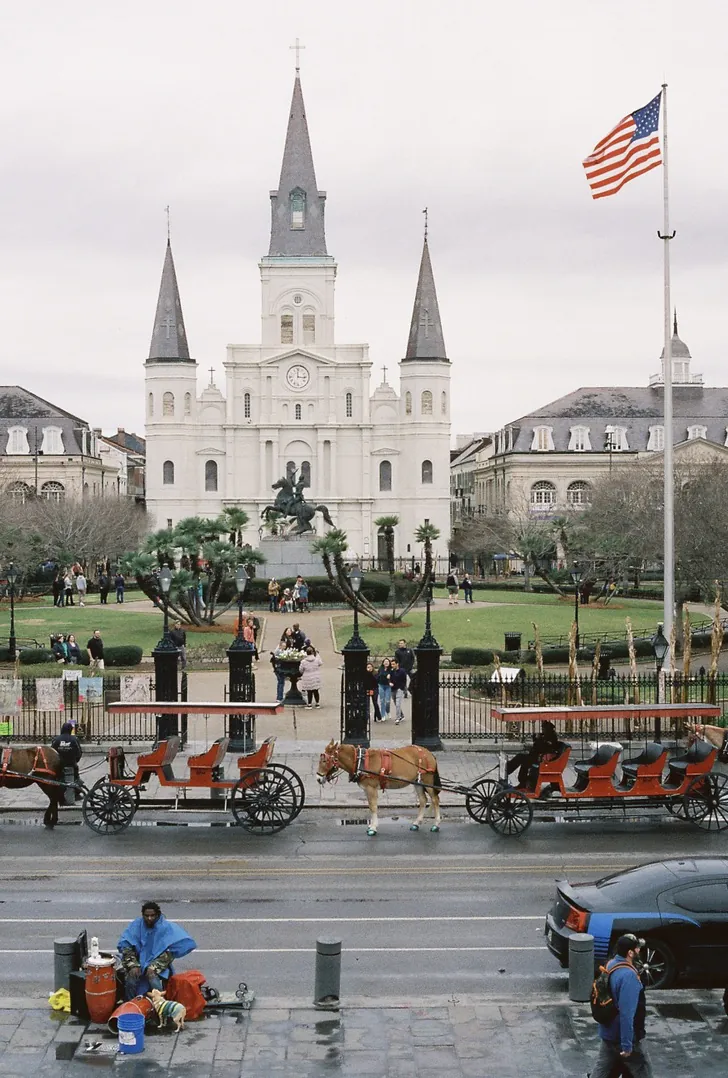 1Historic Site·1721·NRHPJackson Square
Three years after New Orleans was founded, the French laid out the Place d'Armes in 1721 — the oldest designed public space in America. Early French colonial New Orleans centered on this military parade ground. Under Spanish colonial administration in the second half of the 18th century, it became Plaza de Armas. After the Great New Orleans Fire of 1788, Spanish officials rebuilt the St. Louis Church in 1789 and the town hall — the Cabildo — in 1795. In 1803, Louisiana became United States territory here pursuant to the Louisiana Purchase; the final version of the treaty was signed in the Cabildo. Following the 1815 Battle of New Orleans, the former military plaza was renamed Jackson Square for the battle's victorious General Jackson. Clark Mills' equestrian statue of Andrew Jackson — one of four identical statues in the U.S. by the sculptor — was erected in 1856. The statue was dedicated in a grand ceremony on Saturday, February 9, 1856. Baroness Pontalba commissioned the iron fence, walkways, benches, and Parisian-style landscaping in 1851. She also built the Pontalba Buildings, matching red-brick, block-long, four-story buildings from the 1840s that flank the old square. The ground floors house shops and restaurants; the upper floors are the oldest continuously rented apartments in North America. Four slightly older neoclassical statues representing the four seasons stand near each corner of the square. On the north side are three 18th-century historic buildings: St. Louis Cathedral at center — designated a minor basilica by Pope Paul VI — the Cabildo to its left, and the Presbytère to its right, built to match the Cabildo. The Presbytère was initially planned for housing the city's Roman Catholic priests and other church officials, adapted as a courthouse at the start of the 19th century, and became a museum in the 20th century. Together, the ensemble is the most intact colonial civic square in North America. It was declared a National Historic Landmark in 1960. In 2012 the American Planning Association designated Jackson Square as one of the Great Public Spaces in the United States. From the 1920s through the 1980s the square was famous as a gathering place of painters — proficient professionals, talented young art students, amateurs, and caricaturists. The 1960s and 1970s saw the beginnings of the square as a place of business for New Age and pagan devotees telling fortunes and reading palms and tarot cards on St. Ann or St. Peter street, alongside the park. Street musicians, artists, jugglers, and magicians work the section of Chartres Street comprising the parvis of the cathedral, the Presbytère, and the Cabildo, generally working for tips. The Place d'Armes was the site for public execution of criminals and rebellious slaves during the 18th and early 19th centuries. After the 1811 German Coast Uprising, three slaves were hanged here. The heads of some executed rebels were put on the city's gates. During the 1930s, the Works Progress Administration repainted façades, renovated buildings, and improved landscaping in and around the park. In 1971, the pedestrian zone was created when three surrounding streets were closed to vehicular traffic — Chartres, St. Peter, and St. Ann. The square is open daily, no admission. It closes at dusk; the surrounding sidewalks do not.
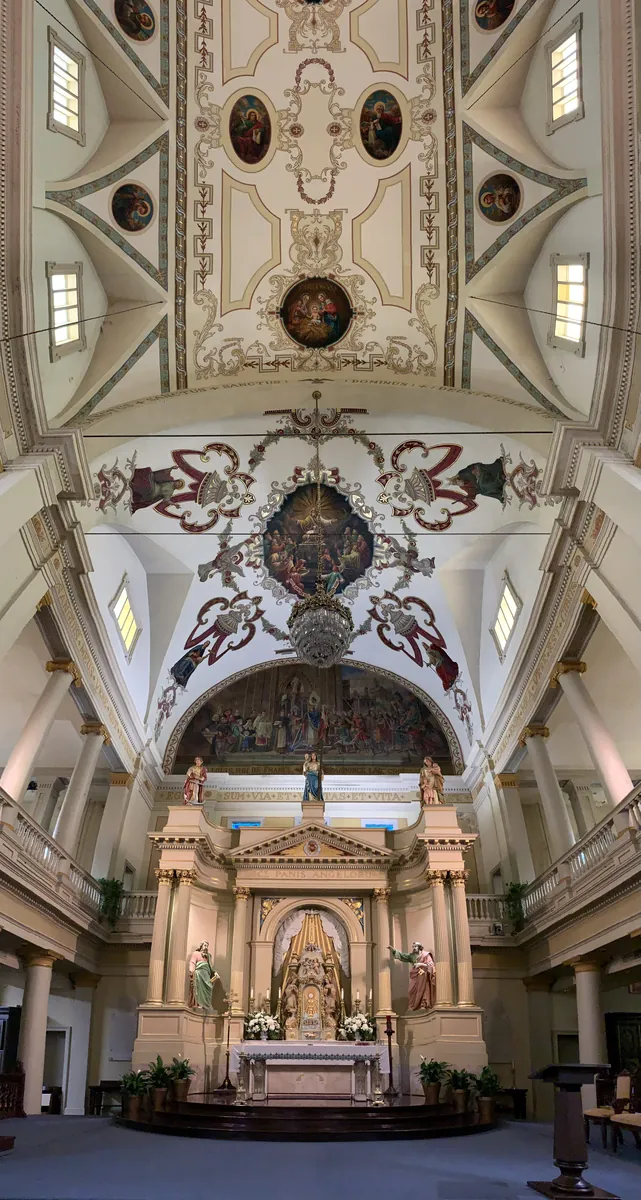 2Religious Site·1718·NRHPSt. Louis Cathedral
The city and the cathedral began together. New Orleans was founded in 1718, and a parish has occupied this spot continuously since that year — making it the oldest cathedral in continuous use in the United States, alongside the Royal Presidio Chapel in Monterey, California. Three churches have stood here. The first was a crude wooden structure in the early days of the French colony. As the French were Catholic, their church was prominently located on the town square. A larger brick and timber church, begun in 1725 and completed in 1727, was destroyed in the Great New Orleans Fire on Good Friday, March 21, 1788. The third went up under Spanish rule — cornerstone laid in 1789, building completed in 1794. In 1793, before the building was finished, Saint Louis Church was elevated to cathedral rank as the See of the Diocese of New Orleans. In 1819, a central tower designed by Benjamin Henry Latrobe was added, with a clock and bell. The bell was embossed with the name "Victoire," in commemoration of the Battle of New Orleans in 1815. The clock installed during that decade is one of the oldest public clocks still operating in the country. In 1849, the diocese contracted to enlarge and restore the cathedral using plans by Jacques Nicolas Bussière de Pouilly. During construction in 1850, the central tower collapsed. Very little of the Spanish Colonial structure survived. The present building dates primarily to 1850 — the triple-steeple profile you see today is de Pouilly's. On April 25, 1909, a dynamite bomb was set off in the cathedral, blowing out windows and damaging galleries. The following year a portion of the foundation collapsed, closing the building from Easter 1916 to Easter 1917. It endured. Pope Paul VI designated it a minor basilica in 1964. Père Antoine — Father Antonio de Sedella — served as pastor for forty years. He is buried beneath the sanctuary floor. Mass is celebrated every day. The cathedral is open daily between services, free of charge.
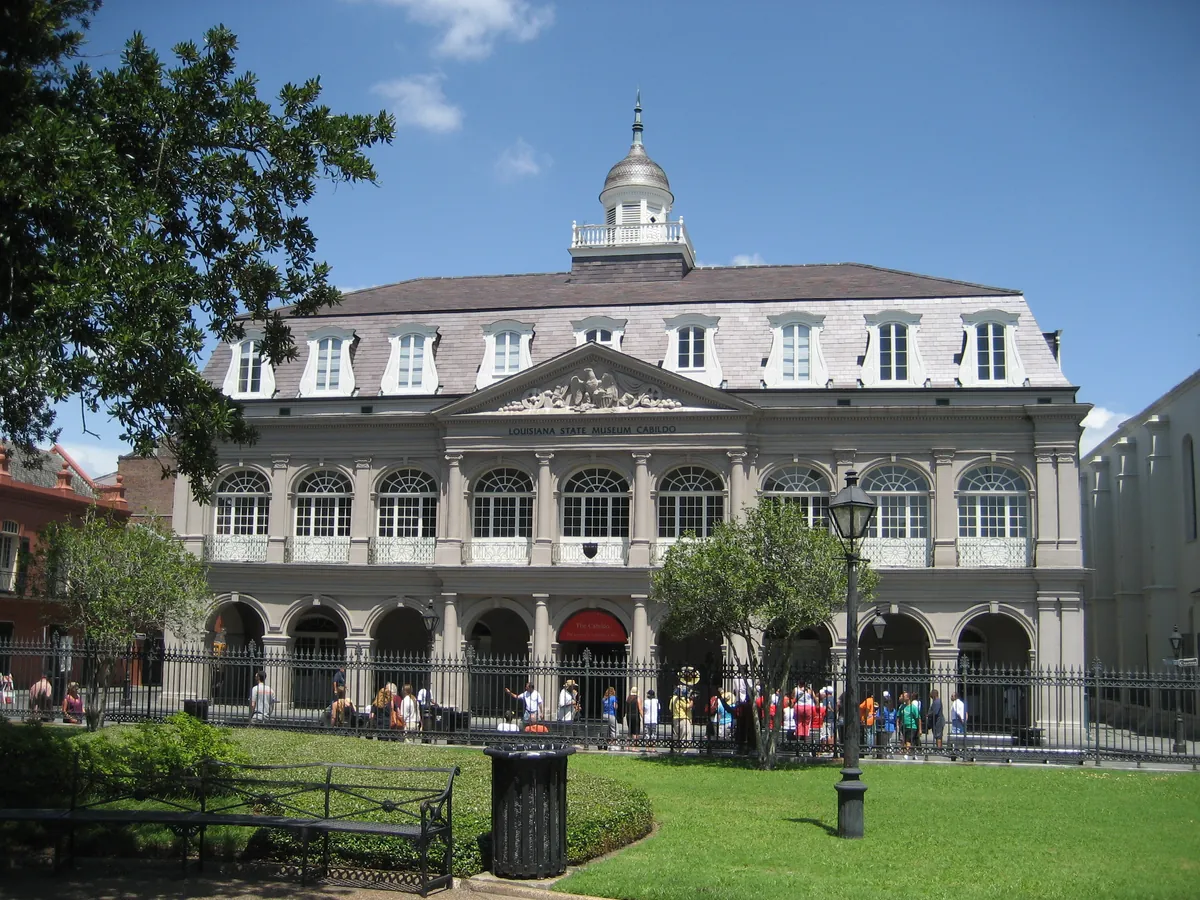 3Museum·1799·NHLThe Cabildo
The sala capitular on the second floor is where the Louisiana Purchase transfer was signed on December 20, 1803. Spanish colonial officials had been using the courtroom for four years — the building went up in 1799 as the seat of the Illustrious Cabildo, the Spanish municipal government. Within a single decade, the hall served under Spanish, French, and American flags. After the transfer, the Louisiana territorial superior court took the courtroom from 1803 to 1812. Between 1868 and 1910, the Louisiana Supreme Court held session in the same sala. The room was the site of Plessy v. Ferguson. By 1895, the building was decaying. The city proposed demolition. Artist William Woodward organized a preservation campaign that succeeded. In 1911, with the state's highest court having vacated, the Cabildo became home to the Louisiana State Museum. Fire gutted the cupola and third floor on May 11, 1988. The $8 million restoration took five years. The museum reopened in 1994, displaying exhibits from colonial settlement through Reconstruction. Napoleon's death mask is on display — one of only four authenticated copies in existence. The building stands along Jackson Square, adjacent to St. Louis Cathedral. In 1960, it was declared a National Historic Landmark. Open Tuesday through Sunday, 10am to 4:30pm. Admission charged; a combo ticket with the Presbytère is available. Three courtrooms across a century and a half. The room where Spanish authority ended. The courtroom that made separate-but-equal constitutional doctrine. The building an artist refused to let the city tear down.
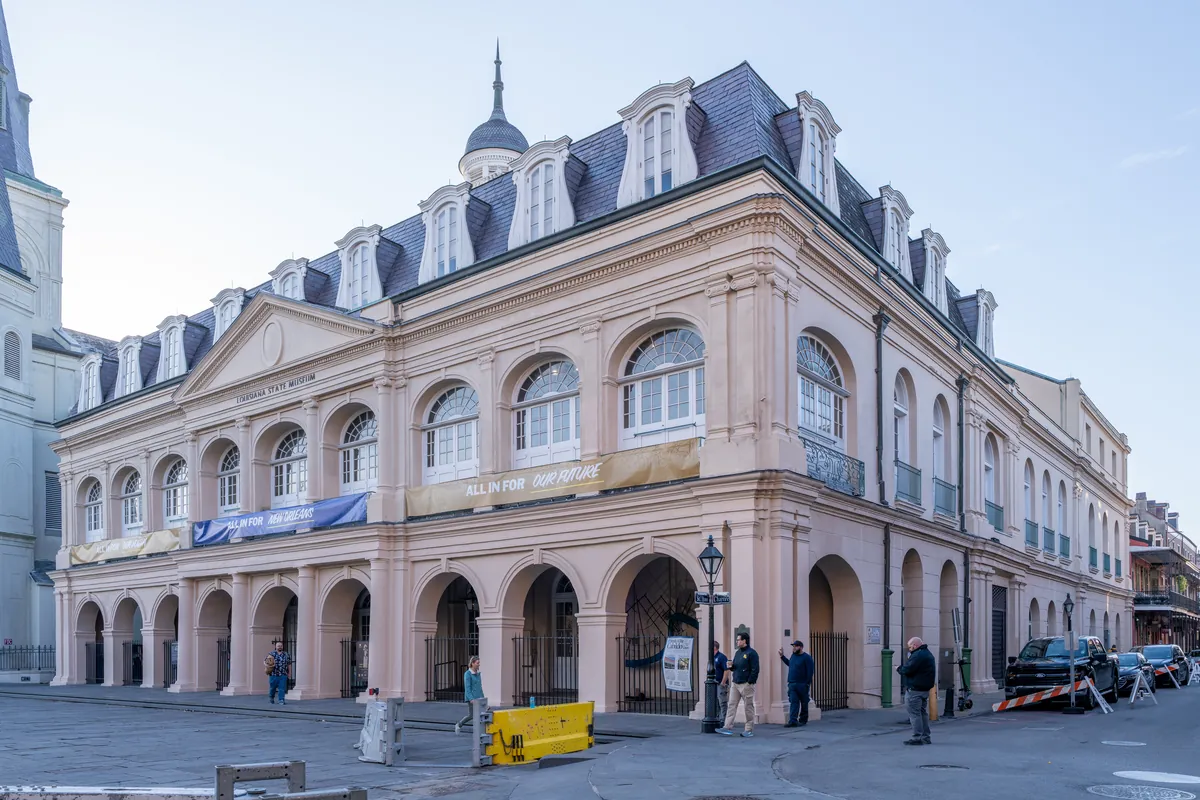 4Museum·1813·NHLThe Presbytere
Gilberto Guillemard designed it in 1791 to mirror the Cabildo on the cathedral's other side — same roofline, same mansard tower — but it took decades to finish. By 1798 only the first floor stood. The second floor wasn't complete until 1813. Built on the site of the Capuchin friars' former residence, it was called the Casa Curial and intended to house clergy. It never did. The building went commercial until 1834, when the Louisiana Supreme Court moved in. Cathedral officials sold it to the city in 1853. The city sold it to the state in 1908. It became part of the Louisiana State Museum in 1911. A mansard roof was added in 1847. The cupola vanished in the 1915 hurricane and was restored in 2005, ninety years later. The first floor now holds a comprehensive Mardi Gras exhibition with a full-size krewe float you can climb into. The second floor is 'Living with Hurricanes: Katrina and Beyond,' one of the most powerful museum exhibitions in the South. The Katrina exhibit includes a rebuilt attic replicating the conditions residents faced while awaiting rescue. Go stand in that room. You'll understand why New Orleans is the way it is. Open Tuesday through Sunday, 10am to 4:30pm. Admission charged; combo ticket available with the Cabildo.
 5Historic Site·1752·NHLOld Ursuline Convent
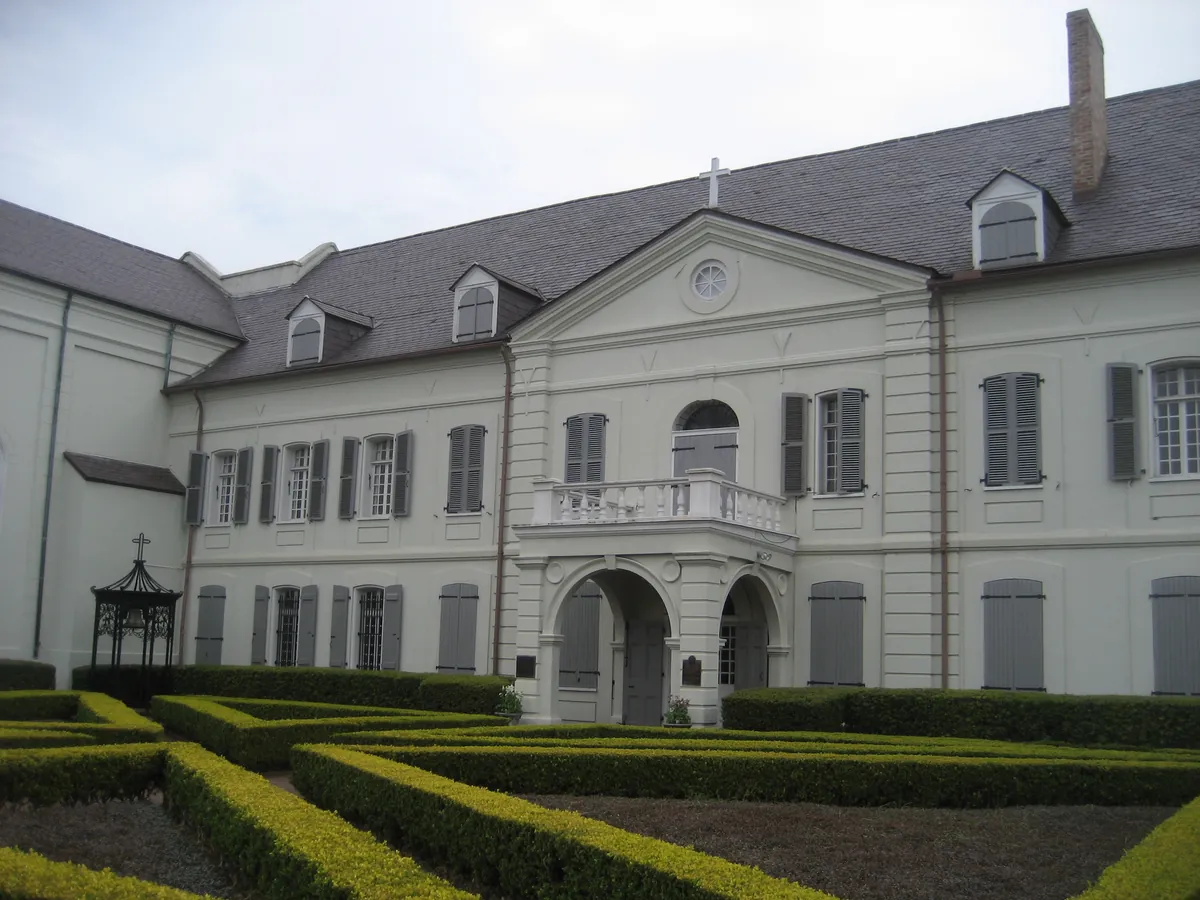
Twelve women crossed the Atlantic in 1727 to teach, nurse the sick, and care for orphans in a colonial outpost founded nine years earlier. The Ursuline nuns arrived in New Orleans when the city was barely more than a muddy grid along the Mississippi, and they built what became the oldest surviving building in the Mississippi River Valley. Completed in 1752, the convent is the only remaining example of French colonial architecture in the French Quarter — stucco-covered brick, severely plain, with a broad hipped roof and narrow central pediment. The National Park Service calls it "the finest surviving example of French colonial public architecture in the country." It survived both Great Fires of 1788 and 1794 that destroyed the rest of the Quarter. Inside, the nuns ran integrated classrooms, educating enslaved and free women of color alongside white girls — 130 years before public school desegregation. When the convent and school moved downriver in 1824, the building became the residence of the bishop of New Orleans, later the archbishop. A portico and gatehouse were added, reorienting the entrance from the river to Chartres Street. The building now serves as the archives of the Archdiocese of New Orleans. Guided tours run Monday through Friday for a small admission fee. You're standing in front of the physical fact that held when everything else burned.
 6Historic Site·1848·NHLU.S. Customhouse
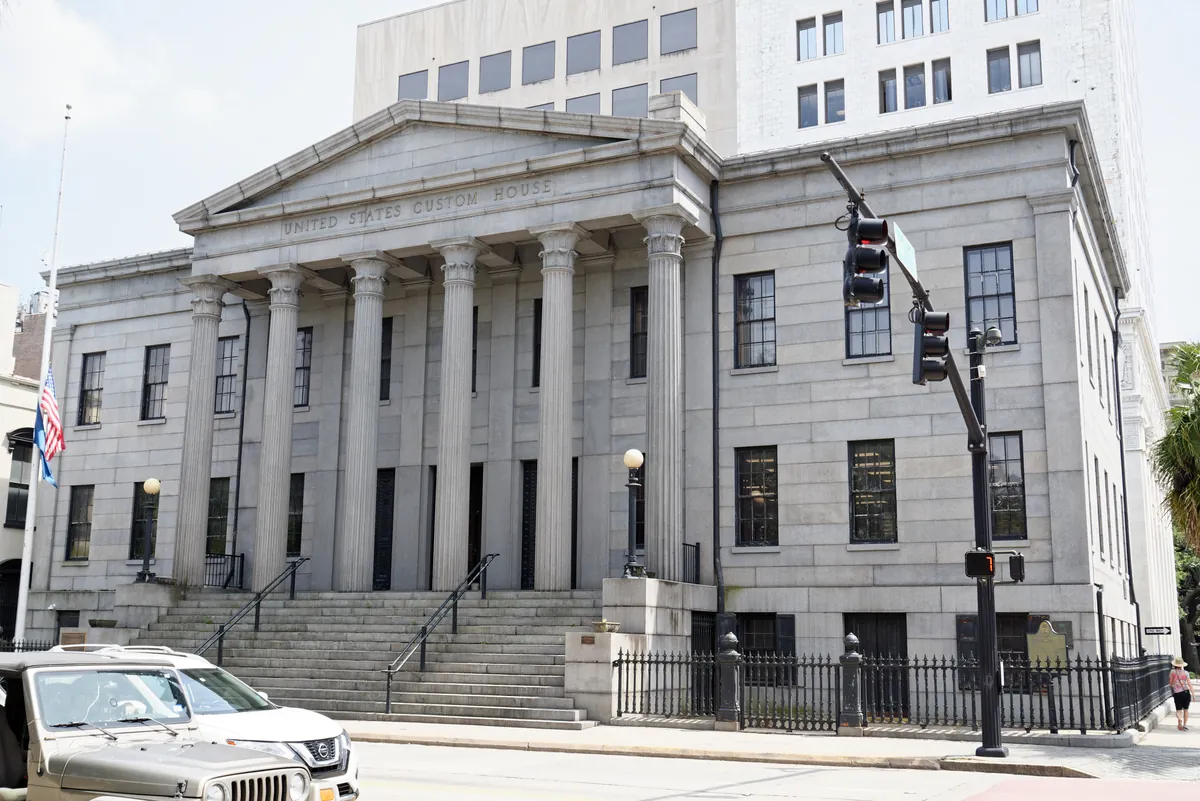
New Orleans was the largest port in the Southern United States throughout the 19th century, exporting most of the nation's cotton output and other farm products to Western Europe and New England. Every bale, barrel, and cask passed through this building — a fortress-scale customhouse that took 33 years to finish, longer than any other federal building of its era. Construction began in 1848 under architect Alexander Thompson Wood, who died before completion. The Civil War halted work for five years. During the occupation of New Orleans, General Benjamin Butler claimed the unfinished building as Union headquarters. When the granite and marble finally stopped rising in 1881, the Customhouse occupied an entire city block at 423 Canal Street. The Marble Hall runs 128 feet long, 84 feet wide, and 54 feet high. Fourteen white marble columns hold up a skylight ceiling. This is the room where clerks tallied the flow that made New Orleans what it was — the cotton that fed Lancashire mills, the sugar bound for Boston refineries, the coffee headed to New York docks. The largest city in the South at the start of the Civil War built a customhouse to match the scale of what moved through it. The building now houses the Audubon Insectarium. Open daily. Walk the Marble Hall and you're standing in the accounting room of an empire's supply line.
 7Museum·1838·NHLU.S. Mint — New Orleans
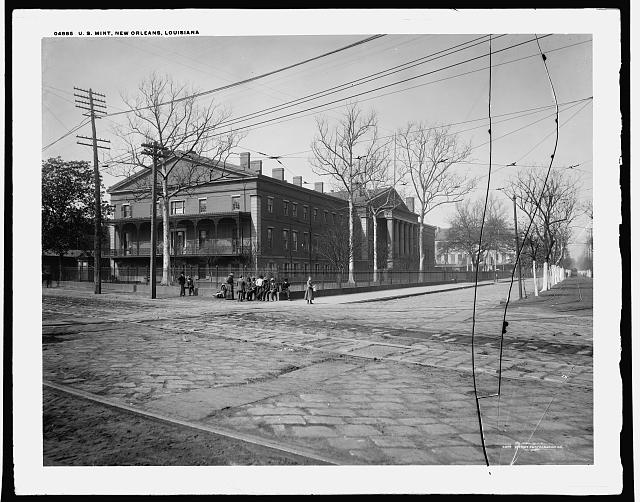
Three governments claimed this building between 1838 and the end of the Civil War. The United States built it, the State of Louisiana seized it, and the Confederate States of America ran it briefly before the metal ran out. It's the only mint in American history to answer to three sovereignties — and that distinction alone makes the coins carrying the 'O' mint mark among the most sought-after pieces in numismatic collecting. The building produced $307 million in coinage over its working life. When Confederate forces took the mint in 1861, they struck their own silver half-dollars until the bullion was gone. A year later, William Mumford tore down a Union flag flying over the building. General Butler had him hanged outside for it — a public execution that defined the bitterness of federal occupation as clearly as any battlefield. New Orleans was the only North American city that allowed enslaved people to gather in public and play their own music, largely in what is now Louis Armstrong Park. That permission created the conditions for jazz. The building that once minted coin now houses the New Orleans Jazz Museum, which holds one of the finest collections of jazz instruments in the world. That includes Louis Armstrong's first cornet. The museum is open Tuesday through Sunday, 10am to 4:30pm. Admission is charged.