The Trace begins where the bluff drops to the river, and the first 30 miles hold what Natchez tried not to look at. The Briars is where Jefferson Davis married Varina Howell in 1845. Temple B'nai Israel, Moorish Revival, 1906, marks a cotton-merchant Jewish community that arrived in the 1840s. The 1940 cantilever bridge to Vidalia crosses one of the river's hardest bends. And the Rhythm Night Club Memorial holds 209 names — a corrugated-tin dance hall that burned on April 23, 1940, the deadliest fire in Mississippi history.
The route
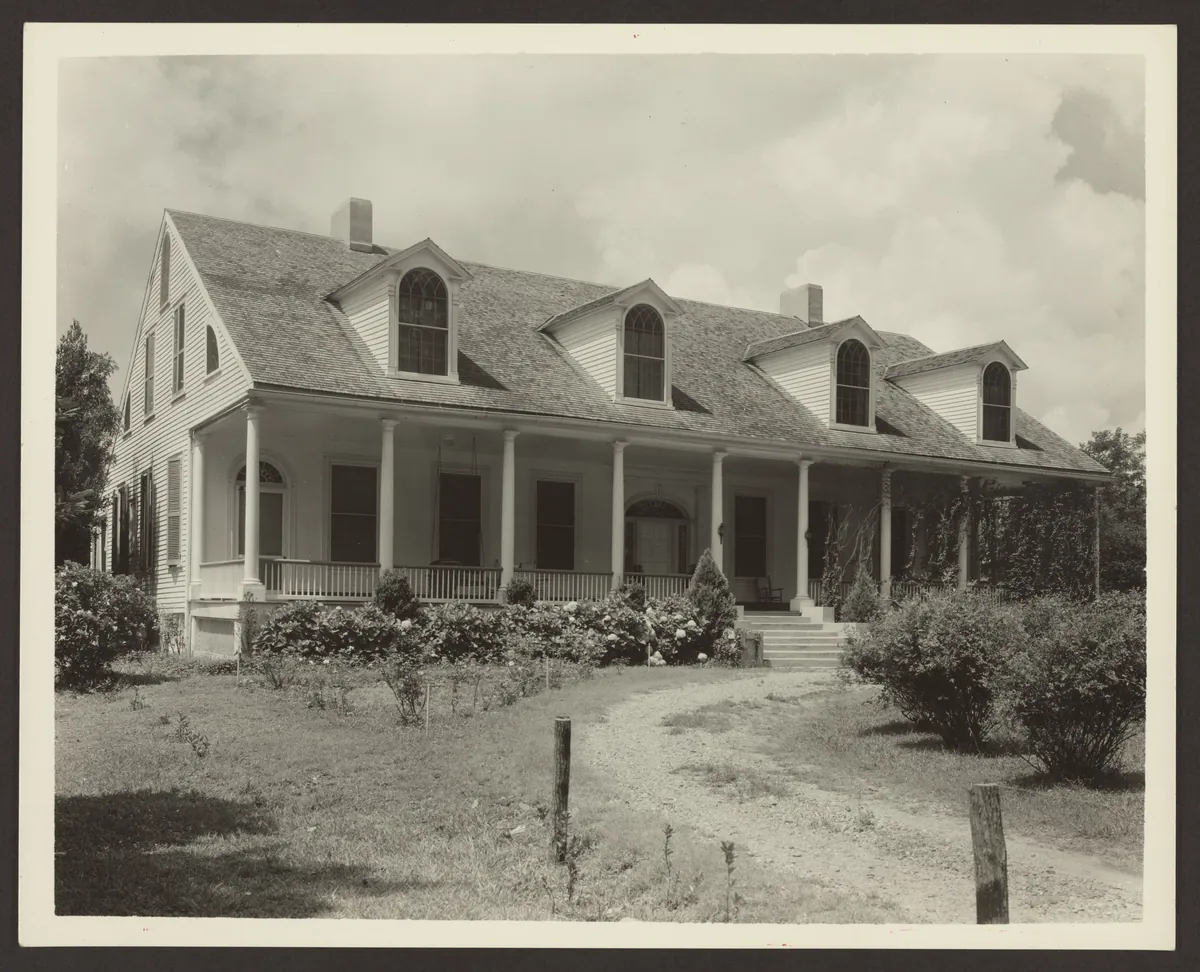 1Architecture·1814·NRHPThe Briars
A planter's mansion on a bluff above the Mississippi River, built in 1818 for Judge John Perkins and designed by architect Levi Weeks. The land had been granted by Spain to Richard Bacon in 1784, then purchased by Arthur Mahan in 1814. When Perkins's wife died in 1824, he tried to sell but instead rented the house to William Burr Howell — son of New Jersey Governor Richard Howell — and Margaret Kempe Howell from 1828 to 1850. Their daughter Varina grew up here, and on February 26, 1845, she married Jefferson Davis at the Briars. She would become the First Lady of the Confederacy, wed in a house overlooking the river that made Natchez the most prevalent slave-trading city in Mississippi, second in the nation only to New Orleans. Natchez was a center of cotton planters and Mississippi River trade in the antebellum years, its strategic bluff location ensuring its role as a pivotal center of commerce for two centuries. The Briars sits at the high end of that geography — one of the best river-view properties in the city. Walter Irvine purchased it in 1853; his heirs sold it to Emma Augusta Wall in 1927. By the 1970s it belonged to Robert E. Canon and Newton Wilds, and was eventually repurposed as a bed-and-breakfast. In January 2023, Chip and Clara Newman bought it for full restoration, opening it to tours and special events. Listed on the National Register of Historic Places since August 24, 1977, the house still takes overnight guests. Check thebriarsnatchez.com for rates.
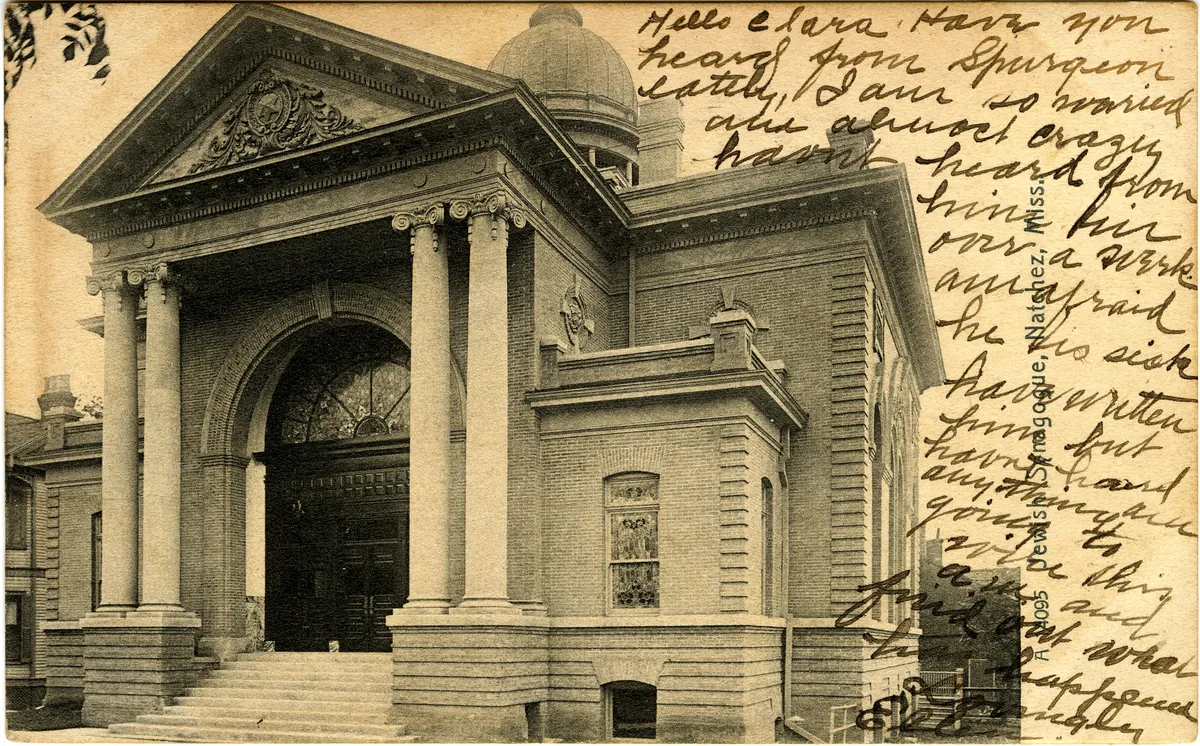 2Religious Site·1905·NRHPTemple B'nai Israel
In 1903, fire consumed the synagogue of Natchez's Jewish congregation — the oldest in Mississippi, established in 1840. The Methodist congregation offered temporary sanctuary. Affluent white Christians donated to the rebuild fund. Within two years, the community had raised a new temple. Architect H. A. Overbeck, who had previously designed a synagogue in Dallas, laid the cornerstone in July 1904. The dedication on March 25, 1905, drew Rabbi Isaac Mayer Wise of Cincinnati and more than 600 attendees. The Beaux-Arts building featured arched stained glass windows, a central dome, and an ornate ark in Italian marble. It seated 450 with a balcony. By the 1870s, Temple B'nai Israel had become the largest Jewish congregation in Mississippi. One-third of all mercantile businesses in Natchez belonged to members of this temple — a measure of the community's reach in a city built on cotton trade and the Mississippi River. In 1866, German immigrant Samuel Ullman sought for the congregation to adopt Jewish Reform traditions that would include women and children, and his idea eventually won out. From 1899 to 1913, Rabbi Seymour Bottigheimer from Virginia led the congregation, providing the first stable rabbi. The building at 213 South Commerce Street was part of the 1998 exhibition *From Alsace to America: Discovering Southern Jewish Heritage*, sponsored by the Museum of the Southern Jewish Experience. It has been a Mississippi Landmark since 2002. By 2010, only around a dozen Jewish residents lived in Natchez. Tours available by appointment.
 3Architecture·1940Natchez-Vidalia Mississippi River Bridge
The river explains the city, and the bridge makes you see it. Built in 1940, this crossing carries US-84 between Natchez, Mississippi and Vidalia, Louisiana — one of the last major spans constructed on the lower Mississippi. The approach from the Louisiana side is the reveal: Natchez rises on its bluff while the floodplain stretches flat behind you, the geography suddenly legible in a way no map delivers. Natchez has been here since 1716, when French colonists built Fort Rosalie on the bluff. The elevation is roughly 46 feet above the river, high enough to command trade and survive floods. The city served as capital of Mississippi Territory and then of the state before Jackson replaced it in 1822. For two centuries it was a center of commerce on the river — cotton, enslaved people, steamboat trade moving through a port that sits where the Natchez people built their ceremonial mounds centuries before Europeans arrived. The river has been boundary, highway, and political fact since the land changed hands from French to British to Spanish to American, all before 1800. The bridge takes five minutes to cross. The best views come at sunset, when the light catches the bluff and the antebellum houses that survived the Civil War because the city surrendered without a fight in 1862. The crossing is free. You go to see why the city sits where it does, and to watch the river do what it has always done: move everything past everything else.
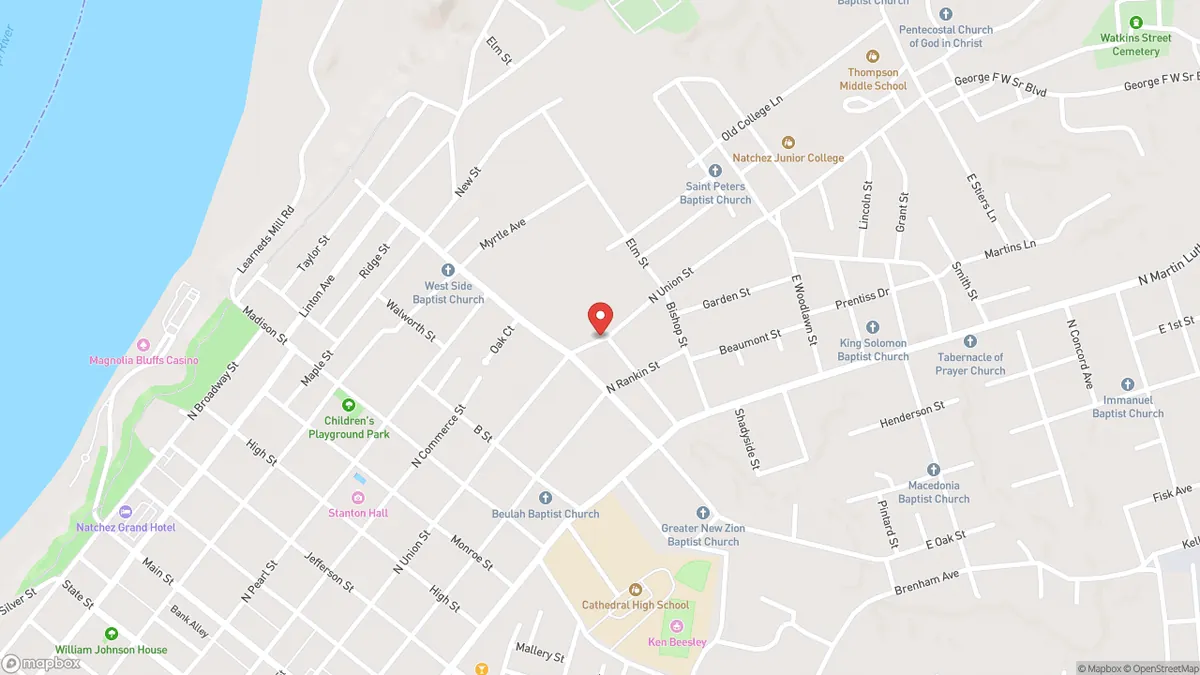 4Historic Site·1940Rhythm Night Club Memorial
Seven hundred and forty-six people, likely. That's the figure the Wikipedia article arrives at by adding ticket sales, passes, and the band. The Rhythm Night Club on St. Catherine Street — a converted blacksmith shop, once a church, then a dance hall leased by a social group called the Money Wasters — recorded 577 paid admissions and 150 passes on April 23, 1940. Walter Barnes and His Royal Creolians, an orchestra from Chicago, was on stage. The building was wood frame with corrugated steel siding, 120 feet by 38 feet. Twenty-one of twenty-four windows had been boarded shut to keep people from watching or listening without paying. One exit: a door that opened inward into a foyer with another set of doors that also opened inward. Around 11:00 p.m., a fire started near the main entrance. Spanish moss draped over the rafters as decoration — sprayed with FLIT, a petroleum-based insecticide — caught quickly. Under dry conditions, flammable methane gas was generated from the moss. The moss fell burning from the ceiling, blocking the exit and igniting clothing and hair. The corrugated steel walls held heat like an oven. When water from fire hoses hit the metal siding, it created steam that scalded victims. Most of the dead were found suffocated by smoke or crushed, stacked shoulder-high near the rear of the building by the bandstand. Two hundred nine people died. The fourth deadliest assembly and club fire in U.S. history. The deadliest fire in Mississippi history. Bandleader Walter Barnes led his band in playing "Marie" as the fire raged; he and nine members of his orchestra died. The average age of attendees was between fifteen and twenty-five. Most were Black. The fire received minimal national press because the victims were Black. The memorial marker stands on St. Catherine Street, free and always accessible. The site itself is an empty grassy plot. Natchez has witnessed mass death before: on November 29, 1729, Natchez Indians killed 229 French colonists — the largest death toll by an Indian attack in Mississippi's history. The Rhythm Night Club fire killed 209 in a single night, in a building with boarded windows and inward-opening doors. The marker exists because more than fifteen thousand people attended Walter Barnes's funeral, because the Natchez Social and Civic Club of Chicago raised money and brought a $350 memorial tablet to the city in September 1940, and because five thousand people attended the dedication service at Zion Chapel AME church and a local park. What was built afterward: building codes requiring doors to open outward, occupancy limits, fire protection systems. What endures: the empty lot, the marker, and the fact that it happened here.