Coca-Cola was first bottled at 1107 Washington Street in 1894 — Joseph Biedenharn figured out the syrup-and-soda math the company itself had not bothered with. That building anchors a mile and a half of museums explaining a city that lost its riverfront in 1876 when the Mississippi changed course, then spent 27 years engineering it back. The Old Court House sits on the highest point, built by enslaved labor beginning in 1858. Robert Dafford's 32 floodwall murals run along the canal the Corps cut to bring the river back. Six museums, one argument: Vicksburg refused to be left behind.
The route
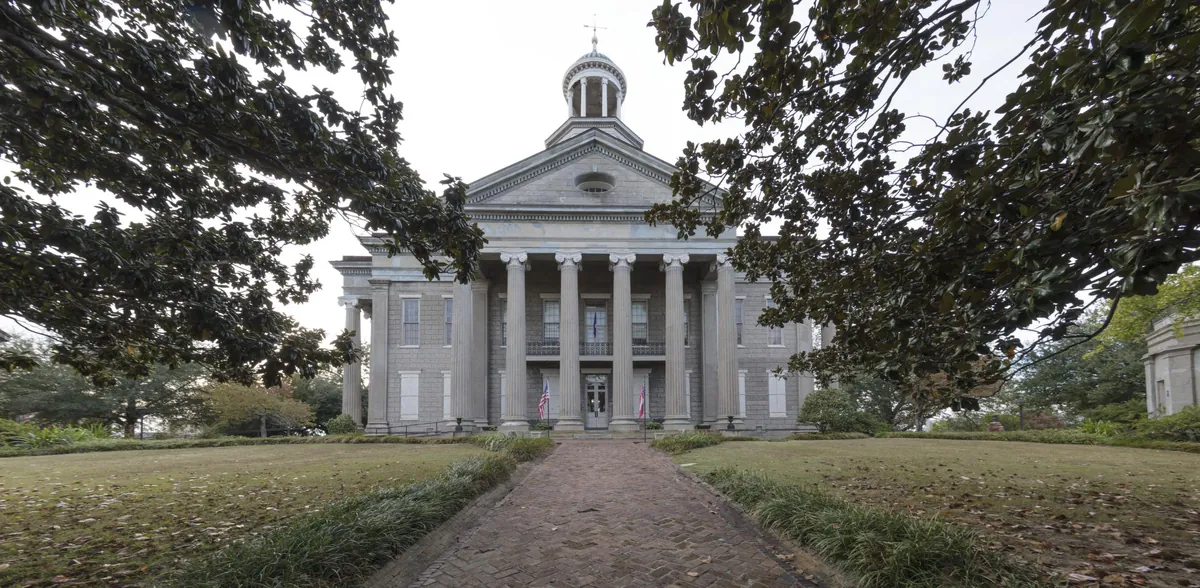 1Museum·1858·NHLOld Court House Museum
The courthouse stands on the highest point in Vicksburg for a reason—the city's entire history has been about holding the bluff. French colonists built a fort here in 1719. The Natchez attacked. The Choctaw took the ground by conquest. The Americans renamed it after a Methodist missionary. In 1858, enslaved labor raised this Greek Revival building on that same commanding elevation, the place from which you can see who controls the river. Both Jefferson Davis and Ulysses S. Grant walked these halls. On July 4, 1863, after Vicksburg surrendered—a moment that, along with Gettysburg, marked the turning point of the Civil War—Union forces raised the American flag from this roof. The building that had governed a Confederate river-port now flew federal colors over the Mississippi. It houses thousands of Civil War artifacts now. Flags, weapons, personal effects—the material record of what was fought over and what remained. The building itself is a National Historic Landmark, which means the federal government has determined it possesses exceptional value in illustrating the heritage of the United States. Nearly 40,000 visitors a year come to stand in rooms where the war's outcome was made tangible. You go because this is where the abstraction of "turning point" becomes physical. The bluff. The flag. The objects men carried. 1008 Cherry Street. Open Monday through Saturday, 8:30am to 4:30pm; Sunday, 1:30 to 4:30pm. Admission charged.
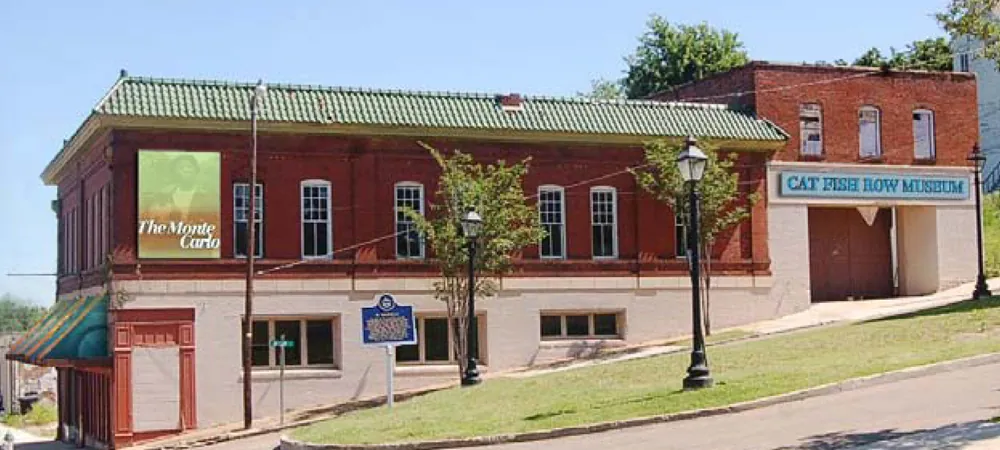 2Museum·Building 1905·NRHPCatfish Row Museum
The Christian and Brough Building went up in 1905 on Washington Street in downtown Vicksburg. It spent decades as the Monte Carlo Club, a blues and R&B venue that ran through the 1970s and 1980s. Now it houses a museum that takes on the part of the city's story most other institutions skip. Vicksburg's museum landscape tilts heavily toward the Civil War — the 1863 siege that became a turning point in the conflict. The Catfish Row Museum doesn't. It focuses on Vicksburg's artistic, literary, and culinary history, and it highlights African American and minority contributions to the city's culture. In a city where the population is now majority African American and where the historical record has often centered on military catastrophe, the museum holds the thread of what people built, performed, and cooked. The building is listed on the National Register of Historic Places. It's open Monday through Saturday. Small admission fee. Current hours are posted at visitvicksburg.com.
- 3Art·2001–presentVicksburg Riverfront Murals
Robert Dafford painted a mile of American time on a concrete floodwall. Thirty-two life-size murals run along the Yazoo Diversion Canal in downtown Vicksburg, open air and free to walk. Dafford — the same Louisiana artist who painted the Paducah and Shreveport floodwall projects — began work in 2002 after Vicksburg residents visited Kentucky looking for ideas. What he painted was the city's entire chronicle: the Natchez who occupied the bluff for thousands of years, French colonists building Fort Saint Pierre in 1719, steamboat traffic when Vicksburg was a key Confederate river-port, the 47-day siege that starved the city into surrender in July 1863, the 1874 massacre when white insurgents killed hundreds of black residents and ran an elected black sheriff out of town, the Great Flood of 1927 when Vicksburg became the primary refugee gathering point, the tornado that killed 38 people in 1953, Willie Dixon and the delta blues, Rosa A. Temple High School and civil rights activism. The subjects trace straight from the historical record — Theodore Roosevelt's bear hunt, the steamboats Sultana and Sprague, the Vicksburg National Military Park. A 33rd mural, painted by Vicksburg artist Martha Ferris, celebrates the three systems that shaped the city: the river, the railroad, the highway. The walk is about a mile along Levee Street. The floodwall exists because the Mississippi River changed course in 1876, cutting Vicksburg off from the water that built it. The Army Corps of Engineers completed the Yazoo Diversion Canal in 1903 to restore river access. A century later, Dafford turned the concrete retaining wall into proof that a city remembers what it survived.