Two years before Montgomery, 20,000 Black residents of Baton Rouge — 80% of the bus ridership — stopped riding the city's segregated buses for eight days in June 1953 and built the free-ride system Martin Luther King Jr. would later copy. Reverend T.J. Jemison ran it out of Mount Zion Baptist Church; the KKK burned a cross on the lawn. Mass meetings filled McKinley High, the first Black high school in the city. Southern University students carried it forward. King called Jemison first. The tactic was invented here.
The route
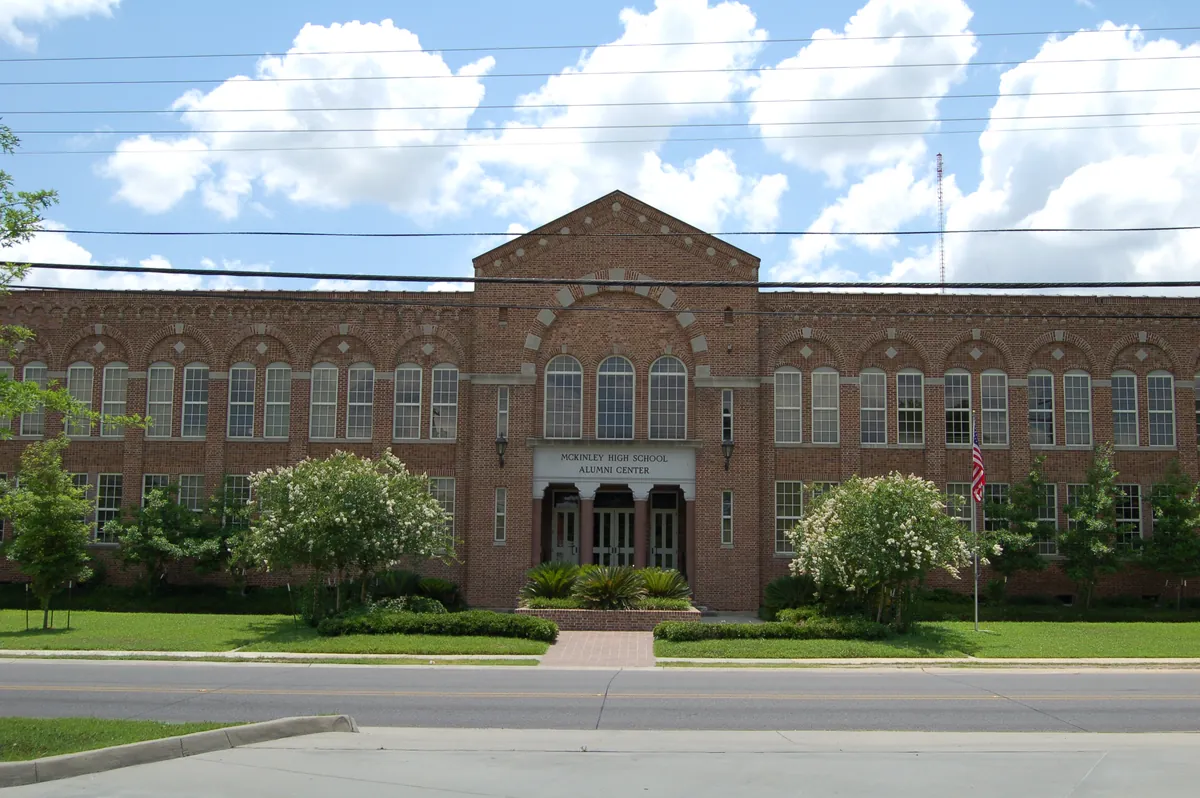 1Civil Rights·1926 / 1953·NRHPMcKinley High School — Bus Boycott Site
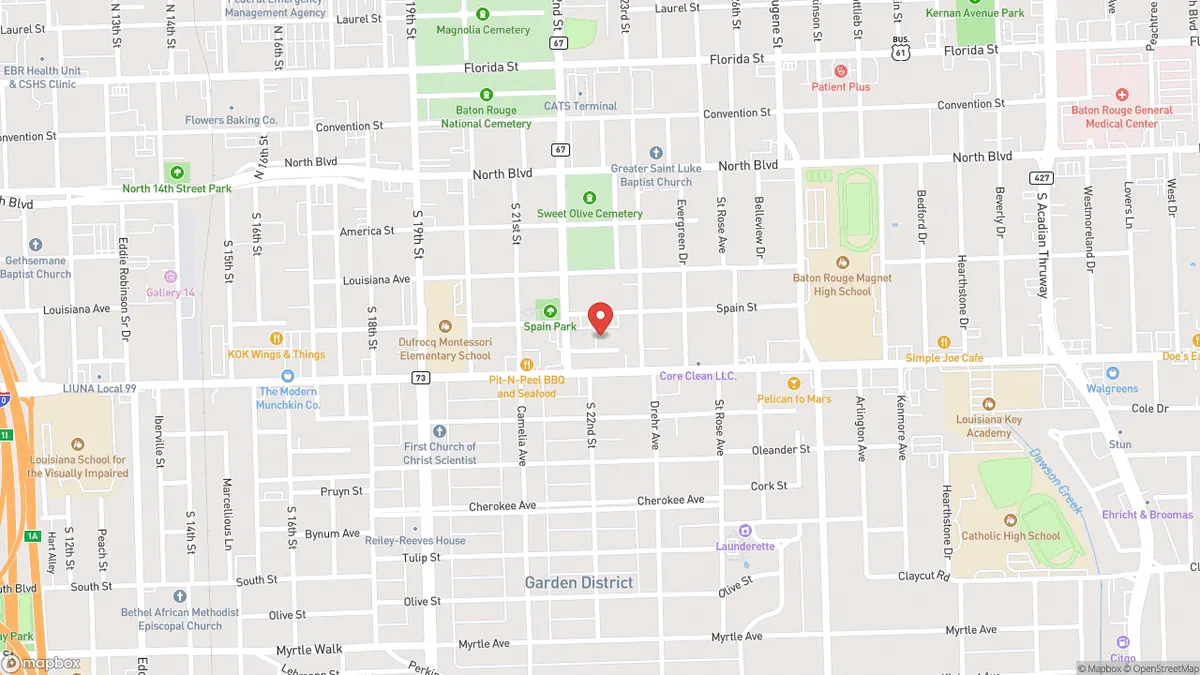
In 1916, four students crossed a stage and became the first African American high school graduates in Louisiana. McKinley was the first high school established for Black students in East Baton Rouge Parish. The original building opened in 1927, named for the 25th president. Twenty-six years later, on June 19, 1953, Reverend T.J. Jemison stood in McKinley's auditorium and launched the Baton Rouge Bus Boycott. Twenty thousand Black residents refused segregated buses for eight days. It was the first large-scale civil rights bus boycott in American history — two years before Montgomery. The meetings outgrew the auditorium and moved to the city's stadium. When Martin Luther King Jr. began organizing in Montgomery in 1955, he contacted Jemison for advice. The original 1926 building entered the National Register of Historic Places in 1981. The Alumni Association purchased it from the school board in 1992 and operates it now as an alumni center. In 2016, the Toni Morrison Society placed a Bench by the Road marker here — one of fewer than thirty worldwide, commemorating sites erased from collective memory. The bench and historical marker are accessible during school hours on East Boulevard, where a strategy session in a high school auditorium became a rehearsal for the movement that followed.
 2Civil Rights·1884Mount Zion Baptist Church
Reverend T.J. Jemison turned Mount Zion Baptist Church into the command center of the 1953 Bus Boycott, coordinating a citywide network of free rides dispatched from church parking lots that paralyzed Baton Rouge's bus company for eight days. Every Black church in the city participated in the logistics, but Mount Zion ran the system. The KKK burned a cross on the church lawn in response. Two years later, Martin Luther King Jr. studied what Jemison had built here and replicated the church-based transportation model in Montgomery. The Montgomery boycott became the more famous action, but the operational blueprint came from East Boulevard. What worked in Baton Rouge — the parking lot dispatch points, the congregation-staffed ride network, the church as nerve center — became the template King deployed at scale. The congregation is active. Visitors are welcome during services.
 3Civil Rights·1880Southern University — A&M College
In 1880, three African-American legislators at Louisiana's constitutional convention—P. B. S. Pinchback, Theophile T. Allain, and Henry Demas—proposed founding a college "for the education of persons of color." The General Assembly chartered Southern University for Colored Students that year, and it opened in New Orleans the following March with twelve students, meeting at the former Israel Sinai Temple on Calliope Street. In 1890, the legislature designated Southern as a land-grant college for blacks, adding an Agricultural and Mechanical department to satisfy federal requirements while maintaining segregated higher education. In 1914, the university moved from Uptown New Orleans to Scotlandville, just north of Baton Rouge, settling on Scott's Bluff above the Mississippi River. Joseph Samuel Clark, an African-American leader from Baton Rouge who had led Baton Rouge College and the Louisiana Colored Teachers Association, became the college's first president after the move. A 1921 constitutional convention authorized reorganization and expansion; under Clark's continued leadership, enrollment grew from forty-seven to five hundred students. His son, Felton Grandison Clark, later became president and oversaw three decades of expansion—building thirty-three of the university's current buildings and growing enrollment to nearly ten thousand by the end of his tenure. In 1946, LSU Law School refused to admit Charles J. Hatfield III, an African-American college graduate who filed suit to gain professional education in the state. A special Louisiana Convention established a law program at Southern in 1947. F. G. Clark later founded affiliated centers in New Orleans and Shreveport; the legislature incorporated them into the Southern University System in 1974. On November 16, 1972, during a second day of student protests demanding inclusion in administrative decisions, Denver Smith and Leonard Brown were shot outside the Old Auditorium with buckshot—the same ammunition the sheriff's deputies carried. The murders have never been solved. Governor Edwin Edwards ordered the campus temporarily closed and patrolled by troops. The deaths galvanized a generation; the students are memorialized in the name of the campus union. Between 1970 and 1990, Southern consistently enrolled over ten thousand students and became the nation's largest HBCU—a distinction it still holds. It remains the only HBCU that is simultaneously a land-grant institution with a law school. In 2021, it attained R2 Carnegie Classification for high research activity, the first HBCU in Louisiana to reach that tier. The campus sits on a dramatic bluff above the Mississippi River with some of the best river views in the city. Lake Kernan flows through the center of campus. The Smith-Brown Memorial Union houses six food outlets, twelve bowling lanes, a game room, an art gallery, a ballroom, and offices for student organizations. The John B. Cade Library contains over a million volumes; its third floor houses the Camille Shade African-American Heritage Collection. The Human Jukebox marching band, representing Southern since 1947, has performed at six Super Bowls, presidential inaugurations, and the Rose Parade. In 2008, USA Today named it the number-one band in the nation. Campus is open to visitors. Start at the Smith-Brown Memorial Union or the archives in Cade Library. The bluff overlooks the working river—the same strategic site that made Baton Rouge defensible, the same river that carried goods and people north from the Gulf. Southern's story is part of the larger arc: what Black Louisianans built when the state would not let them through the front door.