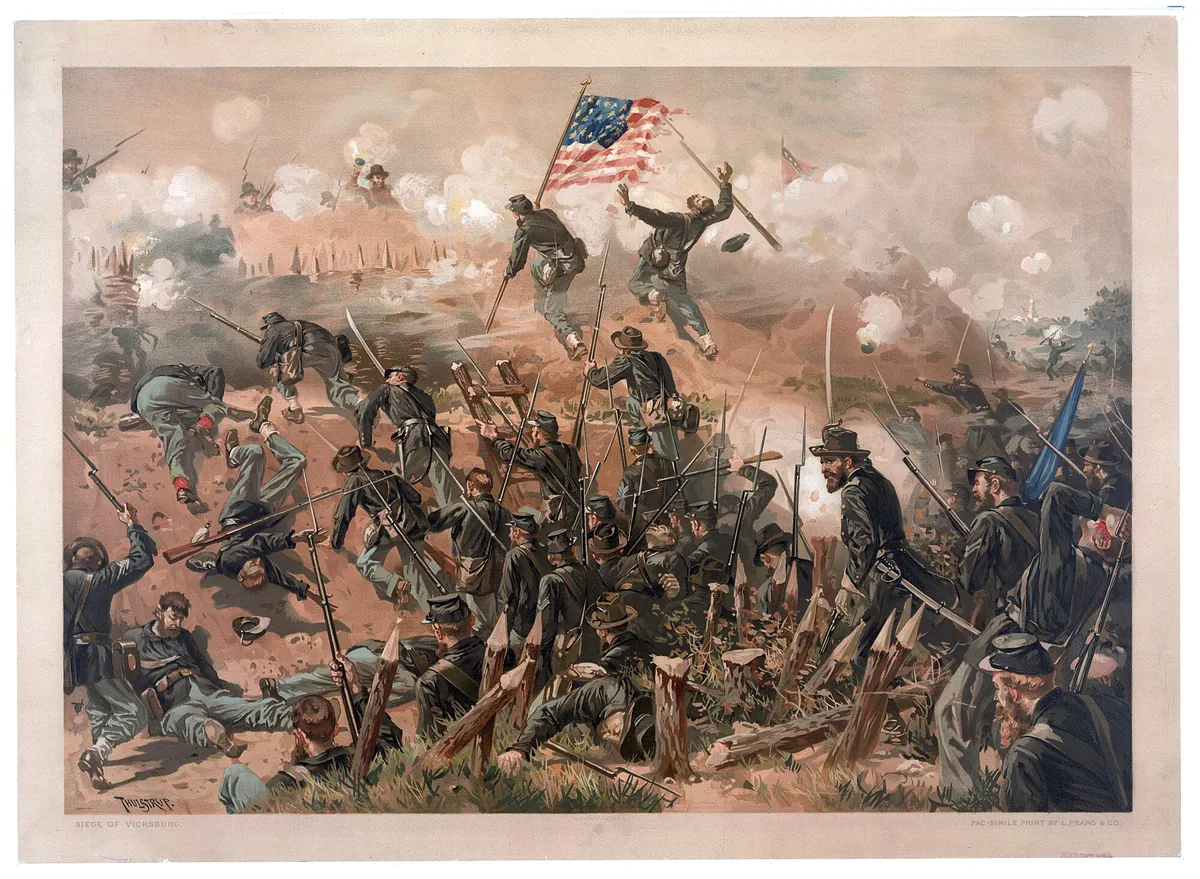
Forty-seven days. That was the length of the siege that severed the Confederacy in two. From May 18 to July 4, 1863, Union forces under Ulysses S. Grant ringed Vicksburg's defensive lines after two frontal assaults failed with heavy casualties. On the final day, Pemberton's garrison surrendered. Combined with the fall of Port Hudson nine days later, the Union controlled the Mississippi River for the rest of the war. Lincoln called Vicksburg "the key to the war."
The 1,800-acre park preserves the battlefield as terrain. Twenty miles of reconstructed trenches and earthworks trace the Union and Confederate lines exactly where they were dug. More than 1,400 monuments, markers, and tablets mark the siege — the second-largest collection of outdoor sculpture in the United States. A sixteen-mile driving tour follows the siege chronologically from Grant's approach to the surrender. Licensed battlefield guides work from the visitor center; they're the best way to understand what the ground itself demanded.
The park also holds the gunboat USS Cairo, sunk by torpedo on the Yazoo River on December 12, 1862 — the first U.S. ship ever destroyed that way — and recovered in 1964. Grant's Canal, a detached section across the river near Delta, Louisiana, preserves the remnants of an attempt to bypass Confederate guns by rerouting the Mississippi itself. Commenced in June 1862 under Benjamin Butler, halted in July due to disease and falling water, then restarted in January 1863 under Sherman at Grant's order, the canal failed for technical reasons. Neither Grant nor Sherman believed it would work, but Lincoln favored the scheme, and Grant used it to keep his troops occupied during the maneuvering that led to the siege.
The Vicksburg National Cemetery, 116 acres within the park, holds 18,244 interments from the campaign and later conflicts. Twelve thousand nine hundred fifty-four are unidentified. The park was established February 21, 1899, transferred to the National Park Service in 1933, and listed on the National Register of Historic Places in 1966. More than half a million visitors come each year. Open daily dawn to dusk. Visitor center 8am–5pm. Free admission.
- ·1,800-acre National Park preserving the 47-day Siege of Vicksburg (May 18 – July 4, 1863).
- ·More than 1,400 monuments, markers, and tablets — the second-largest collection of outdoor sculpture in the U.S.
- ·20 miles of reconstructed trenches and earthworks trace both Union and Confederate lines.
- ·16-mile self-guided driving tour follows the siege chronologically from approach to surrender.
- ·Licensed battlefield guides available at the visitor center — the best way to understand the terrain.
- ·National Historic Landmark. Open daily dawn to dusk. Visitor center 8am–5pm. Free admission.
Memories
Editorial content compiled with AI assistance. Place details verified against public records.