Roanoke in 1949 was a railroad town — the Norfolk and Western Railway had made the city its headquarters in 1882 and turned a village called Big Lick into Southwest Virginia's industrial hub. By mid-century the downtown merchants needed a gimmick to draw shoppers. They raised $28,000 and hired the Roy C. Kinsey Sign Company to build an 88.5-foot illuminated star on Mill Mountain, visible from downtown. It was supposed to be a Christmas promotion, lit for the holiday shopping season, then dismantled in January.
The star went up on an eight-story steel tower weighing 60,000 pounds, mounted on a concrete base that used 500,000 pounds of concrete. Corning Glass Works manufactured 2,000 feet of neon tubing. On Thanksgiving Eve, November 23, 1949, Mayor A.R. Minton hit a dummy power switch for the cameras while Bob Kinsey threw the real switch from behind a circuit box. Former U.S. Congressman Clifton A. Woodrum spoke at the dedication and compared the star to the Star of Bethlehem, quoting the Book of Matthew: "When they saw the star they rejoiced with exceeding great joy." Actor John Payne, a Roanoke native who as a child had won the contest to name the Patrick Henry Hotel, attended.
The star stayed. It was popular enough that the Merchants Association kept it lit year-round. The association paid the electric bill until 1955, when the city took over the cost. It is considered the largest free-standing, man-made, illuminated star in the world. On a clear night it is visible from 60 miles away.
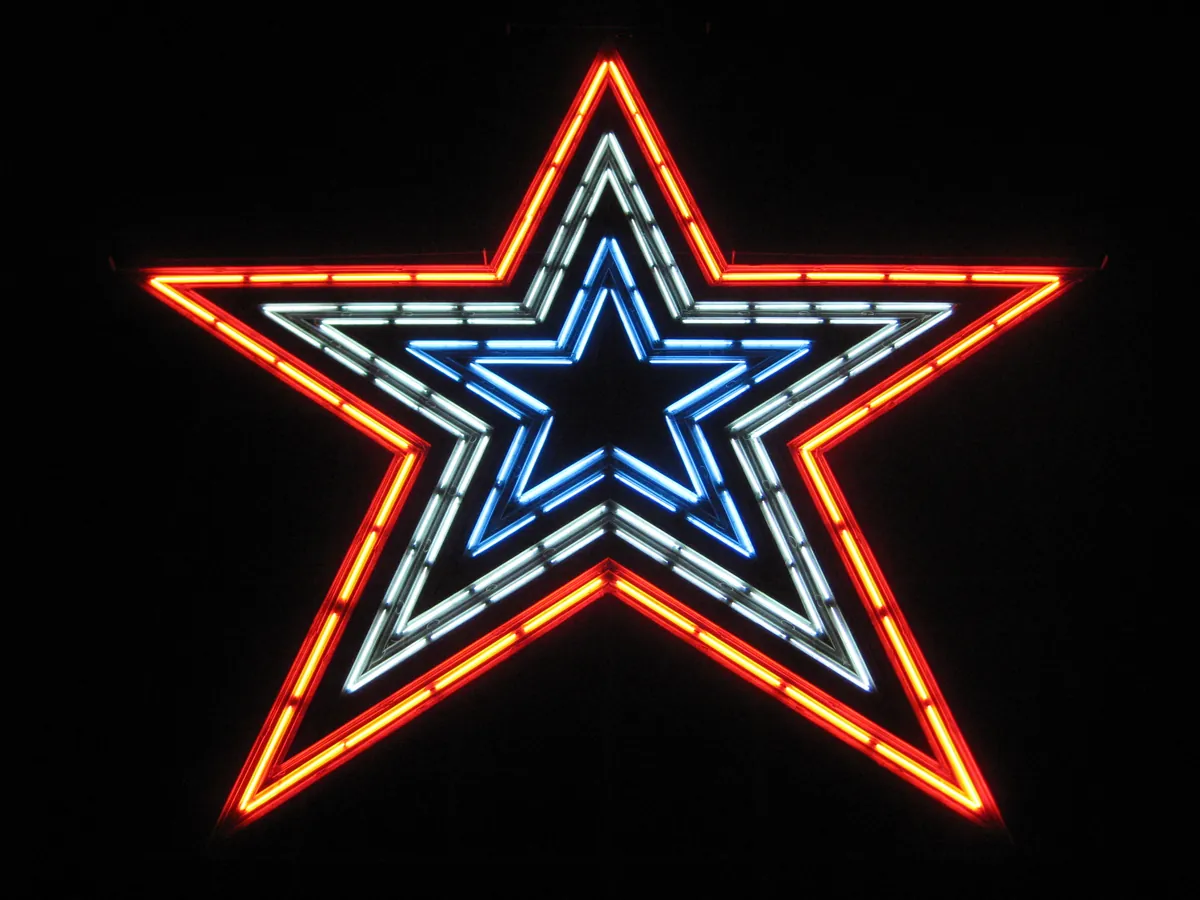
The star was originally lit entirely white. From 1957 until 1976, the city changed it to red for two nights to indicate a traffic fatality. It stayed red for three nights after the assassination of John F. Kennedy and for five after the Challenger disaster. In 1976, for the bicentennial, the design was changed to an outer red star encompassing inner double-stars of white and blue. After September 11, 2001, the star was kept in red, white, and blue for nearly six years. On April 22, 2007, officials changed it to all-white "as a symbol of healing and hope" after the Virginia Tech shooting. Red, white, and blue returned May 24, 2007 and remained until September 12, 2011. Since then it has stayed white except for Memorial Day, Flag Day, Independence Day, September 11, and Veterans Day.
The star sits 846 feet above the Roanoke River. You can drive or hike to the Mill Mountain summit. The overlook is free. The Mill Mountain Zoo is adjacent. The star is the origin of Roanoke's nickname, "The Star City of the South." A 2021 city study found significant rust and damage to the anchors of the sheet metal base that hold the neon tubing, and the steel structure is covered in lead paint — $3 million to remove. As of 2023, the city was undecided on renovation or replacement, but no action would occur in time for the 75th anniversary in 2024. The star is difficult to maintain. It remains lit every night.
- ·88.5 feet tall, 10,000 pounds — the largest freestanding illuminated man-made star in the world.
- ·Started as a temporary Christmas decoration in 1949, sponsored by Roanoke merchants. It was supposed to come down in January.
- ·Visible from 60 miles away on a clear night; lit neon red, white, and blue.
- ·The star is why Roanoke is called the Star City of the South.
- ·Drive or hike to the Mill Mountain summit. Free to visit. The Mill Mountain Zoo is adjacent.
Memories
Editorial content compiled with AI assistance. Place details verified against public records.