The Roanoke Valley sits in a gap where the Blue Ridge Mountains relent just enough to let a river through. The Roanoke River runs west to east across the valley floor, and the Great Wagon Road and the Carolina Road — two branches of the colonial network that developed from Native American trails — crossed near the same spot. Geography made this a place people moved through. It took a railroad to make it a place people stayed.
The Tutelo, a Siouan-speaking people, lived in this valley when European settlers arrived. Scotch-Irish farmers came first in the 18th century, followed by Germans moving south from Pennsylvania along the Great Wagon Road. By 1838 the population warranted a county; by 1852, a railroad. The Virginia and Tennessee line put a depot near a small community called Big Lick, named for the salt deposits that had drawn game to the area for years. The Civil War stalled what growth had begun — Roanoke County voted 850–0 for secession and sent most of its men to fight. The tobacco trade pulled the region back during Reconstruction, and within a decade of the war's end, six tobacco factories operated near the Big Lick depot.
What transformed Big Lick into something else entirely arrived in 1882, when the Norfolk and Western Railway and the Shenandoah Valley Railroad chose the small town as the junction of their two lines and relocated their headquarters there. The railroads didn't just bring jobs — they built a city nearly from scratch: shops, offices, housing, and the 69-room Hotel Roanoke, opened the same year. When Frederick J. Kimball, an executive who had played a significant role in securing the new location, was asked to have the city named after him, he declined. "On the Roanoke River in Roanoke County," he said. "Name it Roanoke." By the end of 1883, the population had passed 5,000, qualifying the town for a city charter. By 1890, it had grown from under 700 residents to over 16,000. They called it "The Magic City."
Boomtowns carry their pathologies with them. Roanoke's infrastructure couldn't keep pace — no sewers, marshy ground, regular outbreaks of diphtheria and cholera. African Americans made up roughly 30 percent of the city's population in 1891, concentrated in the Gainsboro neighborhood, and they were among the first subjects of the Jim Crow laws the city adopted early and enthusiastically. Bond measures meant to address civic deficiencies were designed to benefit white neighborhoods only. In September 1893, a white mob surrounded the city jail demanding a Black prisoner named Thomas Smith, overwhelmed an undermanned militia in a shootout that left eight dead and thirty-one wounded, and lynched Smith. The mayor, Henry S. Trout, who had vowed to protect the prisoner, was wounded and forced to flee the city. The national press condemned the riot and praised Trout's stand. The city rebuilt anyway.
What was built inside Gainsboro during those decades of official neglect is its own story. In 1927, a cafeteria manager named Ethel Earley founded Big Lick Garden Club, one of Roanoke's first African American gardening clubs. Through sustained, unglamorous work — cleaned alleys, tended walkways, increased curb appeal — the club made the Chamber of Commerce and City Council pay attention to parts of the city they had ignored. The Council made overdue street repairs and donated a decommissioned post office to the club, which converted it into a community center. On April 22, 1932, when horticulturist Asa Sims of the Hampton Institute launched the Negro Garden Clubs of Virginia, Earley was voted its first president. The organization grew from seven initial clubs to 65 in its first decade.
The 20th century layered institution on top of institution. Roanoke Memorial Hospital opened in 1900 at the base of Mill Mountain; a local merchants association erected an 88.5-foot illuminated star atop that same mountain in 1949, a Christmas promotion that became permanent and gave the city its nickname, "Star City of the South." In 1982, the N&W completed a merger with the Southern Railway to form Norfolk Southern, which moved its headquarters to Norfolk. Manufacturing closures followed. The city that had been conjured by railroads had to conjure itself again.
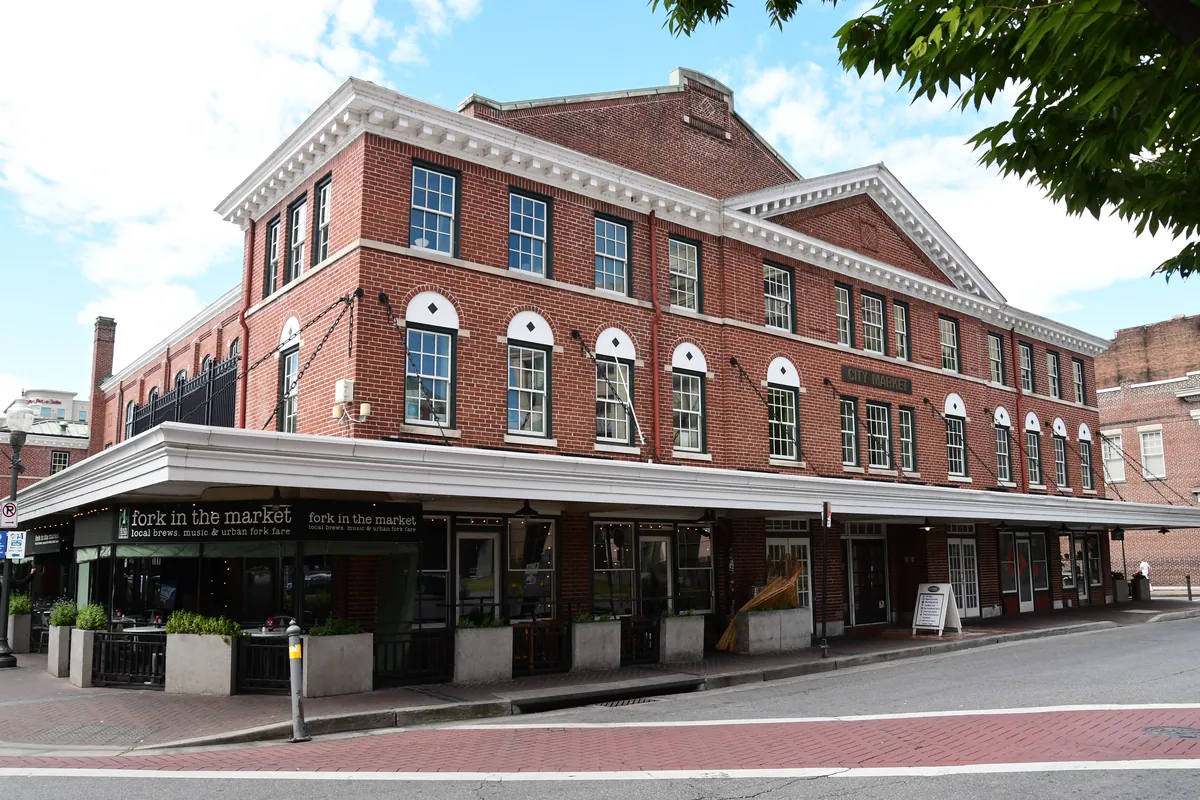
It did. The 1987 merger of two local hospitals created the forerunner of Carilion Clinic, now the largest private employer west of Richmond, with partnerships with Virginia Tech and Radford University that turned a former industrial brownfield south of downtown into what the city calls its "innovation corridor." The Virginia Museum of Transportation houses locomotives built in Roanoke by the Norfolk and Western, including the 1218 and 611 steam engines. The former N&W passenger station — renovated in 1949 in the Moderne style by designer Raymond Loewy — now holds the O. Winston Link Museum, dedicated to the steam-era railroad photography that documented the last years of the line that built this place. The farmer's market at the center of downtown, established in 1882, is still open. Roanoke's population passed 100,000 again in 2020, for the first time since 1980. The valley endures. The star stays lit.