This was Caddo country long before it was Louisiana.
The Caddo Confederacy — a network of agricultural nations speaking related languages, ruled by hereditary leaders, trading across a territory that stretched from present-day East Texas to the Arkansas Ozarks — was the dominant power on this land for at least a thousand years before Europeans arrived. Their ceremonial mounds still rise above the Red River bottomlands. Their trade networks moved obsidian, copper, and marine shell across half the continent. When Hernando de Soto's men stumbled through in 1542, the Caddo were the most populous and organized nation they encountered in the whole lower Mississippi basin.
The French and Spanish mostly traded with them rather than displacing them. The Caddo were too numerous and too well-armed. A post at Natchitoches, founded in 1714 on the Red River just south of here, was the southernmost edge of Caddo influence and the northernmost edge of French Louisiana. For a century the two groups coexisted along this border. Then, in the early 1800s, American settlers began pushing in from the east, and the federal government signed the treaties that removed the Caddo to Oklahoma. By 1835 the Caddo were gone.
What opened the country to Anglo-American settlement was a specific, peculiar geographic fact. The Red River, for at least two hundred miles north of Natchitoches, was clogged by the Great Raft — an immense natural logjam of fallen timber, some of it a thousand years old, that made the river unnavigable and turned the surrounding country into a flood-prone swamp. Steamboats could not reach the upper Red. Settlement could not take hold.
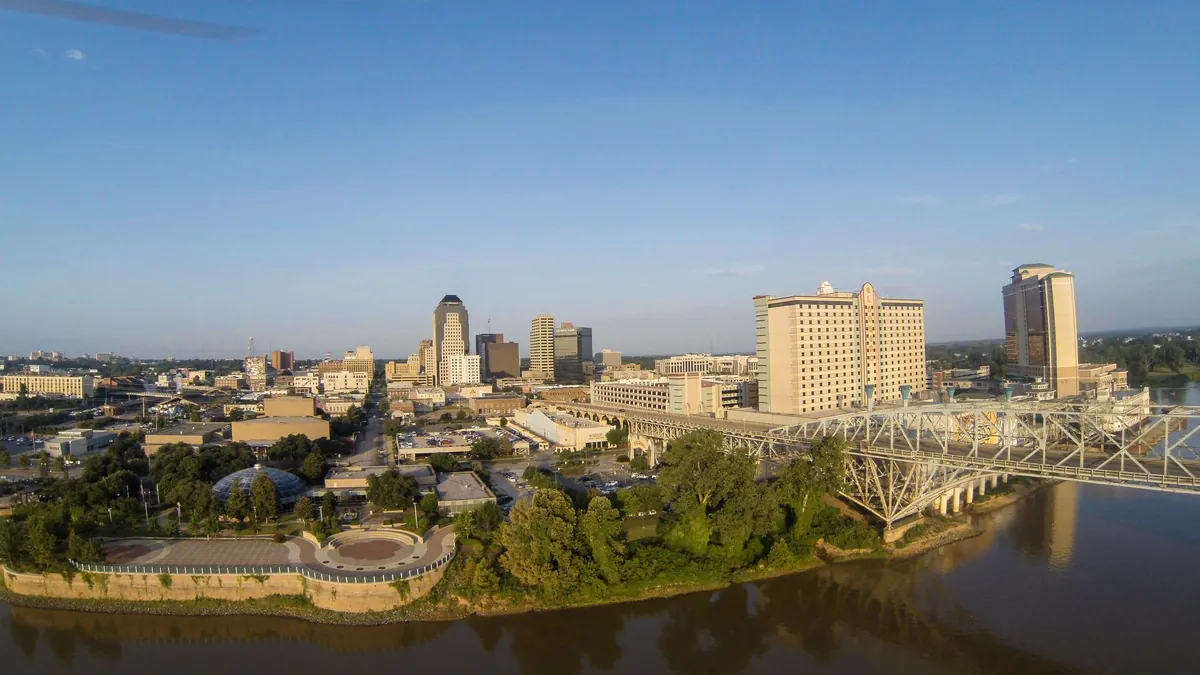
In 1833 the federal government hired Captain Henry Miller Shreve, inventor of the snagboat, to clear it. He spent five years breaking up the raft with specialized steamboats of his own design. The water fell. The swamp drained. Land opened. In 1836 the Shreve Town Company laid out a grid on the newly dry bluff where the Red River bent west. They named it Shreveport. The city exists because one man engineered a river out of the way.
Cotton came first, then the Civil War, then a brief catastrophe — Shreveport was the last capital of Confederate Louisiana, and the Red River Campaign of 1864 turned much of the surrounding country into a battlefield. The real transformation came in 1906, when oil was struck on Caddo Lake, just north of the city. The Oil City boom made Shreveport one of the first oil cities in America. Standard Oil, the Trees brothers, and the Brown family built mansions on South Highland. The downtown filled with Art Deco towers. Barksdale Field opened in 1933 and made Bossier City across the river a military town.
Then came the music. The Louisiana Hayride, broadcast live from the Shreveport Municipal Auditorium starting in 1948, was the proving ground of mid-century American music. Hank Williams walked on its stage. So did Johnny Cash, Elvis Presley in 1954, Johnny Horton, Jim Reeves. Before Elvis had a record deal, he had a Hayride contract. Shreveport-Bossier briefly outshone Nashville as the nursery of country music before the Hayride faded.
The Sabine River marks the Texas line an hour west. The piney woods roll on into the Arklatex, that cultural region with no real name that spreads across three state boundaries. Northwest Louisiana is the place where Louisiana stops being French and starts being something else — more Texan, more Baptist, more oil-and-cattle, still Southern but in a different key. It is the Louisiana most Louisianans from downriver never quite understand.