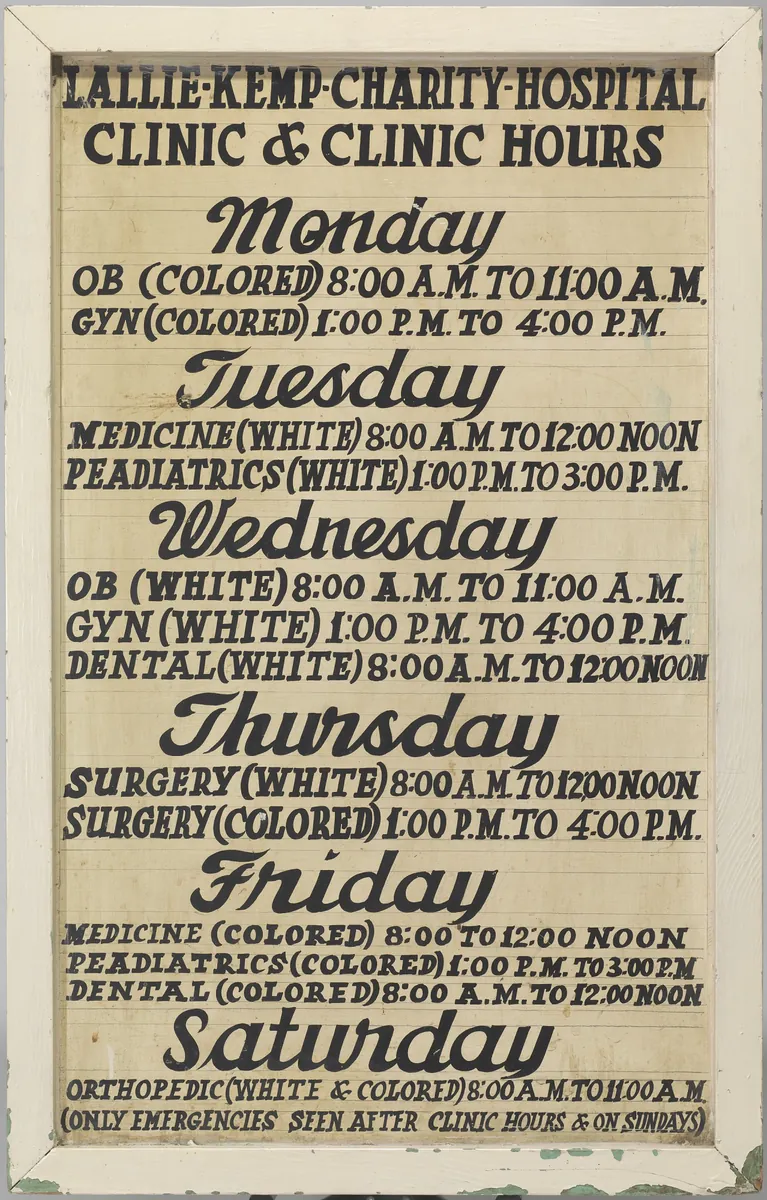
A French sailor named Jean Louis died in New Orleans and left his estate to build a hospital for anyone who needed it, regardless of whether they could pay. The city opened Charity Hospital on May 10, 1736, eighteen years after New Orleans itself was founded. Only Bellevue in New York is older by about a month. New Orleans was a French colony then, a strategic river bend chosen by governor Bienville to control the Mississippi Valley and the trade route between the river and Lake Pontchartrain. The city needed a hospital almost as soon as it had people.
Charity outgrew five buildings over two centuries. Fire, yellow fever, floods—the hospital kept moving, kept opening. By the 1850s it held a thousand beds, more than the Hôtel-Dieu in Paris. The Medical College of Louisiana was founded in 1834, using various locations including Charity Hospital. In 1843 the medical faculty agreed to care for Charity's patients free of charge for ten years, a tradition that continued into the 1960s. When Louisiana State University established its medical school in 1931, it built directly adjacent to the hospital on Tulane Avenue.
The current Art Deco building went up in 1939, designed by Weiss, Dreyfous & Seiferth, the same architects who built the state capitol in Baton Rouge. It was the second-largest hospital in the United States at the time, with 2,680 beds. The mechanical engineer Karl von Terzaghi inspected it and determined it was sinking at a rate of 1⅛ inches per year. The building features stone bas-reliefs and a cast-aluminum screen called *Louisiana at Work and Play* by Enrique Alférez. By 2005, Charity served one of the largest populations of uninsured citizens in the country and operated the nation's second-ranked Level I Trauma Center.
Hurricane Katrina flooded the basement and destroyed the electrical systems in 2005. Patients were ferried out through high water, then evacuated by helicopter from the roof of Tulane Hospital. Toilets backed up, essential supplies ran out, temperatures rose above a hundred degrees. Staff hand-pumped ventilators and used IV fluids to feed each other after food was gone. The evacuation was halted at one point by reports of sniper fire. Eight patients died, mostly from the ICU. Three weeks after Katrina, Governor Kathleen Blanco announced that Charity Hospital would not reopen.
The Louisiana State University System, which owned the building, chose not to restore it. A 2012 study by the architectural firm RMJM Hillier found the Art Deco structure sound and architecturally exceptional—"ahead of its time"—and determined that rehabilitation would be the fastest, most cost-effective way to return a teaching hospital to New Orleans. LSU chose instead to build a new $1.1 billion medical center in Mid-City, which opened in 2015 as University Medical Center New Orleans.
The closure remains one of the most contested decisions in post-Katrina New Orleans. The building sat empty for nearly two decades. In 2019, LSU approved a redevelopment plan to convert it into housing, retail, and offices, with Tulane University as the main tenant. That project stalled during the COVID-19 pandemic. In February 2025, Tulane announced it remains committed to the plan, with completion expected in 2027.
- ·Charity Hospital operated for 268 years (1736–2005), the second-oldest continuously operating hospital in the U.S.
- ·Founded by a French sailor's bequest; served anyone regardless of ability to pay.
- ·The current Art Deco building was completed in 1939 — one of the largest hospitals in the South.
- ·Hurricane Katrina flooded the basement and destroyed electrical systems in 2005; the hospital never reopened.
- ·The building sat empty for nearly two decades before redevelopment began converting it to mixed use.
- ·The closure remains one of the most contested decisions in post-Katrina New Orleans.
Memories
Editorial content compiled with AI assistance. Place details verified against public records.