Bernard de Marigny was twenty-one when he subdivided his family's plantation downriver of the old city limits in 1806. He was a Creole aristocrat, real estate developer, and politician — and the man who introduced the dice game craps to America, which he learned from enslaved people and taught to the city. The lots sold so quickly he extended the development four years later. Sales accelerated in 1831 when the Pontchartrain Railroad began running down the center of Elysian Fields Avenue, the wide boulevard he named after the Champs-Élysées in Paris and designed as the faubourg's main street. It was the first street in the New Orleans area to extend directly from the riverfront to Lake Pontchartrain 8 kilometers away.
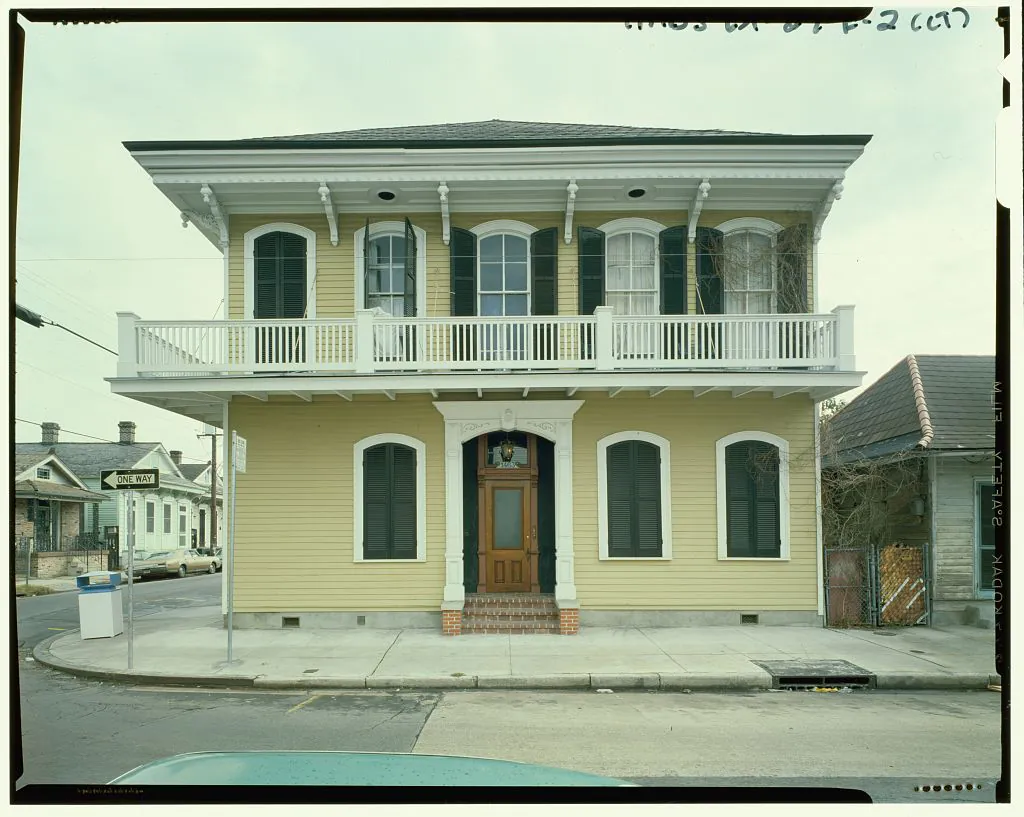
The area was settled primarily by Louisiana Creoles of color and German immigrants between the 1830s and 1880s. The architecture borrows from the colonial French and Spanish with elements of the Caribbean — Creole cottages and shotgun houses line the avenues under longstanding oaks. Ferdinand LaMothe, better known as Jelly Roll Morton, would sneak away from his upright Creole grandmother's home, just off Elysian Fields Avenue, to play piano in the red light district of Storyville. Sidney Bechet, Manny Perez, Danny Barker, and Paul Barbarin all made their homes here.
The neighborhood declined badly in the mid-20th century. The area around Washington Square was nicknamed "Little Angola" after the prison. Profiteering related to the 1984 World's Fair drove many long-term French Quarter residents into the Marigny, and Frenchmen Street became one of the city's premier locations for live music venues when musicians priced out of the Quarter moved here in the 1990s. The New Marigny Historic District was added to the National Register of Historic Places in 1994.
Hurricane Katrina had a less severe aftermath here than in most of New Orleans. The section on the Mississippi River side of Rampart experienced some wind damage, but it was at a high enough elevation to escape the great flood. The lower-lying areas of New Marigny flooded, but not as deeply as elsewhere. Many of the 19th-century-style raised houses were elevated enough that flood waters did not do significant damage. The area rebounded quickly after reopening.
Walk from the French Quarter. The district is bounded roughly by Esplanade Avenue, the river, the railroad tracks along Homer Plessy Way, and St. Claude Avenue. You're here for what was built and what endured — one of the most intact 19th-century residential neighborhoods in New Orleans, where the music moved when the Quarter became unaffordable.
- ·Named for Bernard de Marigny, the Creole aristocrat who subdivided his family's plantation in 1806 at age 21.
- ·Marigny introduced the dice game craps to America — he learned it from enslaved people and taught it to the city.
- ·One of the most intact 19th-century residential neighborhoods in New Orleans, with Creole cottages, shotgun doubles, and corner stores.
- ·Listed on the National Register of Historic Places as a historic district.
- ·The neighborhood became the city's live music hub when musicians priced out of the French Quarter moved to Frenchmen Street in the 1990s.
- ·Bounded roughly by Esplanade Ave, the river, Press St, and St. Claude Ave. Walkable from the French Quarter.
Memories
Editorial content compiled with AI assistance. Place details verified against public records.