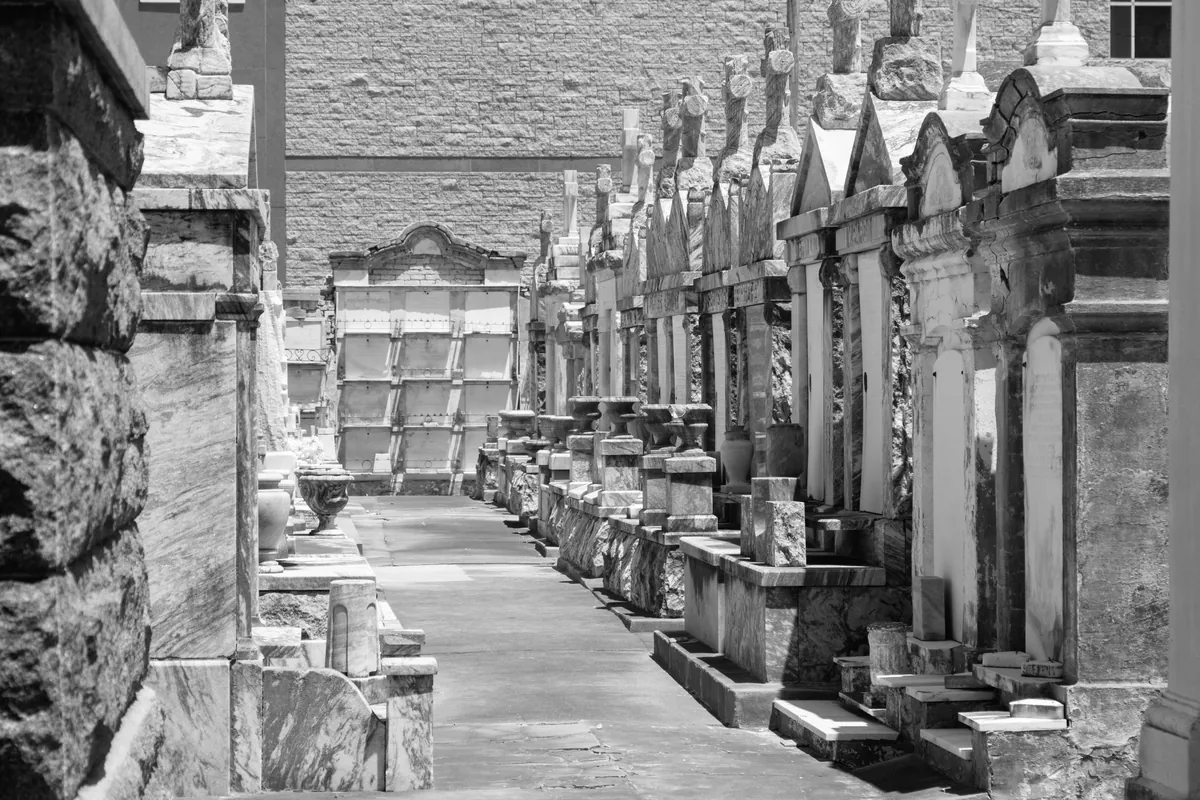
The tombs here have been stacked since 1854, tight enough that the pathways between them barely admit a single person. Irish, German, Italian, and Creole names appear on above-ground vaults — a cross-section of the Bywater's immigrant history, pressed into a few acres on Louisa Street.
The vaults sit above ground because the dead can't be buried in a city built on Mississippi River silt where the water table sits high and floods come. This is New Orleans tradition, born of necessity: you seal the coffin in stone and marble, not earth.
St. Vincent de Paul is one of the most intimate and least-visited cemeteries in the city. Small. Dense. Catholic. It still accepts burials. The density means you walk single-file between generations, close enough to read the names worn into the marble, to see how many came from somewhere else and ended here.
Open daily. Free. The kind of place that rewards twenty minutes of attention — not for famous names or monumental architecture, but for the accumulated fact of who came, who stayed, who got a vault with their name on it in a neighborhood that's always been a landing place.
- ·A small, dense Catholic cemetery in the Bywater accepting burials since 1854.
- ·Holds a cross-section of the neighborhood's immigrant history — Irish, German, Italian, and Creole names on tightly packed tombs.
- ·Pathways between tombs barely admit a single person.
- ·Above-ground vaults follow the New Orleans tradition born of the high water table — you don't bury the dead underground in a city that floods.
- ·One of the most intimate and least-visited cemeteries in the city.
- ·Located on Louisa St in the Bywater. Open daily. Free.
Memories
Editorial content compiled with AI assistance. Place details verified against public records.