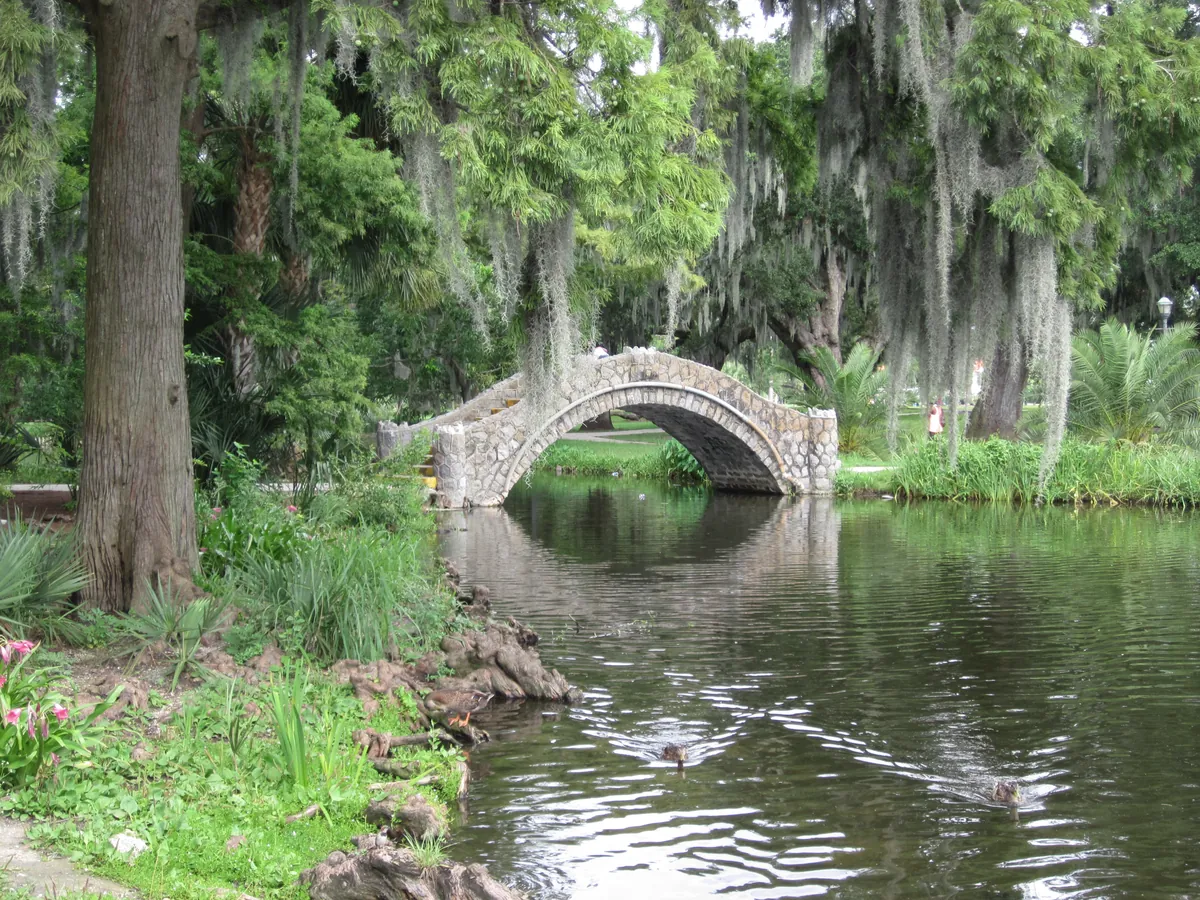
The land came to the city in 1850 through John McDonogh's will — the Allard Plantation turned into public ground along the remains of Bayou Metairie. A court pronounced it a park in 1854. Now it stretches across 1,300 acres, fifty percent larger than Central Park, and holds the world's largest collection of mature live oak trees, some more than 600 years old.
In the 1800s, men settled questions of honor under the oaks. In 1805, Micajah Green Lewis — Gov. William C.C. Claiborne's private secretary and brother-in-law — was killed by Robert Sterry in one such affair. There were originally two dueling oaks; one was lost in a hurricane in 1949. The city stationed a surgeon nearby on weekends. By 1890, dueling was outlawed. The surviving oak still stands where Dueling Oaks Drive meets Dreyfous Drive.
The mule-driven carousel opened in 1897 and went mechanical in 1906. The Peristyle went up in 1907. The Isaac Delgado Museum of Art — later renamed the New Orleans Museum of Art — opened in 1911. In the 1930s the park expanded with a twelve-million-dollar grant from the Works Progress Administration. The WPA installed sculptures by artist Enrique Alférez, laid roads and bridges, and built electrical and plumbing infrastructure still serving the park when Katrina struck. The Beatles performed in Tad Gormley Stadium in 1964. Tickets cost five dollars.
Until 1958, two years after Storyland opened, all park amenities were restricted to white residents. African American children and families were banned from entering.
Hurricane Katrina in August 2005 did forty-three million dollars in damage. Winds toppled an estimated 1,000 trees. Ninety-five percent of the park flooded with one to ten feet of water that remained for two to four weeks. The park lost approximately 2,000 trees total after Katrina and the federal levee failures. About 75,000 local and national volunteers assisted in repair projects that began in 2005. The replanting became one of the largest urban reforestation projects in American history.
The park holds the New Orleans Museum of Art, the Botanical Garden, Storyland, and the Besthoff Sculpture Garden. It is largely self-supporting, with most of its annual budget derived from user fees and donations. Open daily. Free to enter.
- ·1,300 acres of live oaks, lagoons, and Spanish moss — one of the oldest urban parks in the South.
- ·The Dueling Oaks near the entrance saw so many affairs of honor in the 1800s that the city stationed a surgeon nearby on weekends.
- ·Katrina submerged the park under eight feet of saltwater and killed over 2,000 trees.
- ·The replanting effort became one of the largest urban reforestation projects in American history.
- ·Holds NOMA, the Botanical Garden, Storyland, and the Besthoff Sculpture Garden.
- ·Open daily. Free to enter.
Memories
Editorial content compiled with AI assistance. Place details verified against public records.