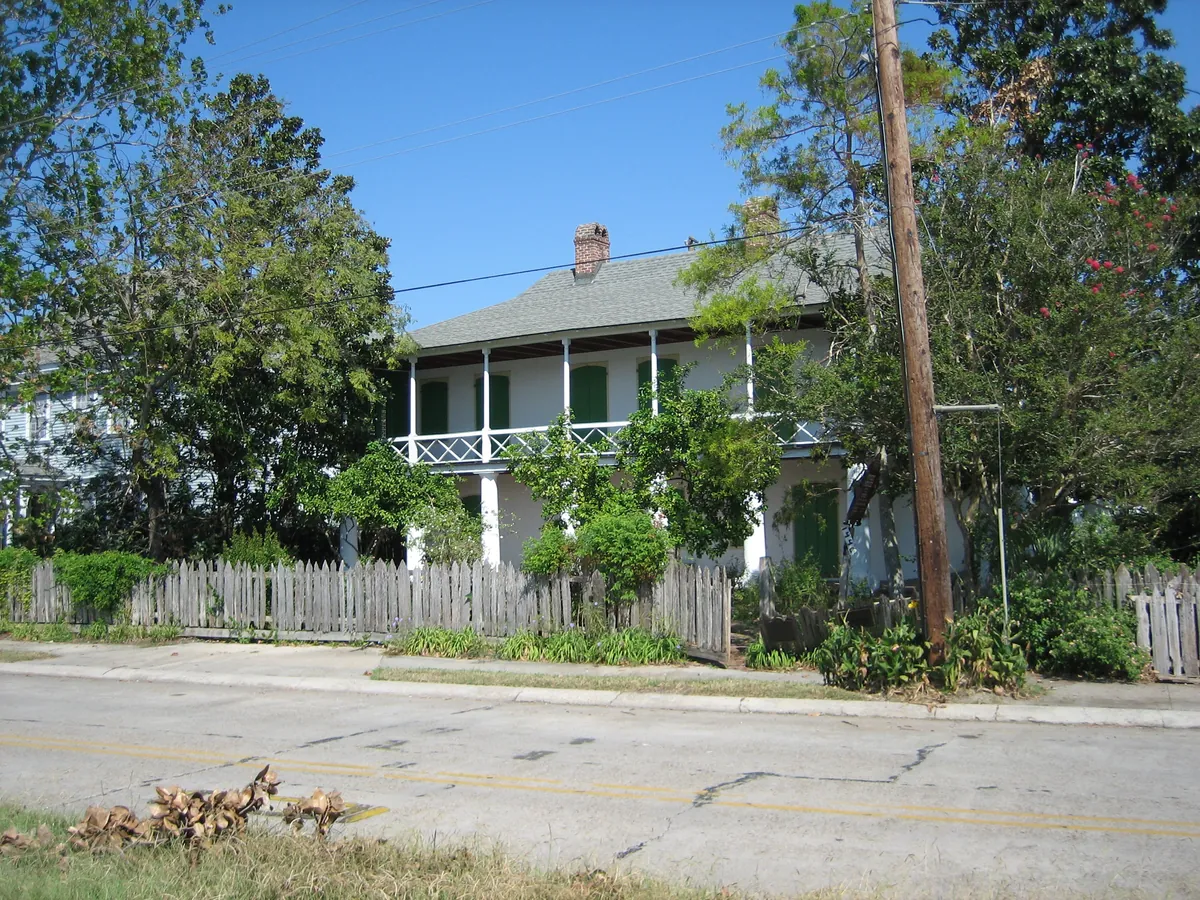
New Orleans exists because the Native Americans who lived here first mapped a portage route between Bayou St. John and the Mississippi River — a trading shortcut that let boats dodge a hundred-mile run downstream to reach the Gulf. Bienville chose this bend of the river in 1718 for exactly that reason: the bayou route gave him a back door to the port at Biloxi. The house standing at 1440 Moss Street, built in 1799 by Spanish colonial official Don Bartólome Bosque, sits within yards of that original portage crossing. This is where the city became possible.
The structure is what survival looked like in a hot, wet, flood-prone delta. A double-pitched hipped roof. Plaster-covered brick-between-post construction — wooden posts carry the structural load, brick insulates, plaster seals against rot and dampness. Madame Rillieux, Edgar Degas' great-grandmother, owned it from 1805 to 1810 and enclosed the ground floor with soft brick masonry walls. She added the southern gallery. James Pitot, the first American mayor of incorporated New Orleans, bought it in 1810 and lived here until 1819. He was born in France, arrived in the city in 1796, and served as mayor from 1804 to 1805.
The design is ensuite — no hallways, an outdoor stairway, doors positioned across from each other to move air through. Galleries on both levels keep sun off the walls and create outdoor breezeways. The gallery, back loggia, and sleeping porch were used for entertaining, dining, and sleeping, all fitted with shutters. The bottom floor has brick pavers originally caulked with a dry mix of sand and lime so floodwater could pass through and drain. Hurricane Katrina proved the logic of that choice.
Inside are American and Louisiana antiques from the early 19th century, none original to the house except a portrait of Sophie Gabrielle, James Pitot's daughter. The Louisiana Landmarks Society saved the building from demolition in 1964, moved it several blocks, and restored it. The parterre garden — designed to be viewed from the gallery above — grows plants traditional to the period: indigenous flowers, citrus trees, perennials, bulbs, antique roses, camellias, herbs, and vegetables. The house is listed on the National Register of Historic Places. It's open for tours. Small admission fee.
- ·The only surviving French colonial-era house on Bayou St. John — built around 1799.
- ·West Indies raised-cottage style with galleries on three sides and a foundation designed to let floodwater pass underneath.
- ·James Pitot, the first American mayor of incorporated New Orleans, bought the house in 1810.
- ·Restored and furnished with period Louisiana and French colonial pieces.
- ·Located at the bayou's edge exactly where Bienville's portage route made the city possible.
- ·Open for tours. Small admission fee.
Memories
Editorial content compiled with AI assistance. Place details verified against public records.