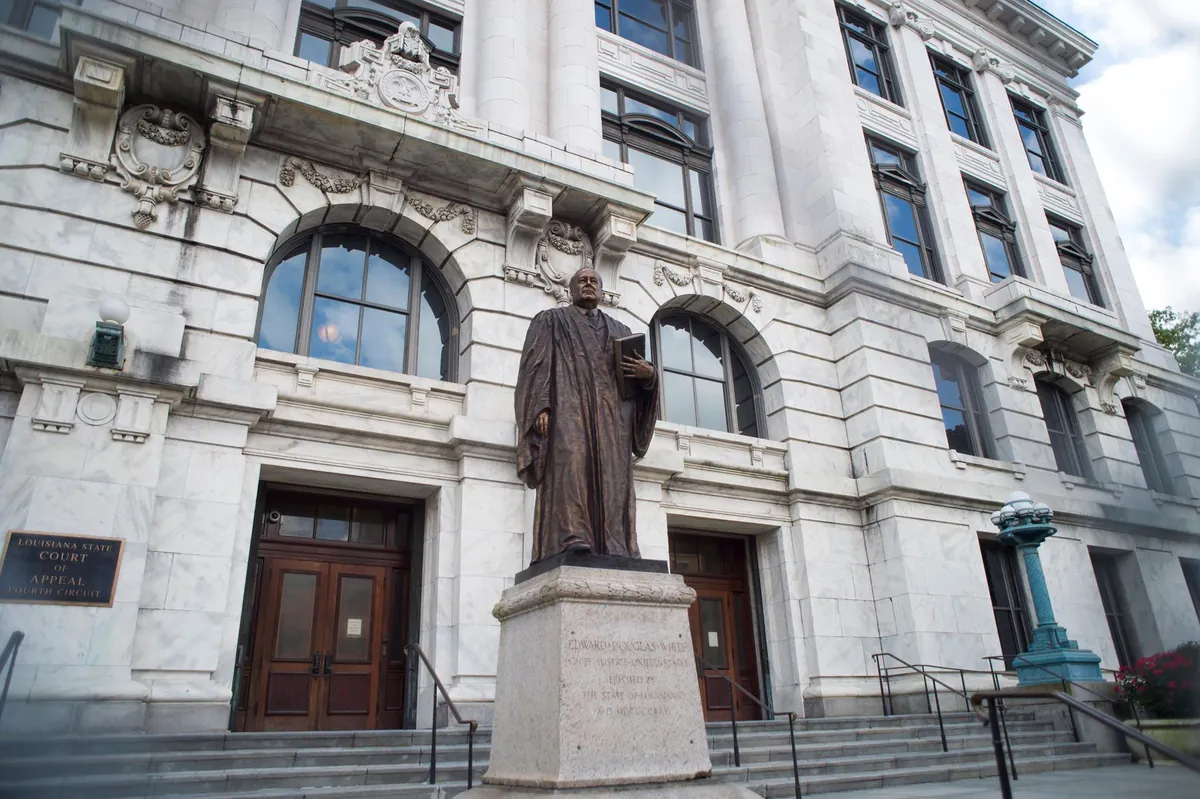
The courtroom that heard civil rights cases during Jim Crow is now a hotel lobby with marble floors. Louisiana's Supreme Court sat at 400 Royal Street from 1910 to 1958, a Beaux-Arts building in the French Quarter where some of the most consequential civil rights cases in Louisiana were decided. After the court moved to the CBD, the building sat empty for decades before restoration.
The grand staircase is still there. So is the lobby, open to visitors during business hours for free. The building now houses a hotel and event spaces, but the public areas remain preserved—marble underfoot, the architecture of authority visible in a place where authority once did its work during a hard period of the state's history. You can walk through rooms that witnessed decisions, stand in a space where Louisiana law was argued and rendered.
The physical fact of preservation matters here. Many courthouses from this era were torn down or remodeled past recognition. This one survived abandonment and came back with its bones intact. If you want to understand how New Orleans holds onto its past—sometimes by accident, sometimes by will—walk into a lobby that used to be the seat of the state's highest court and is now the entrance to someone's weekend.
- ·Beaux-Arts courthouse at 400 Royal Street, seat of the Louisiana Supreme Court from 1910 to 1958.
- ·Some of the most consequential civil rights cases in Louisiana were decided in this building during the Jim Crow era.
- ·After the court moved to the CBD, the building sat empty for decades before a major restoration.
- ·The marble-floored lobby and grand staircase are open to visitors.
- ·The building now houses a hotel and event spaces alongside the preserved public areas.
- ·Free to enter the lobby during business hours.
Memories
Editorial content compiled with AI assistance. Place details verified against public records.