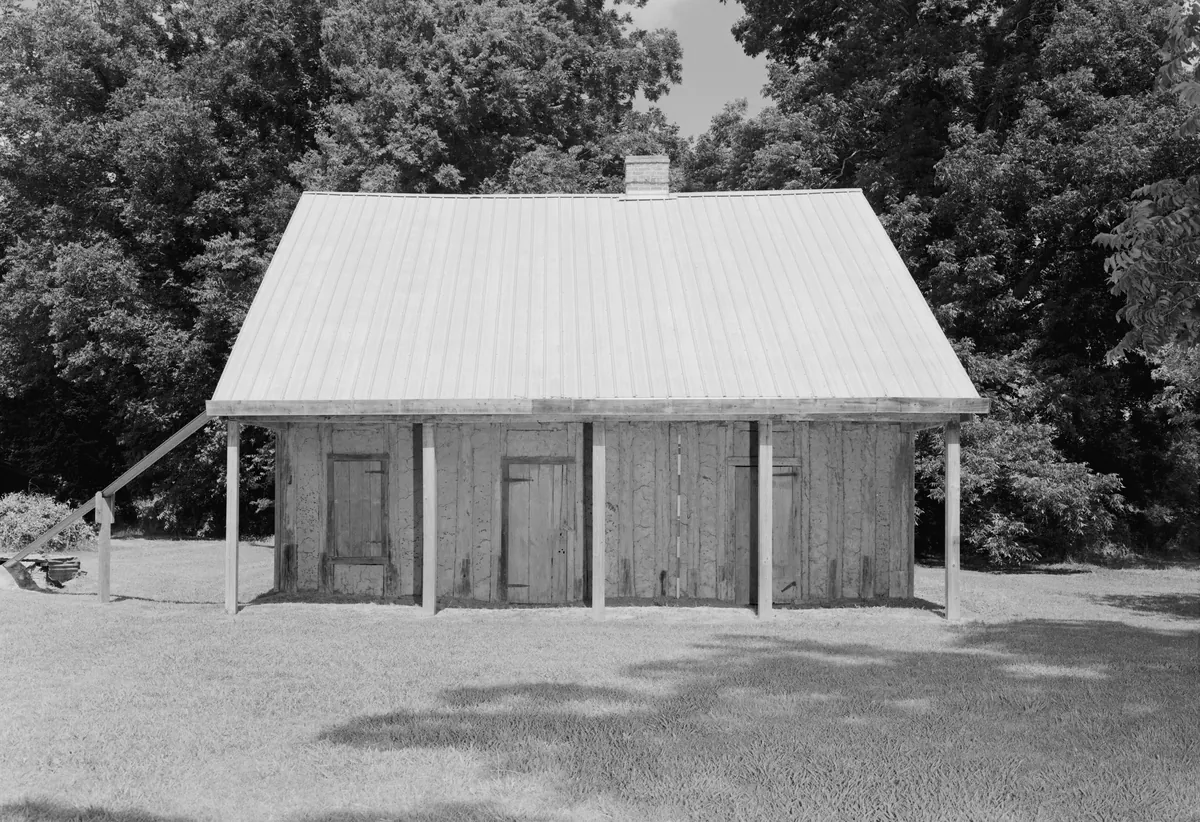
The walls went up in 1803 on Isle Brevelle, built by Yves Pacale -- a free man of color who used his skill as a carpenter to buy freedom for himself, his wife, and his daughter. He built the house on his own land using bousillage entre poteaux: mud and moss packed between hand-hewn cypress posts, a technique carried here from the Caribbean and adapted to a French-then-Spanish colony 76 years after Louis Juchereau de St. Denis established Natchitoches as a trading outpost with Spanish-controlled Mexico. The Roque House is one of the oldest standing structures in the Natchitoches Historic Landmark District.
When the Red River shifted course, it bypassed Natchitoches and cut off its lucrative connection to the Mississippi River, leaving a 33-mile oxbow lake in its place -- now called Cane River Lake. In 1967, preservationists moved the Roque House from Isle Brevelle to the Natchitoches riverbank to save it. It now stands on the Cane River lakefront near Front Street, part of the heritage trail.
Exterior viewing only. Free. You're looking at walls a free man built with his own hands to prove he owned them -- mud, moss, and cypress, still standing.
- ·Built c. 1790 using bousillage entre poteaux — mud-and-moss infill between hand-hewn cypress posts.
- ·One of the oldest standing structures in the Natchitoches Historic Landmark District.
- ·Relocated to the riverbank in the 1960s for preservation; now part of the heritage trail.
- ·Demonstrates the French Creole building technique imported from the Caribbean and adapted to Louisiana.
- ·Exterior viewing only. Free. Located on the Cane River lakefront near Front Street.
Memories
Editorial content compiled with AI assistance. Place details verified against public records.