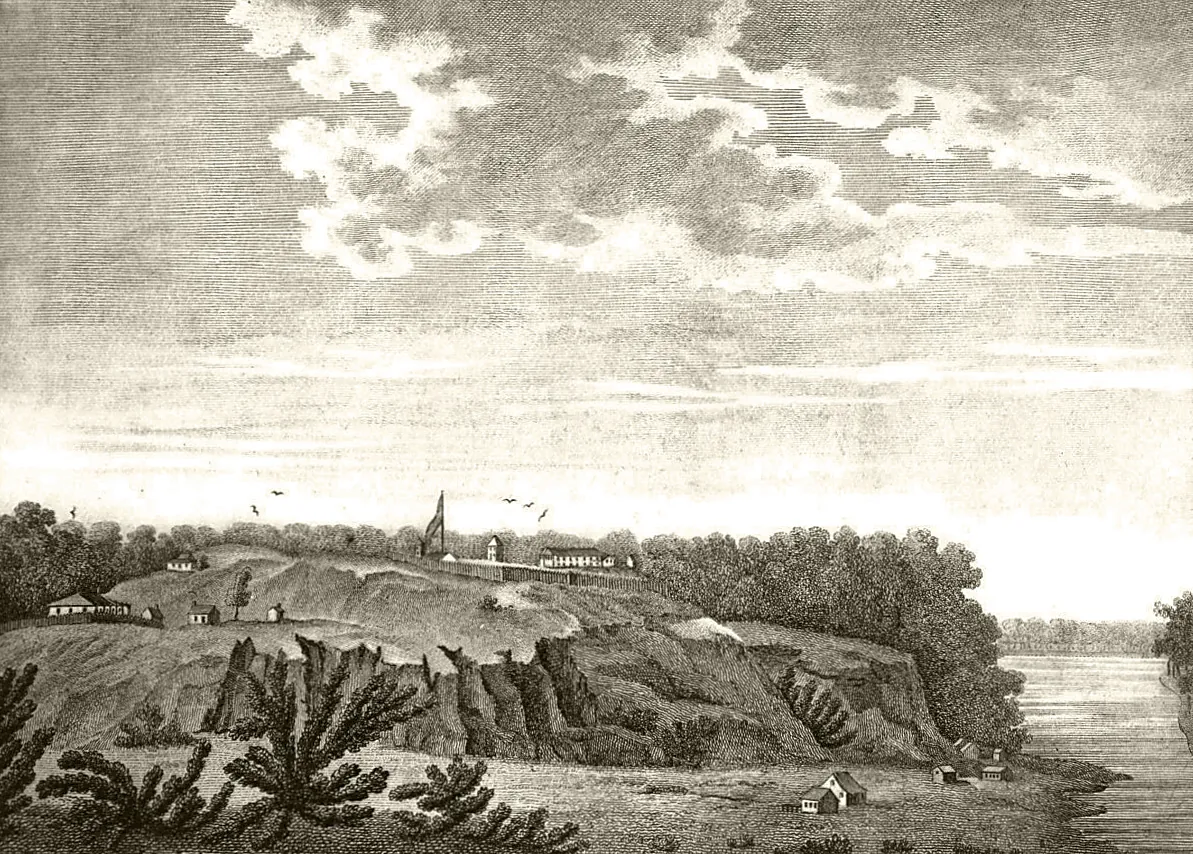
The French built Fort Rosalie in 1716 on a bluff above the Mississippi River — the founding act of what became Natchez. The fort sat close to the main Natchez settlement of Grand Village. Under the peace terms ending the First Natchez War, Jean-Baptiste Le Moyne de Bienville required the Natchez themselves to provide materials and labor for its construction. French settlements and tobacco plantations spread into Natchez territory, with the fort serving as the local seat of colonial government and the primary French stronghold and trading post among the Natchez.
On November 29, 1729, the Natchez attacked in a coordinated assault, destroying the entire French settlement and seizing the fort. They killed nearly all the men — 229 French colonists in total, the largest death toll by an Indian attack in Mississippi's history — and took hundreds of women and children captive. French and allied Choctaw forces retaliated in early 1730, forcing the Natchez to evacuate and leaving the fort in ruins. The French continued to war with the Natchez through 1731, killing, capturing, or dispersing most of them until they ceased to exist as a tribe. The French sold many surviving Natchez into slavery, many destined for French plantations in the Caribbean. Some escaped and found refuge among the Chickasaw, Creek, and Cherokee. The French rebuilt Fort Rosalie in the early 1730s.
Following the Treaty of Paris in 1763, the fort passed to British control and was renamed Fort Panmure, after William Maule, Earl of Panmure. After Bernardo de Galvez conquered Baton Rouge in 1779, Fort Panmure capitulated without further Spanish action. Spain held the fort from 1779 to 1798. The United States took over in 1798, establishing the Mississippi Territory with Natchez as its first territorial capital. The U.S. abandoned the fort in 1804.
The site is now part of Natchez National Historical Park, open daily and free. The bluff overlook offers one of the best Mississippi River views in the state.
- ·Built 1716 by the French as a Mississippi River chokepoint — the founding act of Natchez.
- ·In 1729 the Natchez people attacked and killed over 200 French colonists at this site.
- ·The French retaliation scattered the Natchez nation — one of the last mound-building cultures.
- ·The site flew four flags: France, Britain, Spain, and the United States.
- ·Part of Natchez National Historical Park since its establishment.
- ·Open daily, free. Bluff overlook offers one of the best Mississippi River views in the state.
Memories
Editorial content compiled with AI assistance. Place details verified against public records.