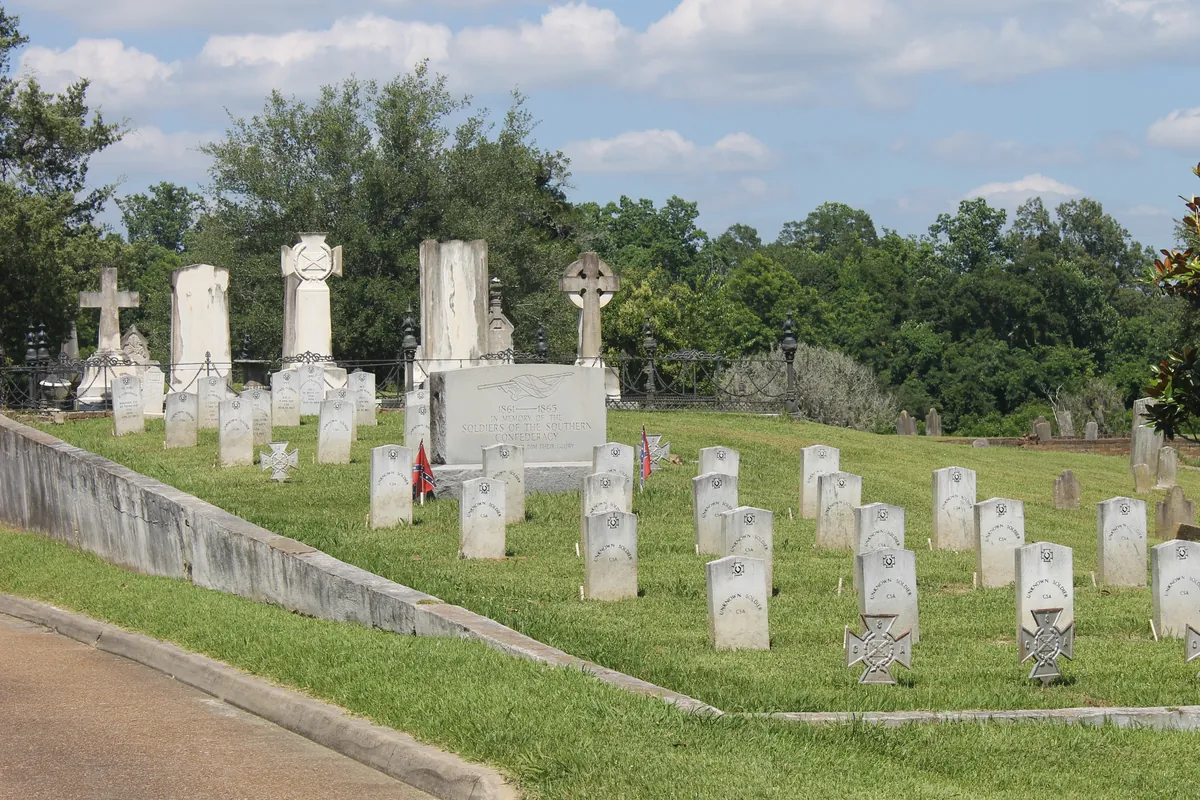
The year Natchez lost its claim as Mississippi's capital, 1822, it opened a cemetery on a ten-acre bluff over the river. The ironwork and marble that followed — cast-iron fencing, Victorian monuments, marble angels crowding the hillside — record exactly who held the money and who was permitted to be remembered. The unmarked enslaved burials are here, unnamed.
The Turning Angel statue marks five young women killed in a 1908 drug company explosion. As you drive past, the statue appears to rotate — an optical illusion of geometry and motion that has never stopped anyone from slowing down to watch.
Florence Irene Ford died in 1871 at age ten. Her mother had a staircase built down to the coffin with a glass window, so she could comfort her daughter during thunderstorms. The staircase remains, glass intact. Grief that exceeds all proportion becomes architecture.
Open daily dawn to dusk, free. Self-guided walking tour brochures at the gate. The collection of 19th-century funerary art rivals any cemetery in the South. Listed on the National Register of Historic Places. Go to see what planter wealth bought, and to reckon with what it tried to bury.
- ·Established 1822 on a ten-acre bluff overlooking the Mississippi River.
- ·Outstanding collection of 19th-century ironwork and marble funerary art.
- ·The Turning Angel statue appears to rotate as you drive past — a monument to five young women killed in a 1908 drug company explosion.
- ·The grave of Florence Irene Ford (d. 1871, age 10) has a staircase built down to her coffin with a glass window — her mother wanted to comfort her during thunderstorms.
- ·Notable for both what it shows (planter wealth) and what it hides (unmarked enslaved burials).
- ·Listed on the National Register of Historic Places.
- ·Open daily dawn to dusk, free. Self-guided walking tour brochures available at the gate.
Memories
Editorial content compiled with AI assistance. Place details verified against public records.