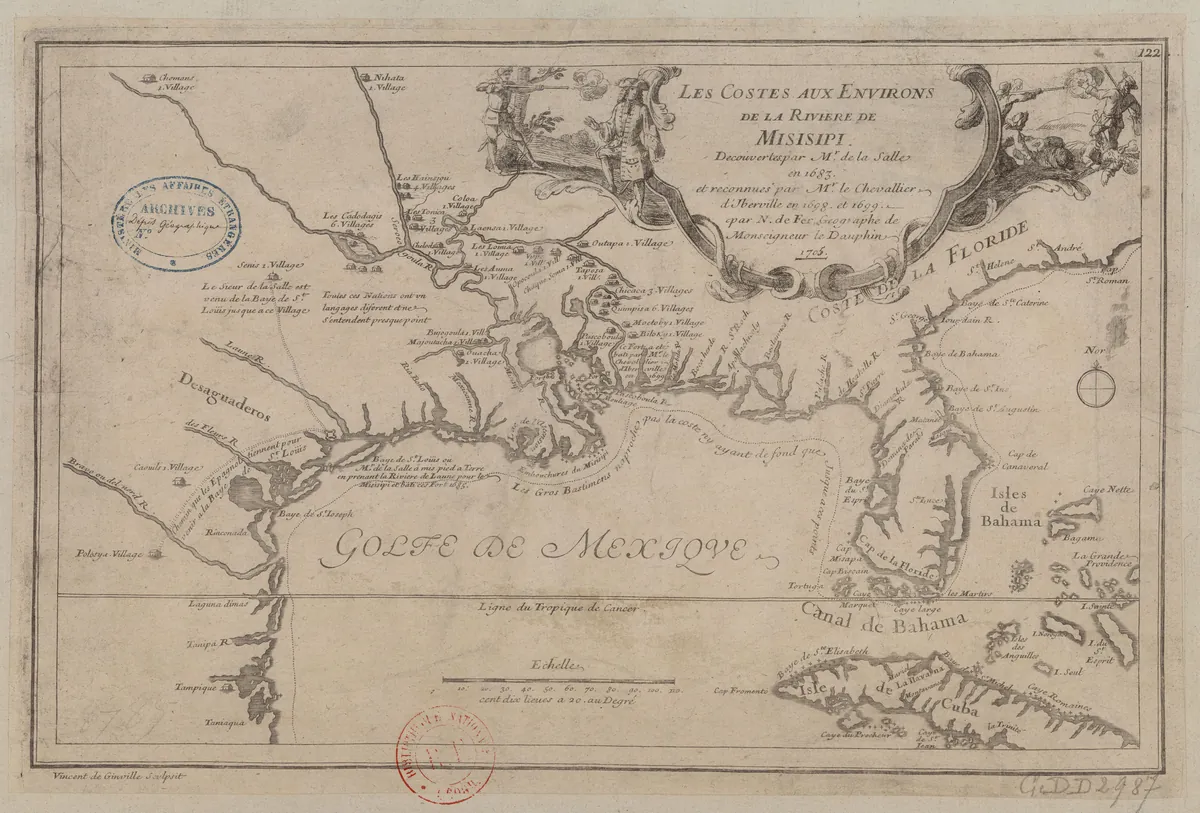
Before Biloxi was a resort city or a casino coast or a hurricane story, it was a people. The French transliterated the name in 1699 — "Bilocci," then Biloxi — from the word the Tanêks used for themselves. The meaning is debated. The fact is not: the Gulf Coast city carries the name of the nation that was here first.
The Biloxi were Siouan speakers, a linguistic family associated with the Great Plains, not the Mississippi Sound. How a Siouan people ended up on the Gulf Coast is not fully understood. When Pierre Le Moyne d'Iberville arrived to establish France's Louisiana colony in 1699, he found them fishing year-round, cultivating maize and squash, hunting deer and bison. He also found a deserted village — cabins of mud with bark roofs, abandoned two years prior after a smallpox epidemic decimated the population. The Biloxi had no immunity. The disease was likely contracted from other peoples already in contact with Europeans.
The Biloxi were descendants of the mound-building Mississippian culture. Their society was stratified, ruled by a figure called the Yaaxitąąyą — "Great Sacred One" — with a cadre of lesser nobles. Political rulers also served as shamans. The bodies of deceased chiefs were dried in fire and smoke, then placed upright on red poles inside a temple. Food was offered daily by visitors.
Men wore deerskin breechcloths and garments made from bear, deer, panther, beaver, otter, and bison skins. Women processed and sewed the hides into clothing, moccasins, and leggings. The Biloxi made tools from bison and deer horn, wore ornaments of cut seashells, and some bore facial tattoos and nose- or earrings.
By the nineteenth century, the Biloxi had migrated west. One village existed along the Red River in 1806, another on Lake Ayovelles. Twenty families settled along the Neches River in Texas in 1828. Military confrontations with Texas were recorded, including a battle in the Guadalupe valley in 1839. A camp on the Little River was reported in 1846 — among the last mentions of a Biloxi presence in Texas.
The survivors merged with the Caddo, Choctaw, and Tunica peoples. When ethnologist James Owen Dorsey visited them in Louisiana in 1892 and 1893, much of the tribal structure had disappeared, but they still traced descent through the maternal line. Three clans were active: Deer people, Bear people, Alligator people. Most identified as Deer. Dorsey documented more than fifty terms for kinship relations — more than any other Siouan people he had studied.
The Biloxi language died in the 1930s when the last semi-speaker, Emma Jackson, passed. Today, descendants are enrolled with the Tunica-Biloxi Indian Tribe of Louisiana, federally recognized in 1981. They speak English or French.
The name on the coast — on the signs, the casinos, the lighthouse — is theirs. The people who gave it are not.
Memories
Editorial content compiled with AI assistance. Place details verified against public records.