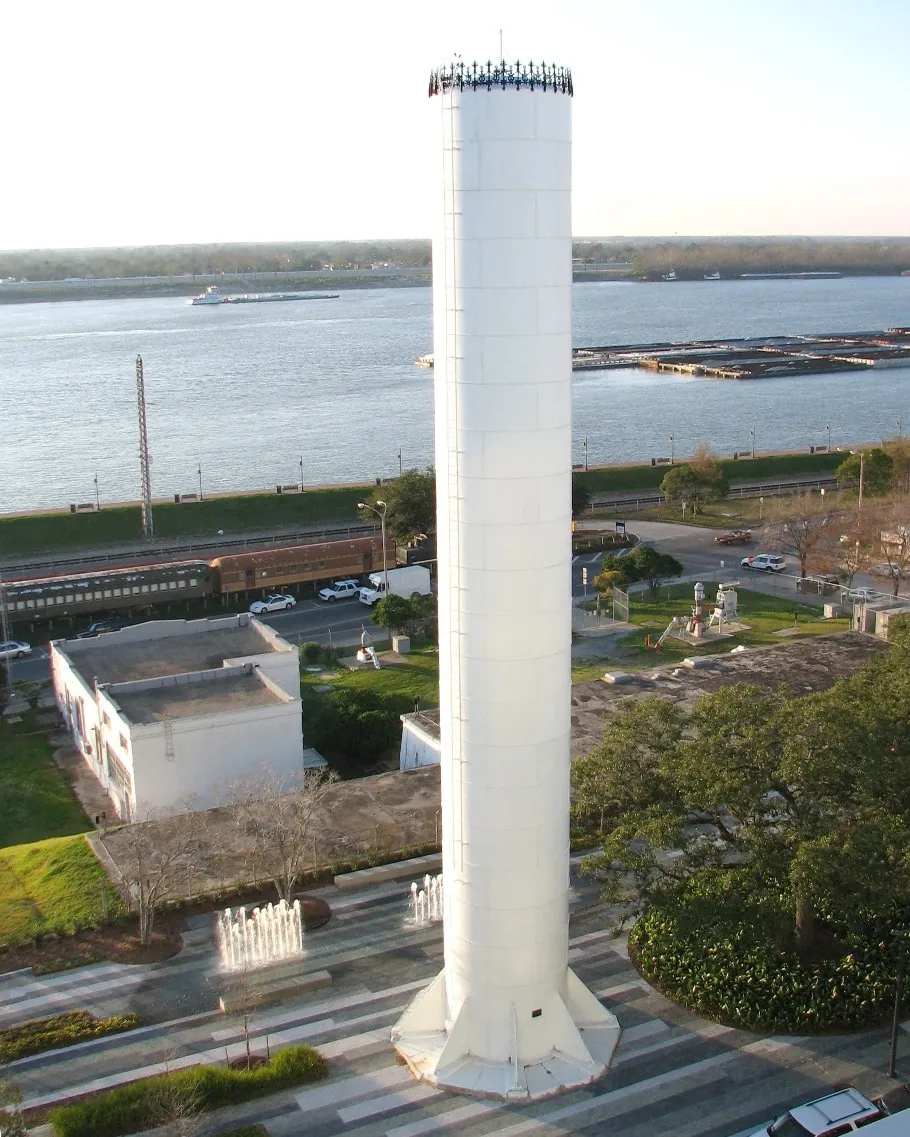
The Baton Rouge Waterworks Standpipe went up in 1888 to solve a Victorian engineering problem: how to regulate water pressure for an entire municipal distribution system. The solution was a cast-iron tower that looks like a church steeple. One of the earliest municipal water supply structures still standing on its original site in Louisiana, it earned a place on the National Register of Historic Places by doing two things at once — keeping the taps running and looking like something that belongs in the skyline.
It stands on Convention Street. You can see it from the sidewalk. The interior isn't open, but the exterior tells the story: ornate cast-iron work applied to industrial infrastructure. Victorian-era engineers built the city's water pressure regulator, and they built it to look like it belonged to the civic architecture of the time. The design outlasted the original function. What remains is the proof that utility and ornament once shared the same blueprint.
- ·Built in 1888, it is one of the earliest municipal water supply structures still standing on its original site in Louisiana.
- ·The ornate cast-iron design makes it look more like a church steeple than a piece of industrial infrastructure.
- ·Originally regulated water pressure for the city's entire distribution system — a Victorian-era engineering solution.
- ·Listed on the National Register of Historic Places.
- ·Located on Convention Street. Visible from the street; not open for interior tours.
Memories
Editorial content compiled with AI assistance. Place details verified against public records.