The French explorer Pierre Le Moyne d'Iberville stopped here in 1699 and found a red-stained cypress pole stuck in the ground, marking the boundary between two native hunting territories. He called it le bâton rouge — the red stick. The Houma and Bayougoula peoples had placed that pole. Iberville built no settlement, but the name stuck to the bluff.
The Tunica people knew this bluff country well. Their trade routes crisscrossed the river from the Red River country all the way east to what would become the Felicianas. When the French finally established a permanent post here in 1721, they were occupying land that already carried centuries of indigenous meaning.
The Spanish took Louisiana in 1769 and held it until Napoleon sold it from under them. The British had a brief claim too. Baton Rouge sat at the intersection of every colonial ambition in North America — it was the northernmost point accessible by ocean-going vessels on the Mississippi, which made it strategically essential. The Americans took formal possession in 1810 when the Republic of West Florida declared independence and was immediately annexed. By 1812, when Louisiana entered the Union, Baton Rouge was already a city.
The Civil War arrived here in 1862. Union naval forces under Admiral David Farragut steamed upriver after taking New Orleans and shelled the city into submission. The Battle of Baton Rouge in August 1862 was the last Confederate attempt to retake it — they failed. The city spent the rest of the war under Union occupation, making it one of the few Southern capitals held by Union forces for nearly the entire conflict.
Huey Long changed everything. Elected governor in 1928, he moved the state government's center of gravity to Baton Rouge by building the tallest state capitol in America — a 450-foot Art Deco tower that still defines the skyline — and funding LSU into a major research university. He was assassinated in the capitol in 1935, shot in a corridor he had built. The bullet hole is still in the marble.
Then, in June 1953, the Black community of Baton Rouge did something that had never happened in the American South. Led by Reverend T.J. Jemison of Mount Zion Baptist Church, 20,000 Black residents — who made up 80% of the bus ridership — refused to ride the city's segregated buses for eight days. They organized free car rides through their churches. The boycott was the first of its kind in American history. Two years later, when Martin Luther King Jr. was planning the Montgomery bus boycott, he called Jemison first. The free-ride system King used in Montgomery was copied directly from Baton Rouge.
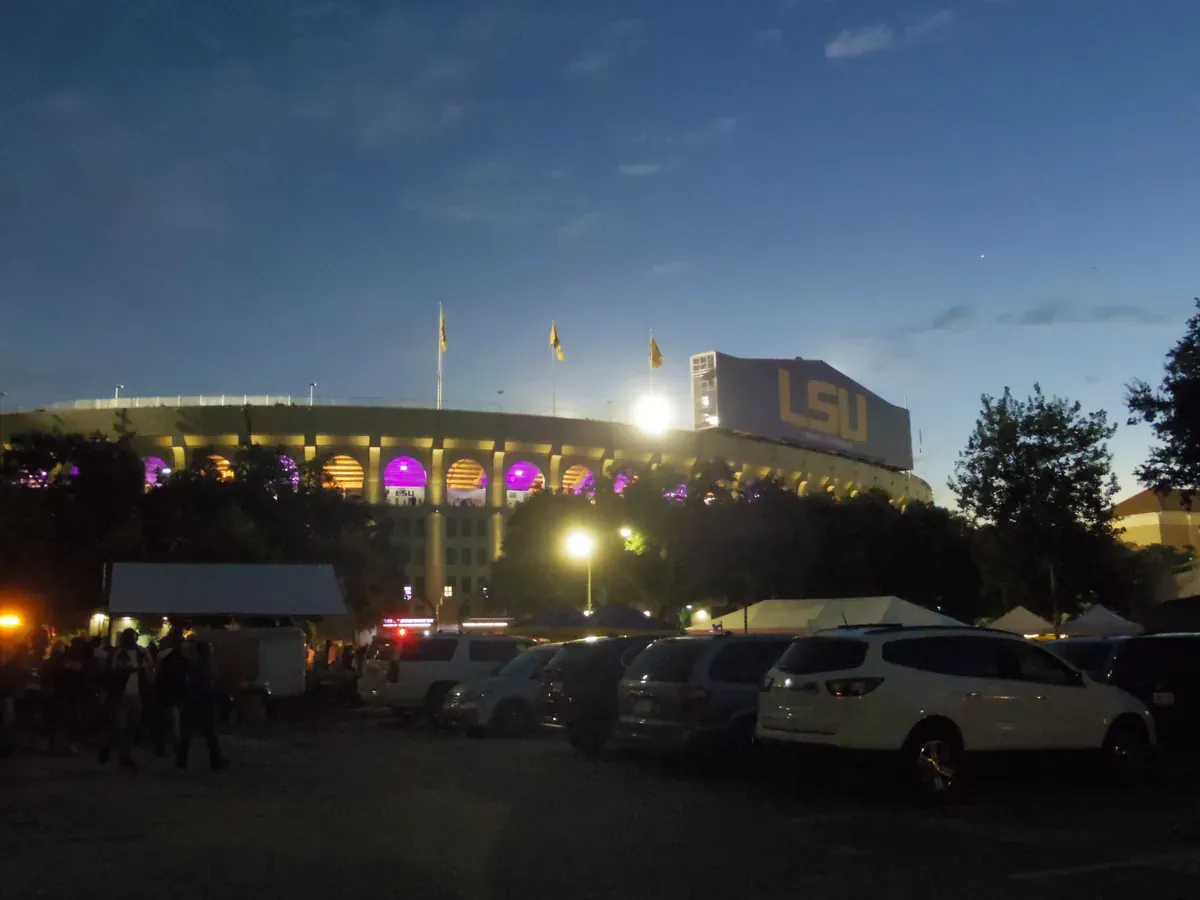
LSU built a city within the city on the bluff south of downtown — Tiger Stadium, the parade grounds, the live oaks along Highland Road. The petrochemical plants that line the river north of downtown built a different kind of prosperity, and a different set of problems. The two Baton Rouges — the university city and the industrial city, the overwhelmingly white south and the historically Black north — have coexisted in tension for generations.
What you find here is the state government, the state university, three National Historic Landmarks, and the birthplace of a tactic that shaped the Civil Rights Movement. It is a city that contains more Louisiana history than any other place except New Orleans — and tells a different part of it.