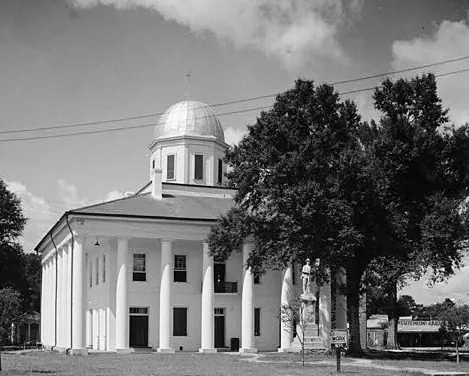
In 1840, when most of Louisiana's civic architecture was still raw-timbered and utilitarian, Clinton built itself a courthouse that could have stood in Athens. The Greek Revival building survives as one of the state's finest antebellum civic structures — columns, pediment, proportions that announce permanence. It was built to serve East Feliciana Parish, which the state legislature had carved from the original Feliciana Parish in 1824 to give residents closer access to their government seat. That original parish took its name from Marie Felicité, wife of Spanish governor Bernardo de Gálvez, who controlled the territory before American annexation.
The courthouse survived the Civil War not through luck but through repurposing: Union forces turned it into a hospital, which spared it the torch that claimed so many other Southern civic buildings. East Feliciana Parish still uses it for official business, the same function it was built for in 1840.
The real exhibit isn't just the building — it's the whole square. Clinton preserves one of the most intact 19th-century courthouse-square streetscapes in Louisiana, a rare thing in a state where hurricanes, fires, and modernization have erased most of their peers. Walk the full perimeter. The streetscape tells you what a working parish seat looked like before the Civil War, and what it means that this one still functions.
- ·The 1840 Greek Revival courthouse in Clinton is one of Louisiana's finest surviving antebellum civic buildings.
- ·It survived the Civil War intact because Union forces used it as a hospital rather than burning it.
- ·The town around it preserves one of the most intact 19th-century courthouse-square streetscapes in the state.
- ·East Feliciana Parish continues to use the building for official business.
- ·Visitor tip: walk the full square in Clinton — the streetscape is the real exhibit.
Memories
Editorial content compiled with AI assistance. Place details verified against public records.