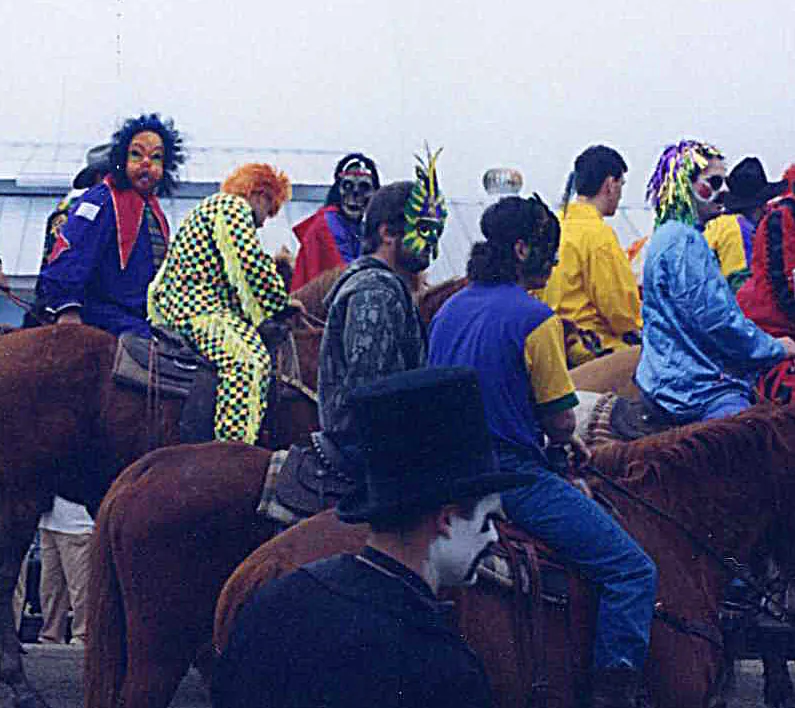
The courir de Mardi Gras is a rural Cajun tradition where disguised revelers travel by horseback, trailer, or on foot through the countryside, begging neighbors for gumbo ingredients. It descends from the fête de la quémande, a medieval French feast of begging, when disguised revelers would visit households and perform for offerings. The poor, at the end of long winters and short on food, would gather and make their way from castle to manor house to beg from the wealthy, dancing and singing in return for their generosity. French medieval carnival celebrations featured contests and races, likely the origin of the chicken chase that defines the courir today.
When Acadian settlers were forcibly deported by the English in the mid to late 18th century, many made their way to South Louisiana, settling what would become the Acadiana region. The Cajuns held on to many traditional customs, including their language, music, dances, and religious festivals such as the courir. The tradition began to fade during the 1930s and 1940s, especially during World War II when many young men who participated were away serving in the armed forces. In the late 1940s and early 1950s the tradition began to be revived, and in the 1960s got a major boost with the "Cajun renaissance," a grassroots effort to promote local food, culture, music, and language.
In early morning the riders or runners gather in a central meeting place, where Le Capitaine and his co-capitaines explain the rules and traditions that must be followed. The Capitaine usually rides on horseback, wears a cape, and carries a small flag. Traditions vary in each town — some have people on horseback, some on trailers, some on foot, and others use a variation of all three methods. The Capitaine is the first to approach houses along the route to ask permission to enter onto the property. Individual Mardi Gras attempt to sneak onto the property and are held in check by the Capitaines, who sometimes brandish a plaited burlap whip. The whips are designed to be flexible and not to inflict serious damage, but produce a loud noise for the edification of onlookers.
Once on the property, revelers play pranks on the farmers and beg for food for the communal gumbo that lies at the end of the route. A prize ingredient is a live chicken, which is usually thrown into the air for the Mardi Gras to chase through the yards and fields. The scene is genuinely medieval and genuinely joyful.
Costumes not only conceal identities but allow participants to parody authority figures and society. Celebrants wear miter hats, mortarboards, and capuchons, initially designed to mock the tall pointy hats worn by noble women. Originally the costumes were made from old work clothes decorated with cloth remnants and pieces of feed sack material, as many participants could not afford to buy material strictly for the event, leading to a patchwork style. Strips of cloth are cut into fringing and sewn onto the sleeves, up and down the legs, and on the capuchon, creating a riot of color and pattern. The masks are made by taking ordinary wire mesh window screen and attaching large protruding noses and painting on features such as eyes and mouths. Many costumes and masks include animal features like beaks, feathers, hair, fur, or tails.
Runs happen in Mamou, Church Point, Eunice, and dozens of communities around Lafayette. Each community's run has its own rules, costumes, and capitaine. Some date back over a century. In Mamou the event was suspended during the American Civil War and World War II, but by the mid-1940s was revived by Alfred "Fred" Tate, Revon Reed, and Paul Tate, proprietors of the newly opened Fred's Lounge. Go to see live chickens chased through actual yards by people in wire-screen masks wearing pointy hats that mock dead nobility — a tradition older than the country that now contains it.
- ·The courir de Mardi Gras is a rural Cajun tradition where disguised revelers travel by horseback or trailer through the countryside, begging neighbors for gumbo ingredients.
- ·The tradition descends from the fête de la quémande, a medieval French custom of socially acceptable house-to-house begging.
- ·Live chickens are donated by homeowners and must be chased and caught by revelers — a scene that is genuinely medieval and genuinely joyful.
- ·Runs happen in Mamou, Church Point, Eunice, and dozens of communities around Lafayette.
- ·The Faquetaique Courir near Lafayette is participatory — visitors can join the run.
- ·Each community's run has its own rules, costumes, and capitaine (leader). Some date back over a century.
Memories
Editorial content compiled with AI assistance. Place details verified against public records.