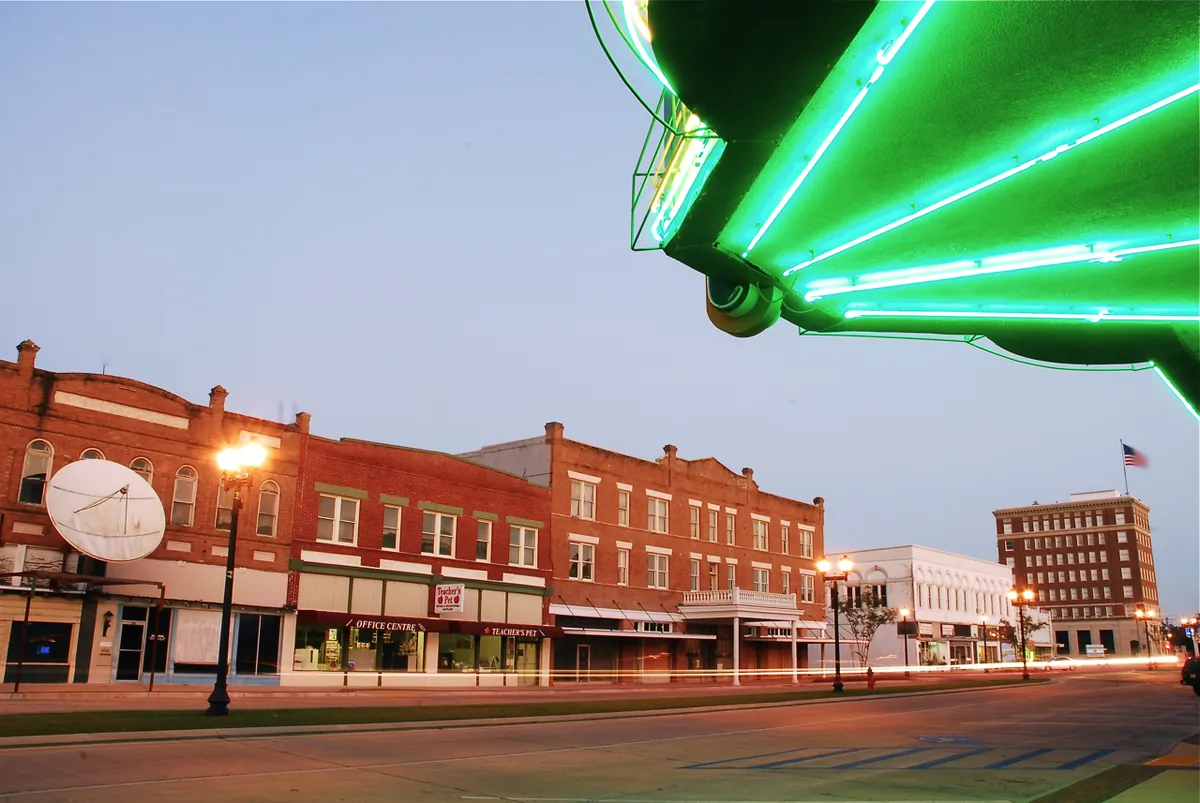
The daily newspaper that first put the word "Acadiana" in print came out of Crowley — October 15, 1946, the Crowley Daily Signal — and the district that carries that history is still here. Two hundred and ten acres, 266 buildings, constructed between 1887 and 1931, all listed on the National Register of Historic Places. Enlarged again in 2024. The only place in a seven-parish area where both the residential and commercial historic fabric survived intact.
Walk Parkerson Avenue and you walk through the whole argument: Queen Anne residences with turrets and wraparound porches, Craftsman bungalows lining the streets, and rising above the usual two- to three-story scale of everything around it, the First National Bank Building — seven stories, built in 1920, an early skyscraper by any measure that matters here. The district holds the eastern part of downtown Crowley and runs out to the residential blocks beyond it. Federal reviewers called it the largest, most complete, architecturally pretentious, and visually impressive example of a late-nineteenth to early-twentieth century town in its region. That's bureaucratic language for: what survived here didn't survive elsewhere.
Anchoring downtown is the Grand Opera House of the South, built in 1901 of virgin Louisiana cypress. Clark Gable appeared on its stage. Babe Ruth. Enrico Caruso. Huey Long. The building that held all of them is still standing.
Park anywhere on Parkerson Avenue. The district is walkable from any spot on that street. What you're moving through is not a restored block or a curated sample — it's the full fabric of a town that came up in the last years of the nineteenth century and the first third of the twentieth, and held.
- ·A 210-acre historic district listed on the National Register — 266 buildings constructed between 1887 and 1931.
- ·Designated as the largest, most complete, and most visually impressive example of a late 19th to early 20th century town in a seven-parish area.
- ·Styles range from Queen Anne residences with turrets and wraparound porches to Craftsman bungalows lining oak-shaded streets.
- ·The Grand Opera House of the South, built in 1901 of virgin Louisiana cypress, anchors downtown — Clark Gable, Babe Ruth, Enrico Caruso, and Huey Long all appeared on its stage.
- ·The only place in the region where both the residential and commercial historic fabric survived intact.
- ·Walkable from any parking spot on Parkerson Avenue.
Memories
Editorial content compiled with AI assistance. Place details verified against public records.