In 1755, the British expelled 10,000 Acadians from Nova Scotia. Roughly 3,000 found their way to Louisiana. This trip visits every major site of that story within a few miles of each other — from the NPS cultural center in Lafayette through the first settlement at the Attakapas post to the Wall of Names in St. Martinville where descendants still come to trace their family name in granite.
The route
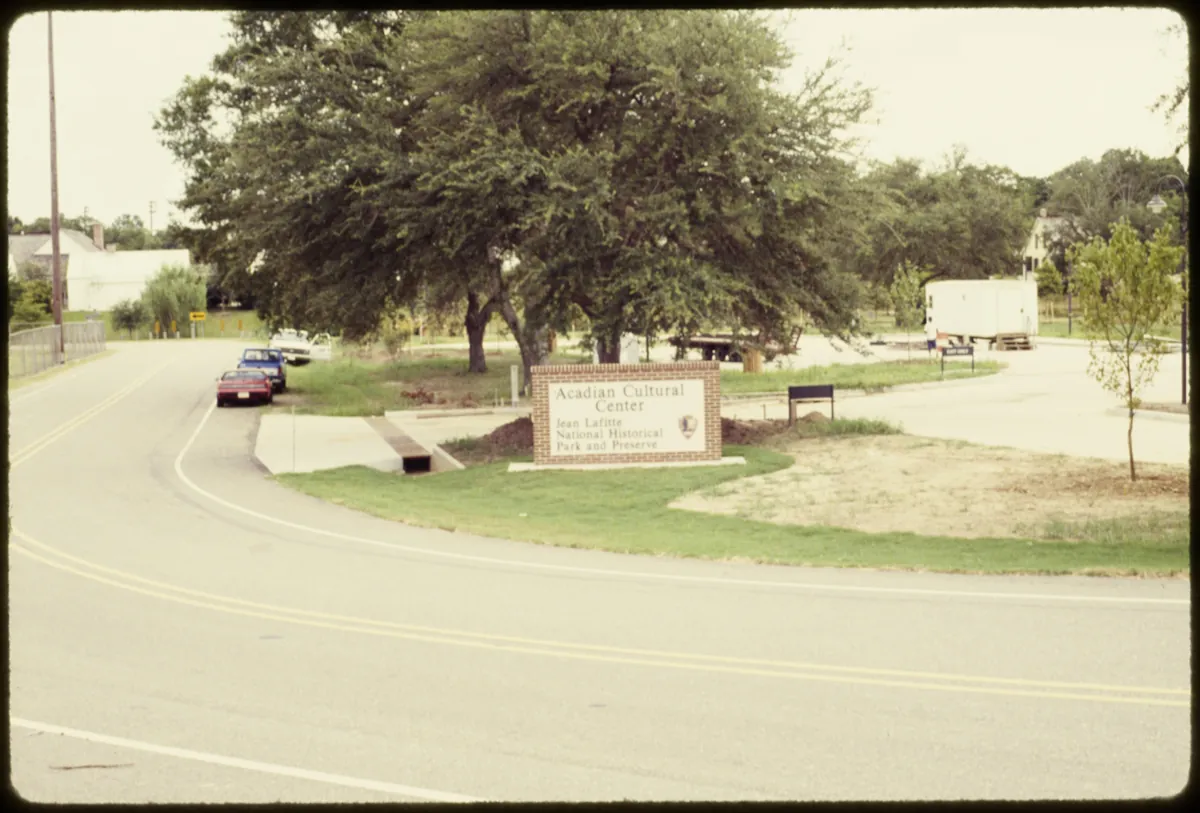 1Nature & Parks·1978Acadian Cultural Center — Jean Lafitte NPS
The National Park Service decided, in 1978, that Cajun culture mattered enough to build a park around it — not a wilderness unit with trails and peaks, but something stranger: a federal institution dedicated entirely to a living people's living culture. The Acadian Cultural Center in Lafayette is one of six scattered sites in Jean Lafitte National Historical Park and Preserve, the only NPS holding built to interpret not what happened, but what persists. The story it tells begins with forced removal. Between 1755 and 1764, the British expelled French-speaking Acadians from Canada in the aftermath of the Seven Years' War. Spain controlled Louisiana by then, and the displaced resettled here, in the wet margins of the Mississippi River Delta. Over two centuries, Acadian became Cajun — a culture built from what survived the crossing and what took root in swamp and prairie. Daily ranger-led programs cover Cajun music, the French language still spoken in the region, foodways, and the ecology of Acadiana. This is not artifact curation. The subject is alive, still changing, still French in a country that mostly isn't. That the federal government chose to memorialize it at all — folding Cajun heritage into the National Park Service's mission in 1978, then formally adding the Acadiana unit in 1988 — was itself a declaration: this counts. This is part of what America is made from. Admission is free. Go hear what two hundred years of transformation sounds like when it's still in motion.
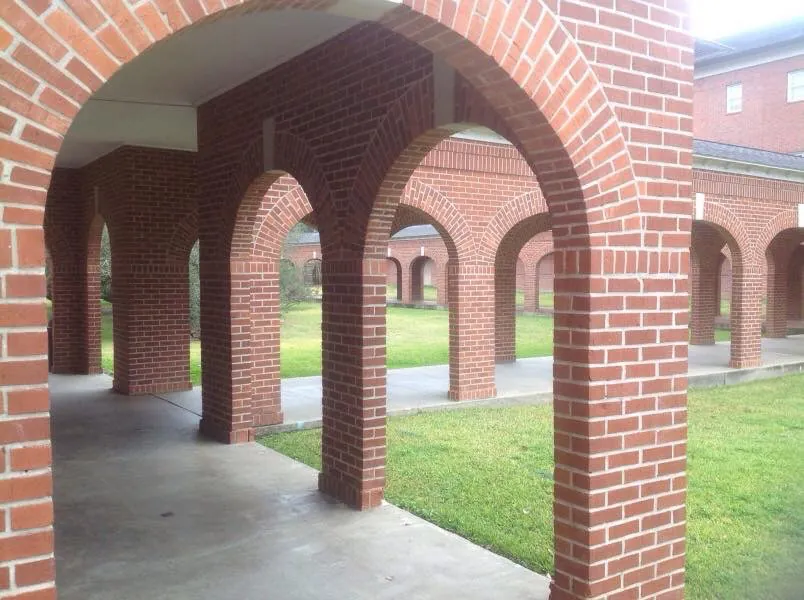 2Museum·1901University of Louisiana at Lafayette
In September 1901, three buildings opened on 25 acres just outside Lafayette donated by Crow and Maxim Girard: Martin Hall, Foster Hall, and a shop building. One hundred students enrolled, taught by eight faculty. The institution had been created through state legislation three years earlier and was named the Southwestern Louisiana Industrial Institute. Lafayette's bid — a parish-wide tax levy, $18,000 in cash, and the land — had beaten New Iberia's 5–2 in a board vote. By 1903, eighteen students had graduated. By 1920 the school offered a four-year bachelor of arts degree. In 1954, within months of Brown v. Board of Education, the university admitted seventy African-American students, becoming the first all-white public college in the Deep South to voluntarily desegregate. In 1962 it awarded the first master's degree in computer science in the United States. In 1994 it established the first francophone PhD program in the Western Hemisphere — only the third in the world. Acadiana was and remains a francophone region; the university's location at the center of Cajun Country gives that program its ground. In 1984 the university changed its name to the University of Louisiana without legislative approval. The legislature overturned the change within a month, though two schools had previously used the same process without interference. The institution was renamed in 1999 to the University of Louisiana at Lafayette. It has been renamed four times since opening. Foster Hall, completed in 1902, and DeClouet Hall, completed in 1905, remain the two oldest buildings on campus. The original Martin Hall was demolished in 1963 and replaced. The Arcade, built in 1940, consists of 415 brick arches and now frames the Walk of Honor, where every undergraduate from 1903 onward is honored with an engraved paver bearing name and graduation year. At the center of campus is Cypress Lake, a habitat for native irises, alligators, turtles, birds and fish — the only such ecosystem located within a university in the United States. Current enrollment exceeds 16,000 students. The Ragin' Cajuns compete in the Sun Belt Conference. In 2023 the university posted $181 million in research expenditures. Ray Paul Authement, president from 1974 to 2008, became the longest serving president of a public university in the United States. Go for the lake. Go because francophone scholarship is still being made here, in a region that held on to French when the rest of the state did not.
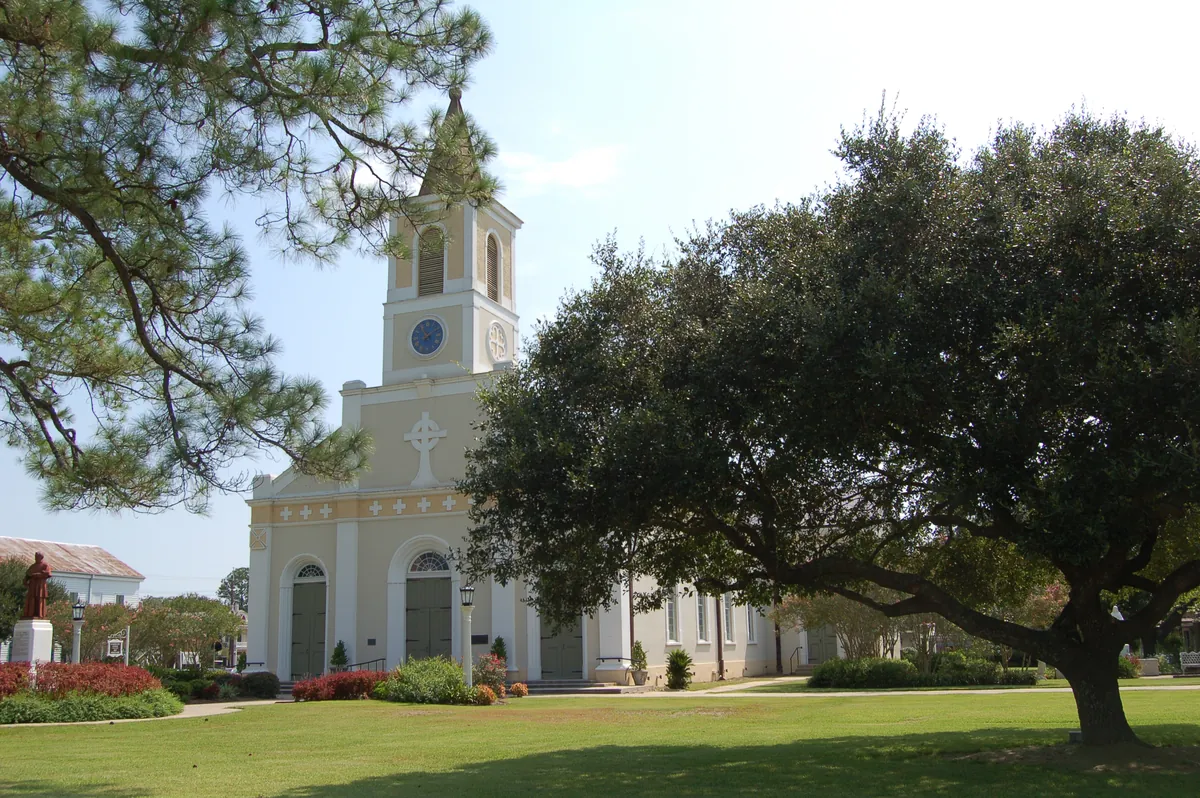 3Cultural Heritage·1765Poste des Attakapas — The First Settlement
Joseph Broussard — Beausoleil — fought the British in Nova Scotia for a decade after the Acadian expulsion. When he finally accepted exile in 1765, he led the first Acadian families to a French colonial post on Bayou Teche: Poste des Attakapas, built on Attakapas territory in the mid-1700s. The French colonial official Jean-Jacques Blaise d'Abbadie assigned them to this stretch of water. Broussard died within months of arriving in Louisiana. The post became St. Martinville. Broussard's descendants still live in the area — the surname is one of the most common in Acadiana, the twenty-two-parish region the Louisiana State Legislature officially recognized in 1971 for its Acadian cultural roots. Most Acadians trace their ancestry to approximately fifty families who lived in Port Royal, now Annapolis Royal, Nova Scotia. They intermarried with other settlers and formed what became Cajun culture. The original colonial post site is not precisely marked. The town it seeded is still here. You're standing in the place where the exiles stopped running.
 4Museum·1996The Grand Dérangement — Acadian Memorial
In 1755, the British expelled Acadians from Nova Scotia. Approximately 3,000 refugees eventually reached Louisiana. This memorial, dedicated in 1996 through a collaboration between Louisiana Cajun families and the Canadian province of New Brunswick, honors them by name. The Wall of Names lists every documented Acadian settler. Descendants still come to find and trace their family name. A 12-by-30-foot mural by Robert Dafford depicts the arrival, with figures based on actual documented refugees. Some were modeled by direct descendants of the refugees they portray. Acadiana — the 22 parishes and surrounding areas officially recognized by the Louisiana State Legislature for their strong French Acadian cultural aspects — exists because those refugees settled here and intermarried with other settlers, forming what became known as Cajun culture. The memorial stands adjacent to the church in St. Martinville, open daily, free. You're here to see if your name is on the wall, or to understand that someone else's is.
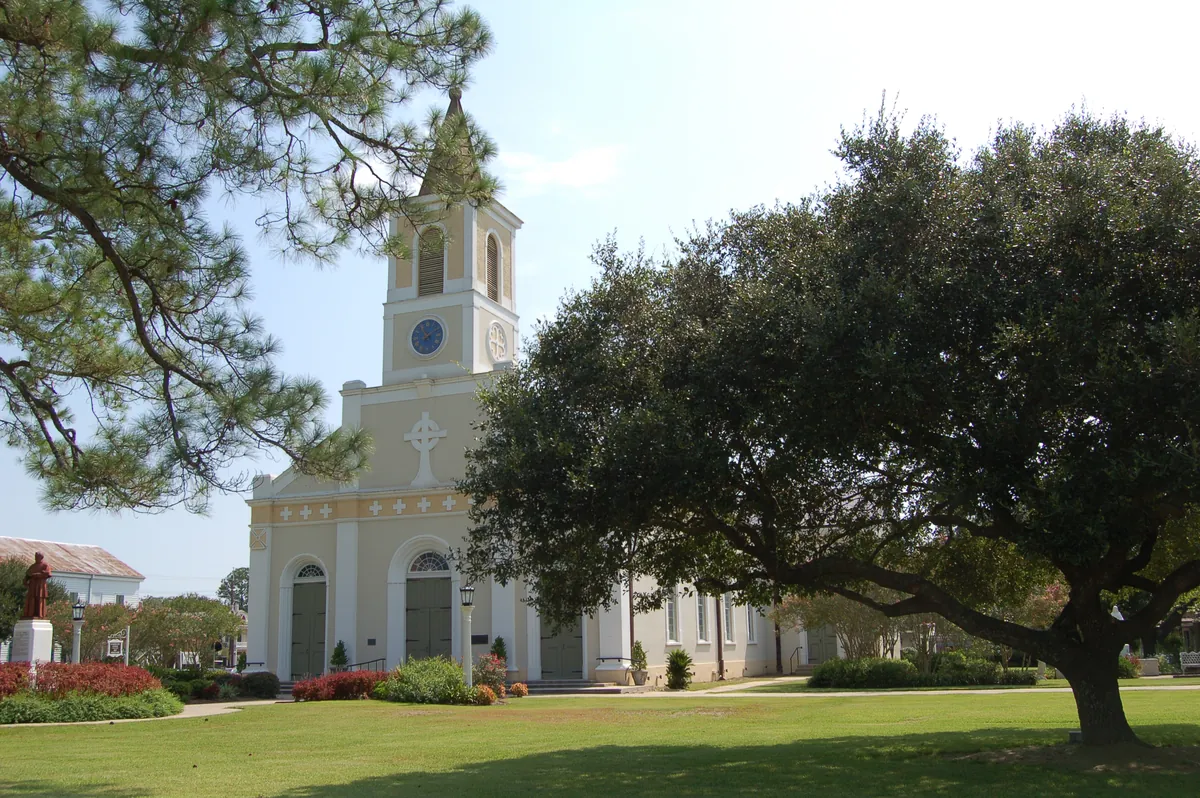
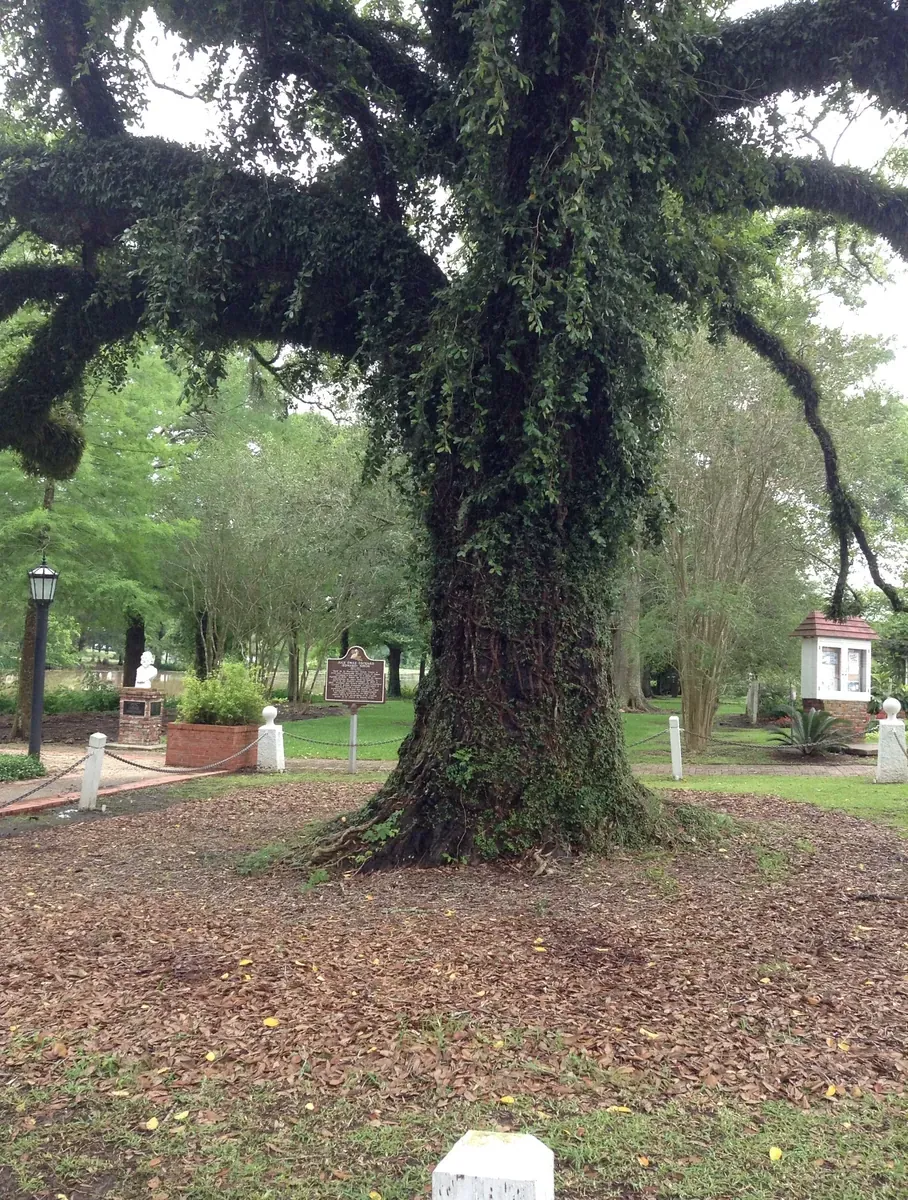 5Religious Site·1847The Evangeline Oak & St. Martin de Tours
Longfellow never saw Louisiana. He wrote *Evangeline* in 1847 from secondhand accounts of the Acadian deportation—the British expulsion from eastern Canada that scattered French families across the Atlantic world. The poem tells of a woman separated from her betrothed during the expulsion, who finds him again in Louisiana only to learn he has committed to another. She never recovers from the shock of both finding and losing him. St. Martinville claimed the story immediately, and by the late nineteenth century the oak tree had become a pilgrimage site. St. Martin de Tours Catholic Church stands beside it. Acadian settlers founded the church in 1765—the third oldest in Louisiana and the mother church of the Acadian people who colonized this parish in the late 1700s. They brought the Evangeline story with them, and some believe the historical woman behind the tale—possibly an orphan named Emmeline Labiche—was buried on these grounds. The statue in the churchyard came later. After Dolores del Río starred in the 1929 film adaptation, she donated a likeness of Evangeline modeled on her own face. Oak, statue, and church stand within steps of each other on Main Street. Free to visit. You're standing at the physical claim Acadiana made on a story written by a man who never came here—proof that a people decides which tales belong to them, regardless of who wrote them down.