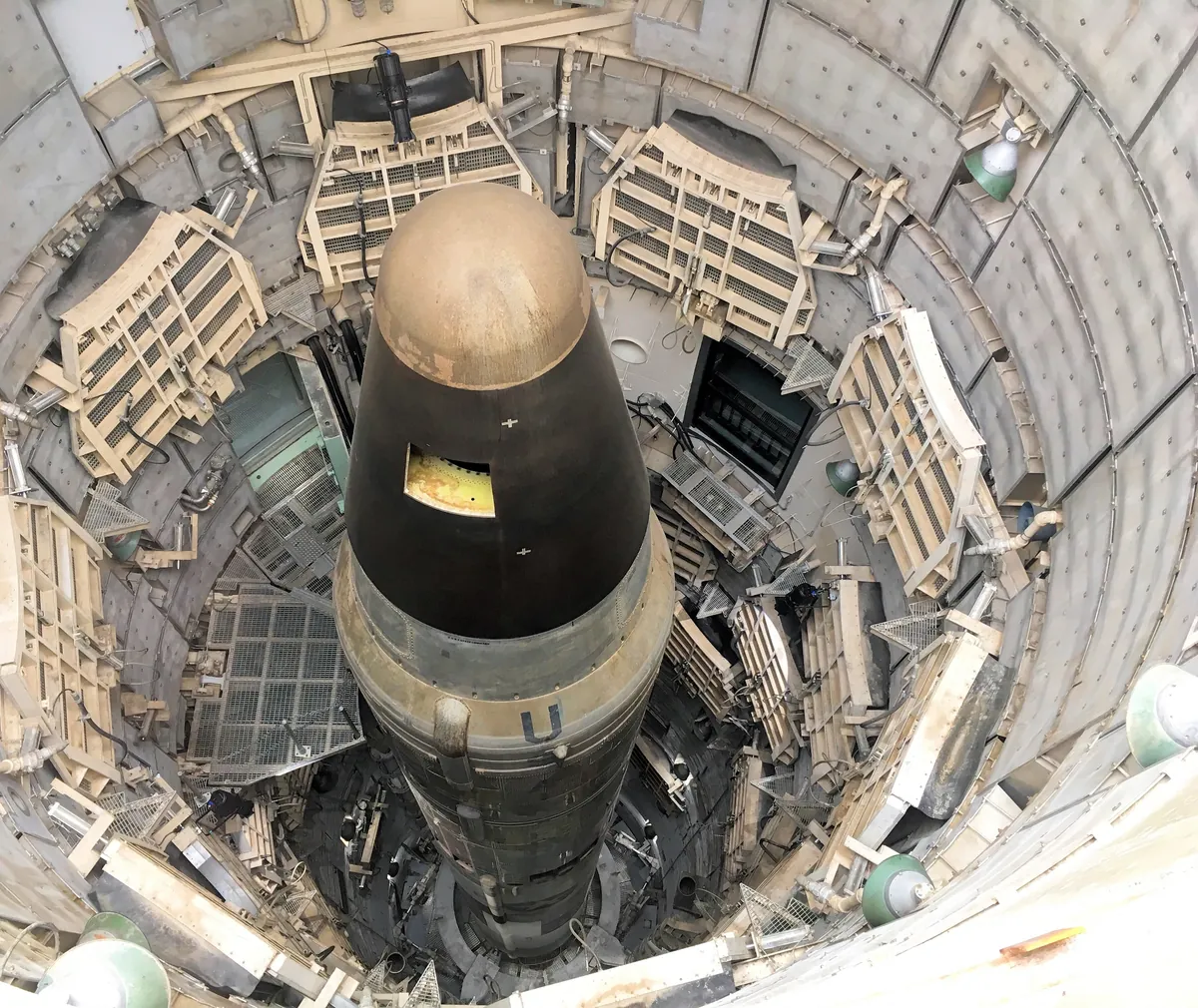
Twenty-five miles south of Tucson, in the desert outside Sahuarita, a museum preserves the machinery of deterrence — and means it literally. The Titan Missile Museum, Air Force Facility Missile Site 8, Complex 571-7, went on alert in 1963 and stood ready for more than two decades before deactivation in 1984. It is the only place in the country where visitors can see a fully preserved intercontinental ballistic missile still in its silo.
Fifty-four Titan II sites once stood on alert across the United States. All were demolished after deactivation except two — this one and 571-3. In 1994, the site was declared a National Historic Landmark. It is now run by the nonprofit Arizona Aerospace Foundation.
The missile is 103 feet of Titan II — the largest operational land-based nuclear weapon the United States ever deployed. It carried a single W53 warhead yielding nine megatons. The warhead and fuel are gone; the dummy reentry vehicle on top has a prominent hole cut into it to prove the point. Under a US-USSR agreement, the silo doors are permanently blocked from opening more than halfway.
Underground, steel-reinforced concrete walls run eight feet thick in places, and three-ton blast doors seal each section from the next. The guided tour descends into a three-level Launch Control Center, continues through the cableways, and reaches level two of the eight-level silo — close enough to the missile to take in what that engineering actually meant. The crew who served here never knew their programmed targets, but Complex 571-7's designated target at closure was "Target Two," still classified, assumed to be somewhere in the former Soviet Union, designated for a ground burst. A hardened facility. Probably another silo.
The NPS puts it plainly: heightening the threat of nuclear war, or preventing Armageddon, depending on your point of view. Come down and decide for yourself.
Memories
Editorial content compiled with AI assistance. Place details verified against public records.