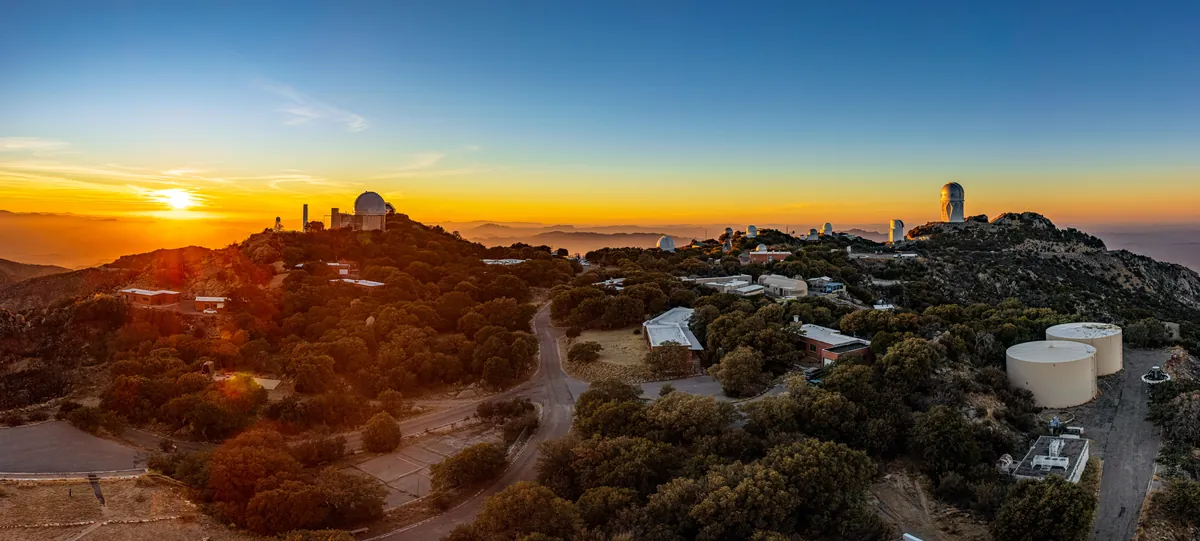
The Tohono O'odham have called this summit Iolkam Du'ag — "hairy mountain" — for generations, and regard it as the home of I'itoi, the Elder Brother figure at the center of their cosmology. In the 1950s, the National Science Foundation went looking for a permanent site for a national observatory. The survey pointed here.
What happened next was unusual. Rather than acquire the land through federal mechanisms, the NSF negotiated directly with the Tohono O'odham tribal council. The tribe agreed to lease the peak for observatory use — a quarter dollar per acre yearly, in perpetuity, an arrangement the council approved overwhelmingly. It was not without tension, and it has evolved over the decades, but it represented an early acknowledgment that Indigenous sovereignty over sacred land deserved genuine respect rather than legal workaround.
Kitt Peak National Observatory opened in 1958, 55 miles west-southwest of Tucson in the Quinlan Mountains. Today it hosts more than twenty optical telescopes and two radio instruments — one of the largest concentrations of astronomical equipment in the northern hemisphere. The flagship instruments include the Nicholas U. Mayall 4-meter telescope, the WIYN 3.5-meter, and the McMath-Pierce Solar Telescope, for decades the largest solar telescope in the world. Research here contributed to work on dark matter, cosmic distances, high-redshift galaxies, and near-Earth asteroids.
In June 2022, the Contreras Fire reached the summit at two in the morning. Four buildings were lost, including a dormitory. The observatory reopened fifteen months later, in September 2023.
Daytime tours cover the history and walk through a working research telescope. The Nightly Observing Program runs from sunset into the dark. The real reason to make the drive: you are standing on a peak that has belonged to someone else the entire time science has been conducted here — a fact the mountain does not let you forget.
- ·Founded 1958. Land leased in perpetuity from Tohono O'odham Nation for $0.25/acre/year (council-approved 1950s). Major instruments: Nicholas U. Mayall 4-meter telescope, 3.5m WIYN, and the McMath-Pierce Solar Telescope (for decades the world's largest solar telescope). Peak is sacred to Tohono O'odham as Iolkam Du'ag ('hairy mountain'), home of I'itoi. Coords 31.9583 N / 111.5967 W from Wikipedia infobox (typo-guard: ~56 mi SW of Tucson center, do NOT fall back to Tucson center). K-10: 5+ facts.
Memories
Editorial content compiled with AI assistance. Place details verified against public records.