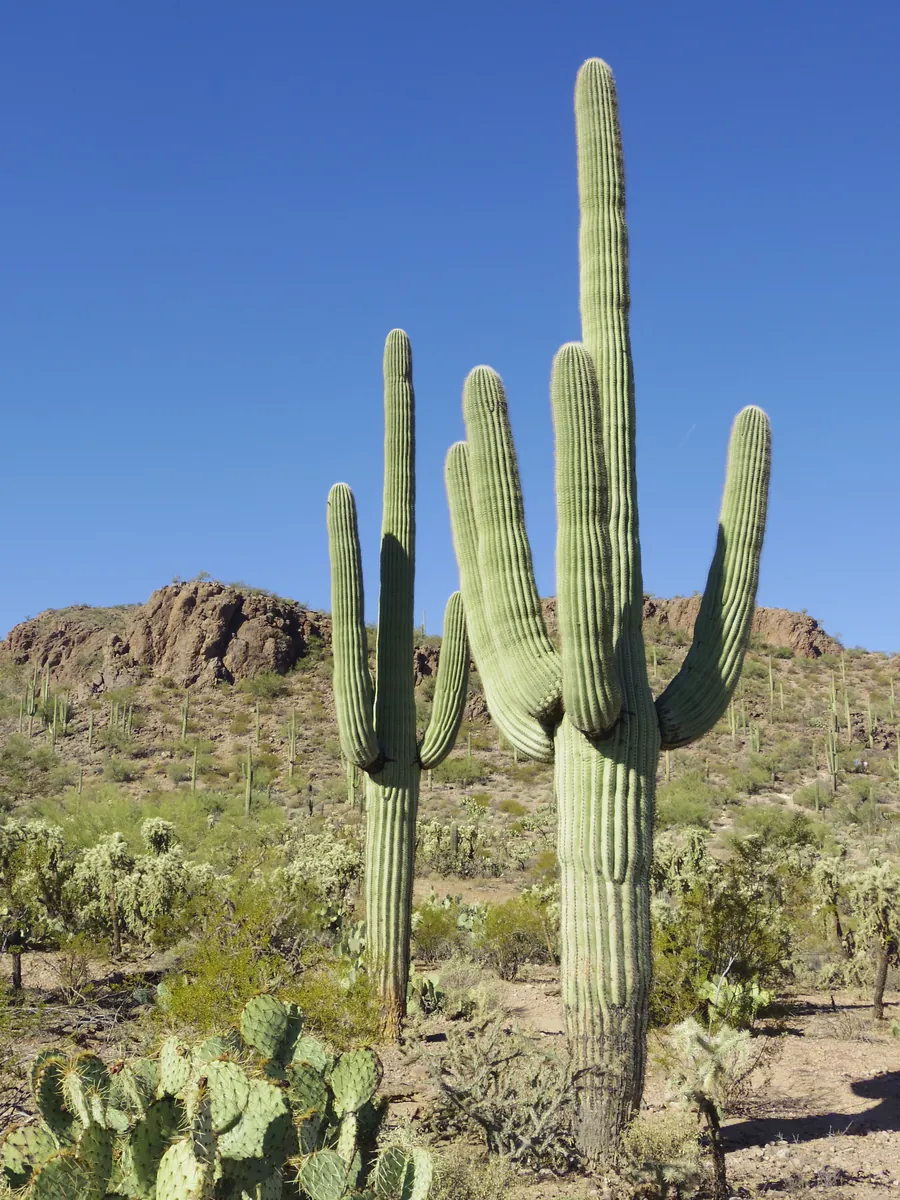
The giant saguaro grows nowhere else on Earth but a small corner of the Sonoran Desert — and Saguaro National Park exists specifically to keep it that way. Across 92,000 acres split into two districts flanking Tucson, the park protects landscapes, fauna, and flora that took millions of years and several civilizations to arrive at their current form.
The two districts are not interchangeable. The Tucson Mountain District sits about ten miles west of the city; the Rincon Mountain District sits about ten miles east. The Rincons are significantly higher and wetter — part of the Madrean Sky Islands, a chain of mountain ranges bridging the southern Rockies and Mexico's Sierra Madre, where elevation pulls down enough moisture to sustain biodiversity that the lower desert cannot. The geological reason: crustal stretching over the past 30 million years displaced rock from beneath the Tucson Mountains eastward, where it was uplifted, domed, and eroded into the Rincons. Two ranges made from the same material, transformed into different worlds.
People have known this ground for a long time. The Hohokam lived here. So did the Sobaipuri, the Tohono O'odham, Apaches, Spanish missionaries and explorers, miners, homesteaders, and ranchers. President Hoover used the Antiquities Act to establish the original Saguaro National Monument in the Rincon Mountains in 1933. President Kennedy added the Tucson Mountain District in 1961. Congress combined both into a national park in 1994.
The saguaro at the center of all this is slow, patient, and enormous — a cactus that may live 200 years, with its first arm appearing somewhere between age 50 and 70. The park estimates 1.8 million of them stand here. With 165 miles of trails threading both districts, there is enough ground to find your own.
Memories
Editorial content compiled with AI assistance. Place details verified against public records.