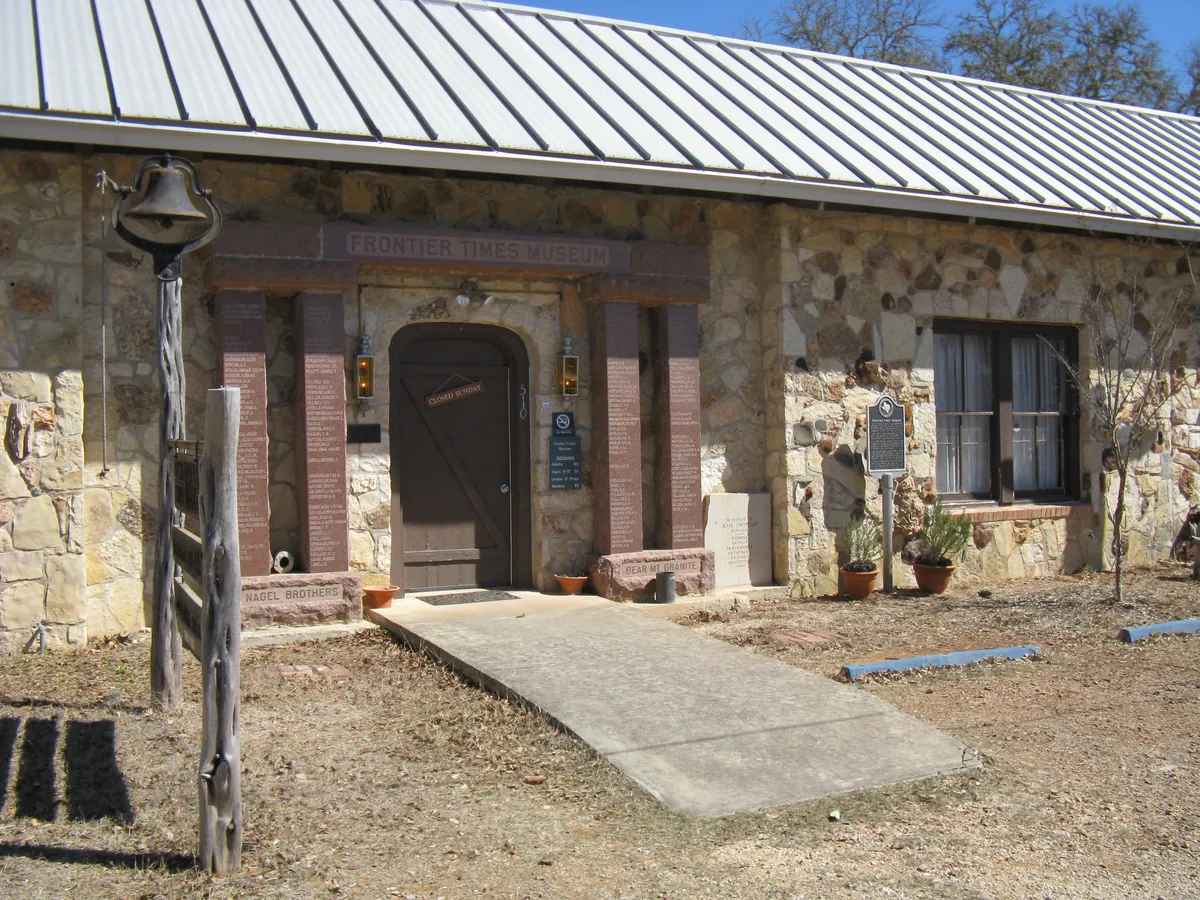
J. Marvin Hunter was a journalist, which means he knew how to collect evidence of a world disappearing in front of him. In 1933, he opened the Frontier Times Museum in Bandera — a town that had already lived several lives as a cattle-drive crossroads on the edge of the Hill Country's limestone breaks. What he assembled over time grew to more than 40,000 artifacts: tools and relics of frontier Texas, objects from Native American material culture, and the accumulated memorabilia of a cattle-drive era that was recent enough, at the time, that people still remembered the smell of it.
The Hill Country was always a borderland — geographically between the American South and Southwest, historically contested ground between settlers and the people who had been there first. The Frontier Times Museum holds that tension without resolving it. Hunter's instinct was preservation, not curation. Go because the collection is the record of people who built something hard in difficult country, and someone thought it worth keeping.
- ·The Frontier Times Museum was built/founded in 1933 by J. Marvin Hunter, Sr. (1880-1957) — printer, newspaperman, and historian — who settled in Bandera as owner of the local weekly newspaper the 'New Era' from 1921 to 1934, and who in 1923 founded 'Frontier Times,' a magazine devoted to frontier/border history and pioneer memoirs/accounts. (Directly confirmed via HMDB historical marker #162838 text and corroborated by Wikipedia's Frontier Times entry and the TSHA Handbook.)
- ·Hunter built the museum to house his own personal Western collection (financed by selling copies of his own book) and ran it until his death in 1957. His stated collecting philosophy was that if an artifact was deemed important enough to be donated, it deserved to be exhibited — producing a dense, eclectic, non-curated walk through Bandera County frontier history rather than a modern curated museum layout. (Confirmed via wonderfulmuseums.com and corroborated by frontiertimesmuseum.org / HMDB marker on Hunter's death and personal financing.)
- ·The museum describes itself, in its own current marketing language, as having been 'a revered landmark... for over 90 years' and having 'amazed visitors for 90 years,' consistent with continuous operation as a physical institution in Bandera since 1933, giving it a direct physical link to the town's frontier/cattle-drive era. NOTE: reject/drop the added superlative 'one of the longest-running frontier-history institutions in the Hill Country' — no source substantiates that comparative ranking, and ownership was not continuous in a single-operator sense (sold to F.B. Doane in 1960, transferred to the Doane Foundation in 1964).
- ·From roughly 1874 to 1894, Bandera served as a staging/gathering area connected to the Western Trail (Great Western Cattle Trail), over which an estimated 30,000 cowboys drove 7 to 10 million longhorns and 1 million horses toward Kansas/Nebraska railheads. (Directly confirmed via True West Magazine content.)
- ·A San Antonio newspaper first referred to Bandera as the 'Cowboy Capital of the World' in 1948, and in 2013 both the Texas Senate and Texas House passed resolutions honoring/reaffirming Bandera's 'Cowboy Capital of the World' title. (Confirmed independently via Texas Highways and True West Magazine content, and via a separate search on the 2013 legislative resolutions.)
- ·Bandera's local rodeo tradition began in 1924 at Mansfield Park, and rodeos have continued there since; more broadly, dude ranches, dance halls, and rodeos have drawn tourists to Bandera since the 1920s as a general town-wide trend. (Confirmed via Texas Highways 'Saddle Up in Bandera' content.)
More archive
Memories
Editorial content compiled with AI assistance. Place details verified against public records.