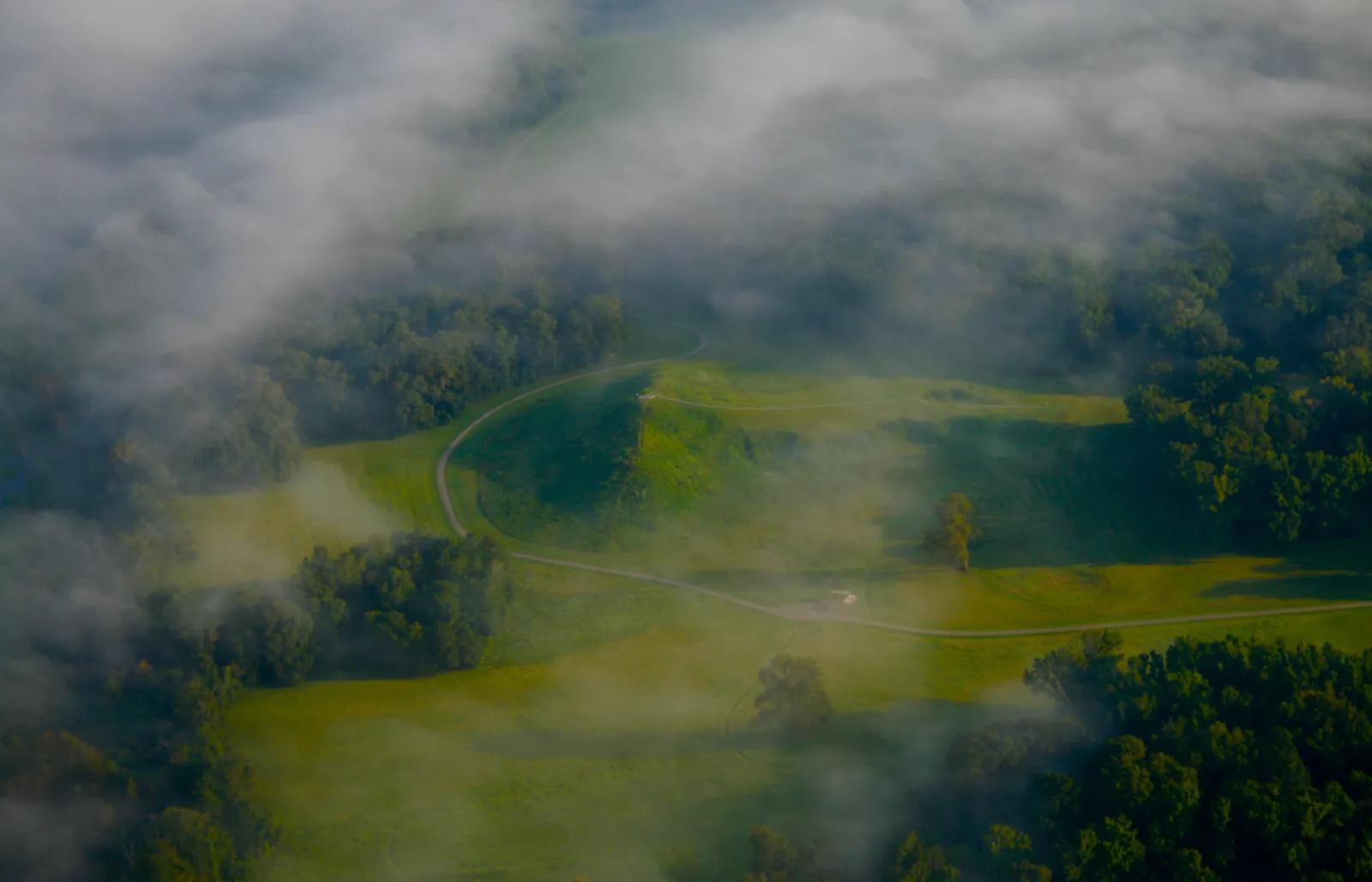
The oldest large-scale architecture in North America is here.
Three thousand five hundred years ago — fifteen centuries before the Maya built their first pyramids, two thousand years before the Mississippian mound builders to the north — a people whose name we will never know constructed an enormous earthwork complex on a low ridge above Bayou Macon. Six concentric C-shaped ridges, a seventy-two-foot mound shaped like a bird in flight, plazas, causeways. They moved an estimated 1.5 million cubic yards of soil by basket. They traded for stone from a thousand miles away. They sustained the project for six centuries. Then, around 1100 BCE, they left. The site is called Poverty Point — named for the failing nineteenth-century cotton plantation that owned the land — and UNESCO recognized it as a World Heritage Site in 2014. It is the oldest such recognition in North America.
The Caddo, Tunica, Ouachita, and Tensa peoples followed in the same country over the next two millennia. The Ouachita River, draining out of the Arkansas highlands and curling south through the parishes that now bear their name, was the spine of all of it. The river was navigable. The bottomlands were rich. The fish and game were endless. The high ground above the floodplain made for permanent towns.
The Spanish came up the Ouachita first. In 1785, Don Juan Filhiol established Fort Miró on the river bluff at the site of present-day Monroe — a Spanish military post designed to anchor the colonial frontier and control the bayou trade. Filhiol was the only European authority for hundreds of miles. The Louisiana Purchase brought the parish into the United States in 1803, and the post was renamed Monroe in 1819 after the steamboat James Monroe became the first to ascend the Ouachita that far.
The nineteenth century was cotton. The Delta — the alluvial plain stretching east from the Ouachita to the Mississippi — was the richest agricultural country in the state, and the most brutal. Tensas, Madison, East Carroll, and Concordia parishes ran on enslaved labor at a scale that approached the sugar parishes of the south. After emancipation, the labor system reorganized as sharecropping, and the population stayed Black, poor, and rural for another century. The blues that came out of that experience — country blues, before it electrified up in Chicago — was the soundtrack of the Delta on both sides of the Mississippi River.
Monroe became something else. In 1907, Joseph Biedenharn — the first man to bottle Coca-Cola, in Vicksburg — moved his operation to Monroe and built a fortune that funded a music conservatory and a pipe organ collection. The Masur Museum, the Biedenharn gardens, and the airline that became Delta Air Lines all started here. Delta took its name from the country it served. The Flying Tigers — the volunteer American pilots who fought the Japanese in China before Pearl Harbor — were trained at Selman Field in Monroe.
The Tensas River bottomlands, a two-hundred-thousand-acre tract of forested swamp, are the last remaining habitat of the Louisiana black bear, the subspecies that gave Theodore Roosevelt the "teddy bear" after he refused to shoot a tied one on a 1902 Mississippi hunt. The bears are still here. So is the cotton. So are the mounds at Poverty Point, and the river that has run past them for the entire 3,500 years of recorded human time in this corner of Louisiana.