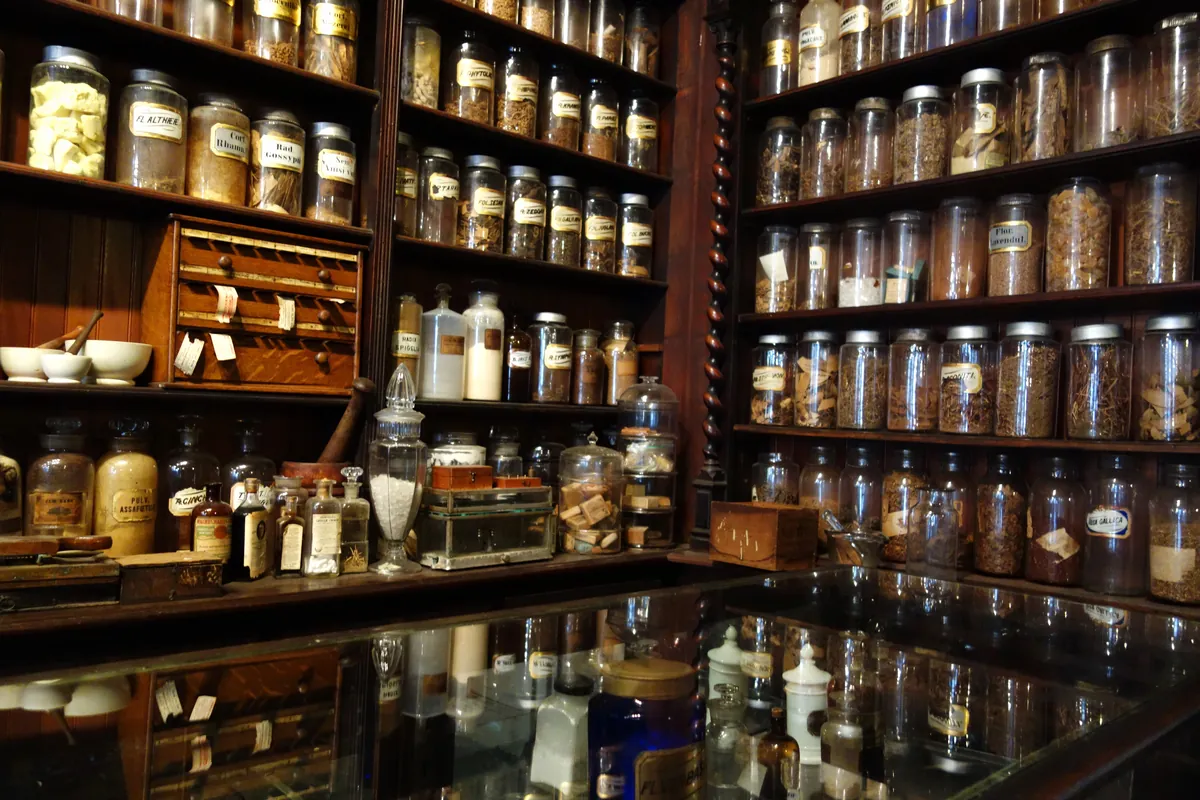
Louisiana passed the first pharmacy licensing law in the United States in 1816, and Louis Dufilho Jr. was the first to qualify. By 1823 he was running his apothecary at 514 Chartres Street, mixing compounds in a city where yellow fever ran through neighborhoods in waves and two parallel systems of medicine — licensed and folk — worked the same blocks. The building is now a museum preserving what that looked like: hand-blown glass bottles, leech jars, patent medicines still on the shelves, and a courtyard herb garden out back where the materia medica grew.
The voodoo section makes the duality explicit. Gris-gris potions sit in labeled rows. Folk remedies that operated alongside Dufilho's licensed work get the same curatorial attention, because in 19th-century New Orleans they treated the same fevers, and visitors who wanted a root and visitors who wanted a tincture might stop at both in the same day.
The Civil War–era surgical instruments on the upper floor are notoriously graphic — the tools that came out when laudanum and a leather strap were all the anesthesia a field hospital could offer. The museum is listed on the National Register of Historic Places. Open Tuesday through Saturday, small admission fee.
- ·America's first licensed pharmacist, Louis Dufilho Jr., operated his apothecary here starting in 1823.
- ·The museum preserves hand-blown glass bottles, leech jars, patent medicines, and a courtyard herb garden.
- ·The voodoo section displays gris-gris potions and folk remedies that operated alongside licensed medicine in 19th-century New Orleans.
- ·Civil War–era surgical instruments on the upper floor are notoriously graphic.
- ·Louisiana passed the first pharmacy licensing law in the U.S. in 1816; Dufilho was the first to qualify.
- ·Located at 514 Chartres Street. Open Tue–Sat. Small admission fee.
Memories
Editorial content compiled with AI assistance. Place details verified against public records.