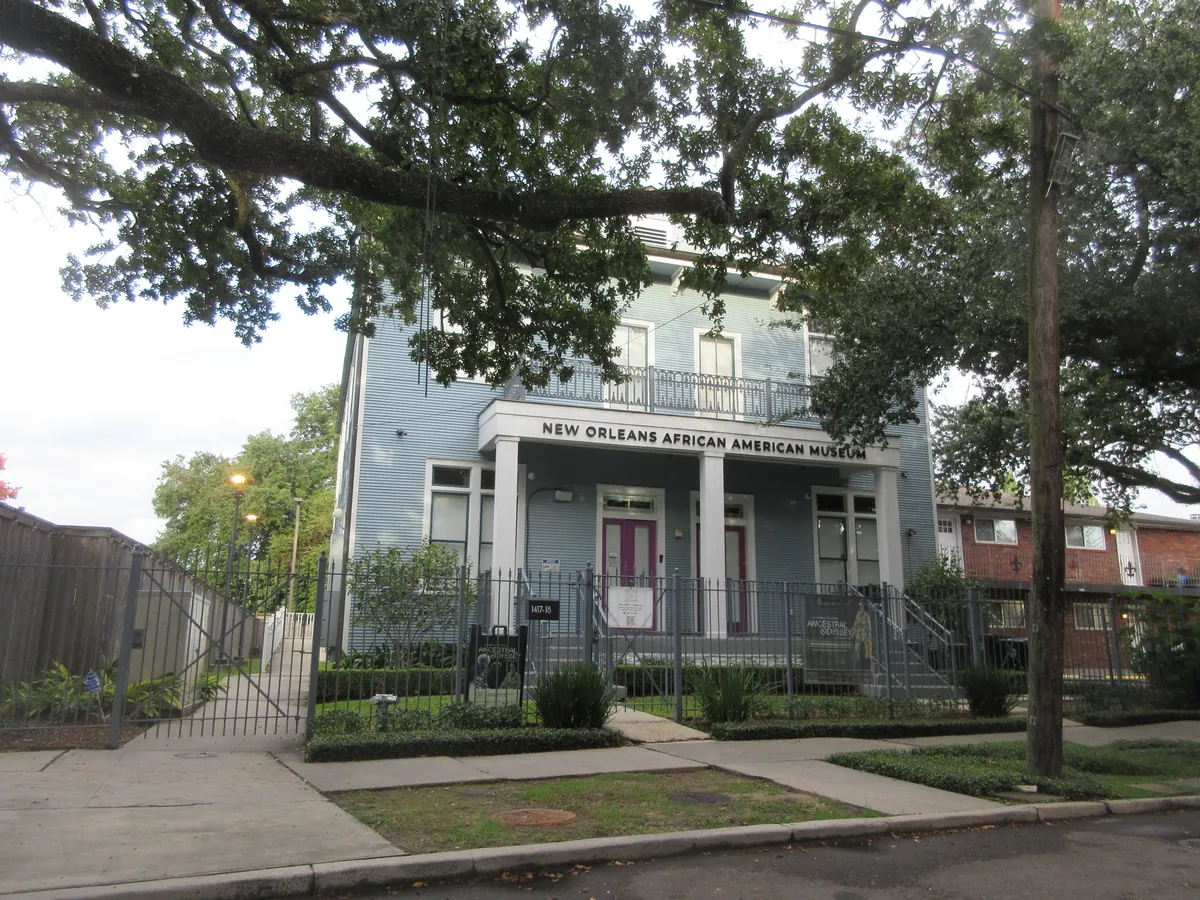
The finest surviving Creole master's house in New Orleans was built of brick in 1828–1829 by a prosperous free Creole family — part of the story it now tells. The Meilleur-Goldthwaite House is a raised center-hall cottage with large dormer windows, preserved with its outbuildings, original interior, and much of the large lot on which it was built. The property encompasses seven historical structures on the site of a former plantation.
The house holds the New Orleans African American Museum, which interprets the contributions people of African descent made to New Orleans and Louisiana culture — as slaves and as free people of color throughout American slavery, emancipation, Reconstruction, and contemporary times. Tremé is the oldest-surviving black community in the United States, and the museum stands as the cornerstone of the neighborhood's redevelopment. Permanent and temporary exhibits spotlight contemporary artists in the main house and in the former slave quarters.
One centerpiece is "Louisiana-Congo: the Bertrand Donation," a 70-piece collection of African beadwork, costumes, masks, textiles and musical instruments from the Democratic Republic of Congo. The collection illuminates the parallels between everyday life in the Congo and Louisiana folk culture. Other exhibits change regularly and highlight a range of works from traditional African art to black influences and culture in modern New Orleans life.
The museum suffered substantial roof and water damage during Hurricane Katrina in 2005. It was restored and reopened in February 2008. The house is listed on the National Register of Historic Places and featured as a site on the Louisiana African American Heritage Trail. Check hours before visiting.
- ·Housed in an 1829 Creole villa on Governor Nicholls Street — one of the oldest surviving houses in the Tremé.
- ·Listed on the National Register of Historic Places.
- ·Tells the story of the oldest African American neighborhood in the United States.
- ·Collections cover colonial-era free people of color through the civil rights movement.
- ·The villa itself was built by a prosperous free Creole family — part of the story it tells.
- ·Located in Tremé. Check hours before visiting.
Memories
Editorial content compiled with AI assistance. Place details verified against public records.