1. **Founding and colonial layering** — French fort 1716, British, Spanish, American — oldest settlement on the Mississippi 2. **Natchez Trace** — southern terminus, critical trade and military route 3. **Antebellum wealth** — wealthiest city per capita in pre-Civil War America; the mansion district 4. **Slave trade** — Forks of the Road, second-largest slave market in the country 5. **Reconstruction-era Black leadership** — Robert H. Wood (mayor), Hiram Rhodes Revels, John R. Lynch 6. **William Johnson** — "Barber of Natchez," his diary 7. **Norman Studio photographers** — 1870–1950 documentary record 8. **Architectural survival** — Civil War surrender without fight; mansions intact; Longwood, Stanton Hall, Melrose
All eight must be represented or worked in. The spine: colonial layering → Trace/trade → cotton wealth built on slavery → Civil War survival → what endured.
---
Natchez sits on a bluff two hundred feet above the Mississippi River, and that elevation explains everything. The river below is commerce, danger, connection to the world. The bluff is control — whoever held it could command the lower valley. The Natchez people understood this before any European arrived; their ancestors had inhabited the area since the eighth century, building platform mounds and a ceremonial center at the Grand Village. When the French established Fort Rosalie among them in 1716, they were planting a flag on ground already old with human purpose.
What followed was three more flags in quick succession. The British took the territory in 1763 under the Treaty of Paris, after France lost the Seven Years' War. Spanish forces moved in during 1779. Then, in 1797, Major Andrew Ellicott of the United States marched to the highest ridge in town, raised the American flag, and claimed everything east of the Mississippi above the 31st parallel. Each colonial power left something behind — in the architecture, the land grants, the legal customs, the mixing of Native American, European, and African cultures that the Wikipedia article calls the city's defining condition for two centuries. Natchez became the first capital of the Mississippi Territory, then the first capital of Mississippi when it achieved statehood in 1817. Jackson replaced it in 1822, being more centrally located, but by then Natchez had already outgrown the need for political status.
The Natchez Trace gave the city its first commercial identity. Flatboat and keelboat crews floated cargo down to Natchez or New Orleans, then had no way to push a loaded boat back upriver against the Mississippi's current — that problem wasn't solved until steamboats arrived in the 1820s. So they walked home, north through seven hundred miles of wilderness to the Ohio River Valley, along the Trace. Natchez was where that journey began. Travelers, merchants, soldiers — they all funneled through. The city became a hinge between the river economy and the interior.
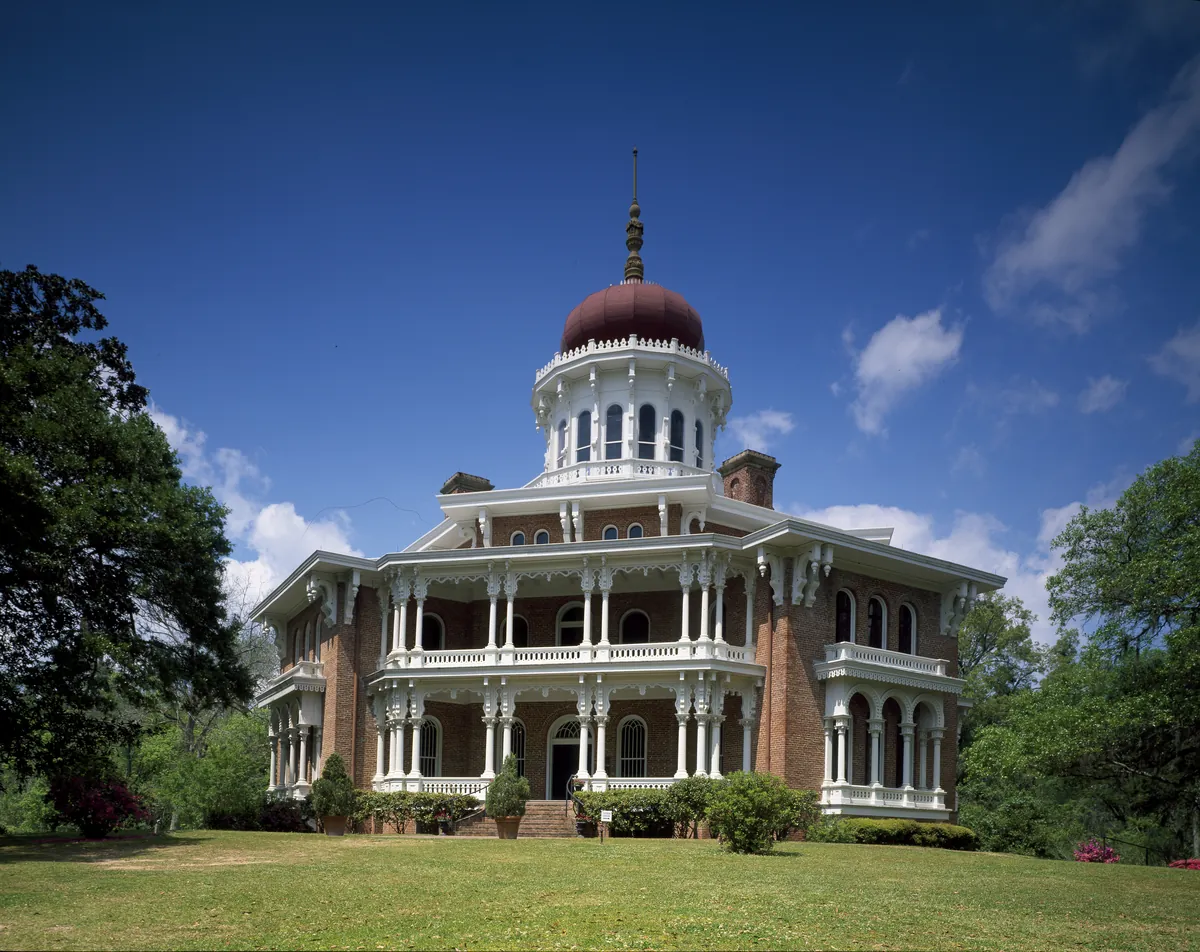
Cotton made Natchez rich, and that wealth rested entirely on enslaved labor. By the antebellum period, the city was second only to New Orleans as a slave-trading center in the United States. The leading market operated at the Forks of the Road, at the intersection of Liberty Road and Washington Road. The firm of Franklin and Armfield ran coffles south from Virginia annually, selling people individually in a practice the Wikipedia source describes as resembling a modern retail operation. The mansions that survive — Melrose, constructed in the 1840s for a wealthy attorney and cotton planter and home to twenty-two enslaved people; Longwood, whose construction began in 1860 and stopped when the Civil War started, craftsmen leaving mid-project and never returning; Stanton Hall, occupying an entire city block downtown — were built on that market. They are not separable from it. The city became, per one source, the wealthiest per capita in pre-Civil War America. The architecture documents that wealth with precision.
Natchez surrendered to Union forces in September 1862 without a fight, a fact that determined the city's physical future. The destruction visited on much of the South did not come here. The mansions stood. But the war's aftermath was not gentle: thousands of formerly enslaved people and refugees crowded into the city after the Union victory at Vicksburg in 1863, and the relief system failed them badly. Hundreds died. Yet from that same moment came something durable. From 1870 to 1871, Robert H. Wood served as Mayor of Natchez — one of only five African Americans to hold a mayoral office during Reconstruction, and among the first Black mayors in the country. Hiram Rhodes Revels and John R. Lynch, both Natchez figures, entered national politics. William Johnson — born enslaved, freed at eleven, eventually owner of barber shops, rental property, a farm, and timberland — left behind a lengthy personal diary that remains one of the most detailed records of antebellum life and the experience of free Black people in the South. And from roughly 1870 to 1950, photographers Henry C. Norman and his son Earl ran the Norman Studio, producing a visual record of the city's life across the decades that is now preserved at Louisiana State University.
The railroads bypassed Natchez in the early twentieth century, drawing commerce elsewhere. Decades of economic decline followed. The population today is a fraction of what it was at its peak. What remains is the built record: the mansion district largely intact, the Forks of the Road site now being acquired by the National Park Service, Fort Rosalie, the William Johnson House. Natchez accumulated history from too many directions for any single one of them to own it. That is still true.