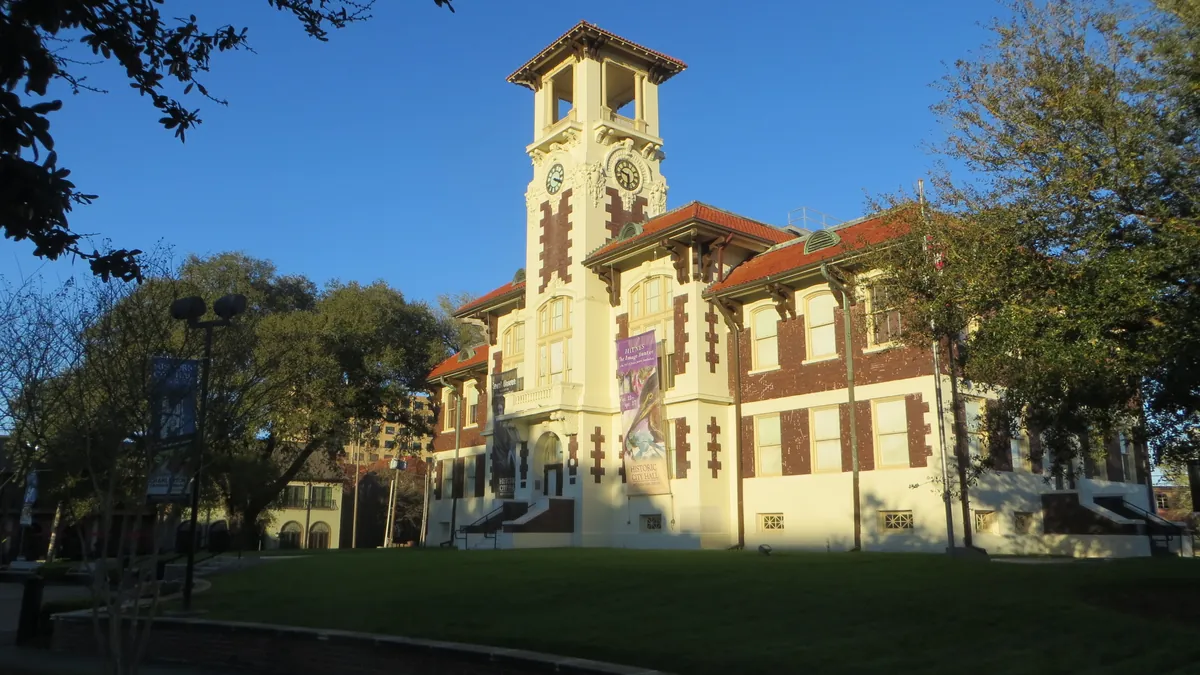
The land that became Lake Charles sits on a level plain in the southwestern corner of Louisiana, about thirty miles from the Gulf of Mexico, thirteen feet above sea level. The Calcasieu River runs through it. So do Contraband Bayou, Henderson Bayou, and English Bayou. The surrounding forests were once dense with longleaf yellow pine. The waterways connected this country to the Gulf long before roads could. That combination — timber, water, access to the sea — is why people came, and why they stayed.
The first white settlers arrived before the city had a name. Martin LeBleu and his wife came from Bordeaux in the late eighteenth century. Charles Sallier followed, a native of Spain, and built his house close enough to the lake that the water eventually took his name — Charlie's Lake. Sallier married Catherine LeBleu in 1802, and they had the first white child born in Southwest Louisiana. The land had been home to the Atakapa-Ishak people long before any of this; the name "Calcasieu" itself comes from the Atakapa language, meaning "crying eagle." By 1817, Jacob Ryan had arrived and put a different kind of stake in the ground: 160 acres on the east shore, and the town's first sawmill. Lumber was not an amenity. It was the reason the city existed at all. Between 1817 and the mid-nineteenth century, longleaf yellow pine and cypress drove everything. The settlement was incorporated in 1861 as Charleston, named for Charles Sallier. Six years later, confusion with mail deliveries to another Charleston prompted a rename: Lake Charles, reincorporated in 1867.
The railroad arrived in 1880, connecting Lake Charles to New Orleans and Houston, and the timber trade accelerated. Then the Great Fire of April 1910 burned through the city's business district — the courthouse, city hall, much of what had been built. Lake Charles rebuilt, which turned out to be a pattern. The Port of Lake Charles opened in 1926, making the city accessible to ocean-going vessels via the Calcasieu Ship Channel. When World War II arrived, so did the petrochemical industry: refineries came in during and after the war, and the city's industrial identity shifted from pine to petroleum. That identity held. Today the Calcasieu Ship Channel hosts major plants operated by Westlake Chemical, Citgo, PPG Industries, Phillips 66, Sasol, and others. The Port of Lake Charles ranks among the thirteenth-busiest seaports in the United States.
Underneath the industrial weight, something else was being made. Lake Charles sits at the edge of Acadiana, and its Creole and Cajun culture runs deep — expressed in food, in music, in the zydeco trail rides that wind through Southwest Louisiana, in a Mardi Gras tradition that dates to 1882. The Louisiana Pirate Festival draws more than 200,000 people over twelve days each May, built around the legend that Jean Lafitte used Contraband Bayou for his operations. The city's Mardi Gras collection, housed at the Central School Arts and Humanities Center, is the largest in the South. McNeese State University, founded in 1939 and named after educator John McNeese, anchors the city's educational life on a 121-acre campus through which Contraband Bayou flows. The Lake Charles Little Theatre, founded in 1927, is the second-oldest community theater in Louisiana. Lucinda Williams, who grew up here, wrote a song with the city's name as its title. Tony Kushner set his musical *Caroline, or Change* — nominated for the Tony Award for Best Musical in 2004 — in Lake Charles. Jack Kerouac put it on the road.
In 2020, Hurricane Laura made landfall with sustained winds of 150 miles per hour. The National Weather Service called the storm surge unsurvivable. Capital One Tower, its windows blown out, was later demolished. A few weeks later, Hurricane Delta hit the same city. Residents described the damage as if twenty tornadoes had come through at once. The city had been through this before — Hurricane Rita in 2005, the Great Fire before that, an economic collapse in the 1980s, a naval base that was planned, half-built, and shuttered before the Cold War ended. Lake Charles has never had the luxury of assuming stability. What it has instead is the thing built in the absence of that assumption: a city that keeps making itself, along the same river, under the same moss-draped oaks, with the Gulf always close enough to remind everyone what the stakes are.