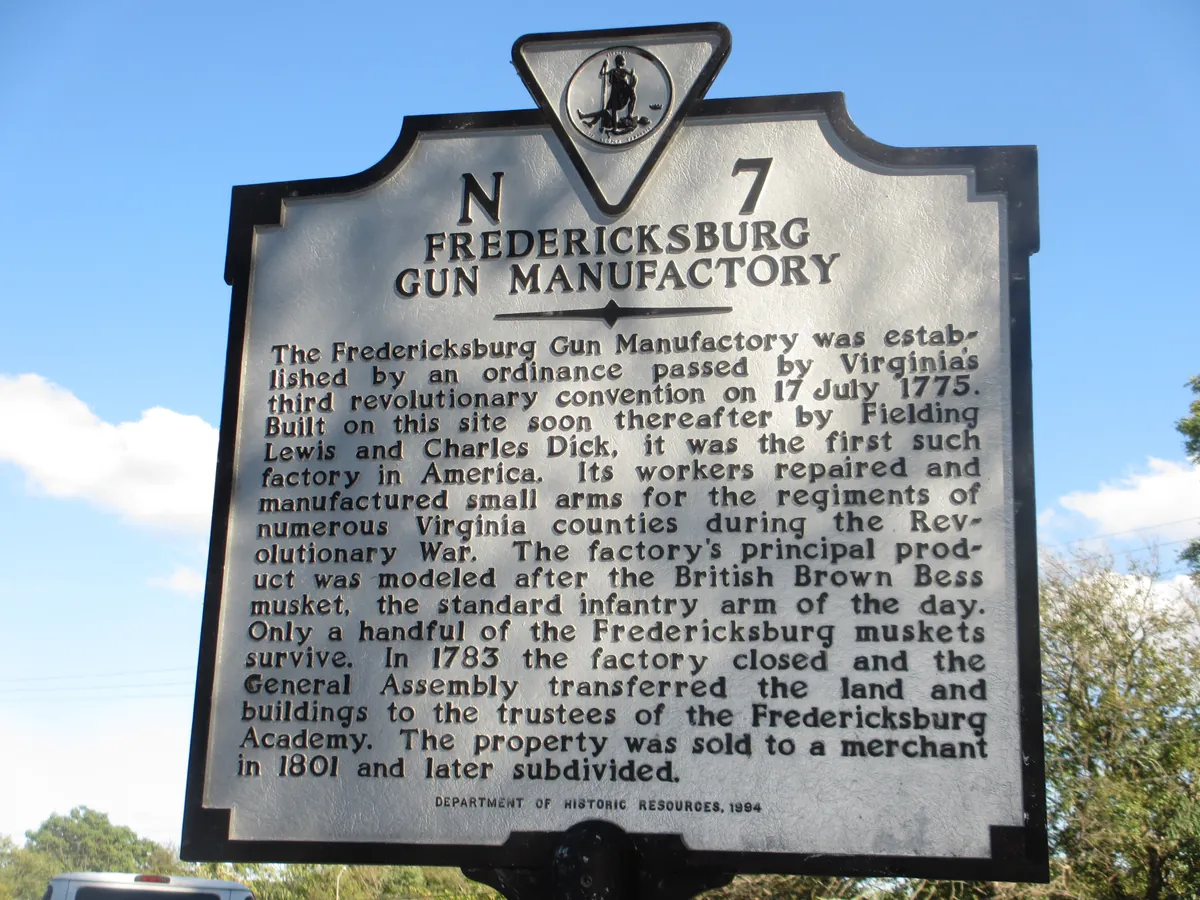
In July 1775, before independence was declared, before most colonists believed there would be a war, the Virginia Convention passed an ordinance establishing a gun manufactory near Fredericksburg. The assignment went to five commissioners, though only two stepped forward: Charles Dick, a merchant, and Fielding Lewis, the plantation owner who had married Washington's sister. They bought land on the southern edge of town — low ground with access to water — and built what the new nation needed most: a place to make its own guns.
Until that point, Virginia had been buying muskets from England. The ordinance changed the premise. Workers ground gun barrels, fitted locks, carved walnut stocks from rough planking. They made their own tools. They proved barrels with lead stripped from their own windows when military requisitions took what little supply existed. A September 1775 notice in the *Virginia Gazette* called for gunsmiths and locksmiths "capable of managing that business in its various branches," promising exemption from military service if they signed on for a year. By December the same paper reported that the factory had produced "some most comparable guns, completely finished."
The complex grew. A two-story magazine went up in 1776 — 28 feet square on the upper floor, vaulted below for ammunition storage, built to the same plan as the Williamsburg powder magazine. There was a storehouse, a coal house, a millhouse adapted from a rented property that had belonged to a Loyalist. Workers lived communally, ate at one long table, drew water from a spring that still flows. Charles Dick, who ran day-to-day operations, wrote that they functioned "as a large family." No drinking. Osnaburg trousers, coarse shirts, sturdy shoes. A spacious garden for greens and roots. Dick practiced division of labor — one man distributed tools and materials, others specialized in specific operations. By May 1777 the factory was producing at least 20 muskets a week, complete with bayonets.
Fielding Lewis went into debt. More than £7,000 of his own money, eventually. The records are full of his pleas — workers unpaid for months, reduced to rags, furnished with beef he compared to carrion. Men left to earn money for their families. The state reimbursed some expenses. Not all. Not enough. Lewis never recovered what he spent.
The manufactory armed Virginia regiments. It supplied 600 stand of arms and 50,000 cartridges to Lafayette's men. It repaired the muskets from which Lord Dunmore's forces had stolen the locks at Williamsburg. It trained locksmiths who became expert. In January 1781, Charles Dick wrote the governor that "the men of Fredericksburg and even the Ladys have very spiritedly attended at the Gunnery and assisted to make up...20,000 Cartridges with Bullets."
By early 1783, three artisans and a few servants remained. The new director — Alexander Dick, Charles's son — wrote the governor that he could employ no more without paying back wages. He recommended the factory be closed and usable materials sent to Point of Fork. The Council agreed five days later. In May the legislature transferred the land and buildings to the Trustees of Fredericksburg Academy. The war was over. The factory that had made it possible to fight was no longer needed.
Nothing stands above ground now. The magazine, the storehouse, the main building — gone. A 1975 survey using an 1793 plat located substantial brick remains over a 60-by-50-foot area. Walls at least 35 feet long. A reused sandstone sill nearly four feet wide. A section of brick that cut through an earlier pier from another structure. Foundations that tell you something was here, something that mattered, something a man spent his fortune on and never got back.
You come because this is where American arms manufacture began — not as policy, not as infrastructure, but as two men buying land, hiring workers, and betting everything that a new country would need its own guns. The ground remembers. The National Register recognized it in 1978. What it recognized was absence: the cost of making a revolution real.
- ·Address restricted. NRHP 1978. Located at the southern edge of the Fredericksburg Historic District. Factory closed 1783.
Memories
Editorial content compiled with AI assistance. Place details verified against public records.