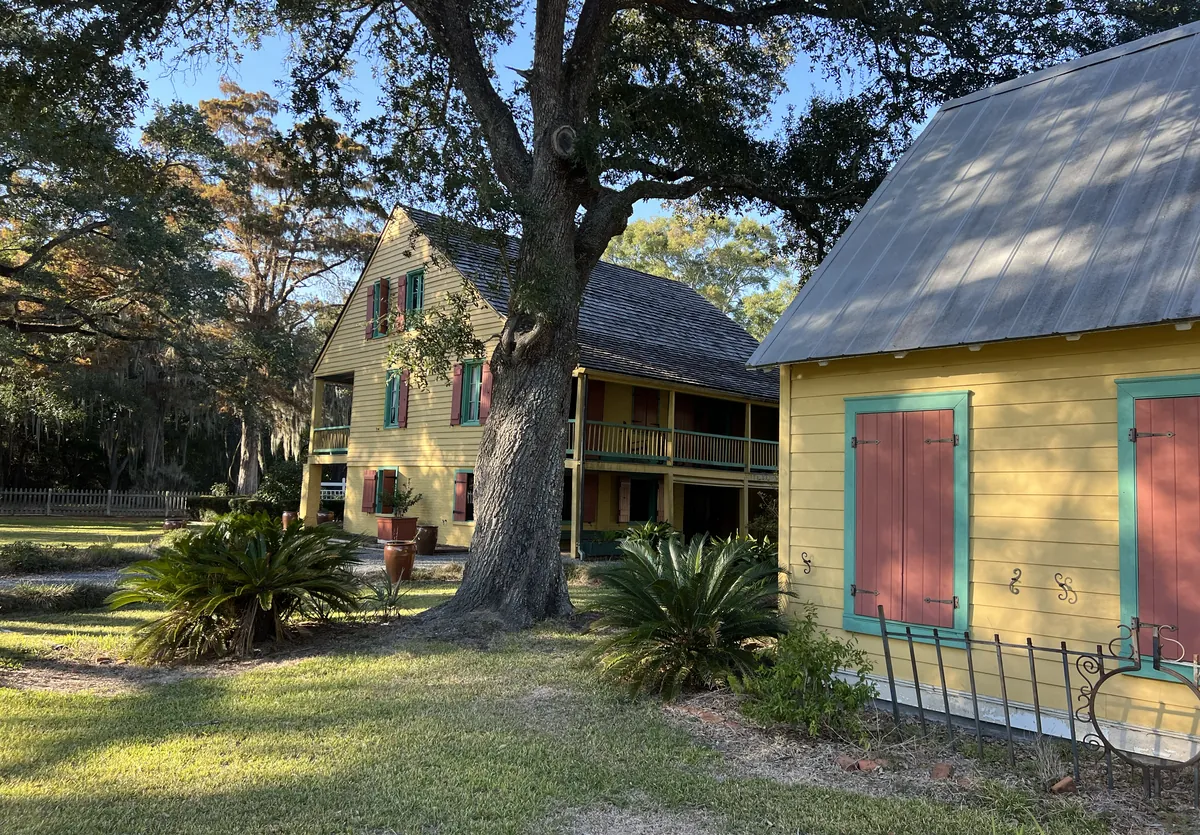
Louisiana's first state park opened here in 1934, named for a poem whose author never set foot in the state. The site anchors on Maison Olivier, a Creole plantation house built around 1815 that pulls from French, Creole, and Caribbean architecture — galleries wrapping the main floor, hipped roof, columns holding up the overhang. The house overlooks Bayou Teche, where Acadians expelled from Canada after the Seven Years' War settled among Attakapa peoples already living along the water.
A reproduction Acadian farmstead on the bayou bank reconstructs a single-family farm circa 1800: outdoor kitchen, bread oven, slave quarters, barn. The site interprets the cultural interplay among Acadians, Creoles, enslaved Africans, free people of color, and Native peoples who built the corridor. Longfellow published *Evangeline* in 1847 without visiting Louisiana, but the poem lodged the region into American literary imagination, and the state claimed it anyway.
Open Wednesday through Sunday, 9am to 5pm. Admission charged. The farmstead sits on the bayou bank — you can see how the water organized everything.
- ·Louisiana's first state park, founded in 1934.
- ·Maison Olivier, the anchor structure, is a Creole plantation house built around 1815 blending French, Creole, and Caribbean architecture.
- ·A reproduction Acadian farmstead on the bayou bank shows a typical single-family farm around 1800 — outdoor kitchen, bread oven, slave quarters, and barn.
- ·The site interprets the cultural interplay among Acadians, Creoles, enslaved Africans, free people of color, and Native peoples along Bayou Teche.
- ·Named for Longfellow's 1847 poem — though Longfellow never visited Louisiana.
- ·Open Wed–Sun 9am–5pm. Admission charged. Located on North Main Street in St. Martinville.
Memories
Editorial content compiled with AI assistance. Place details verified against public records.